
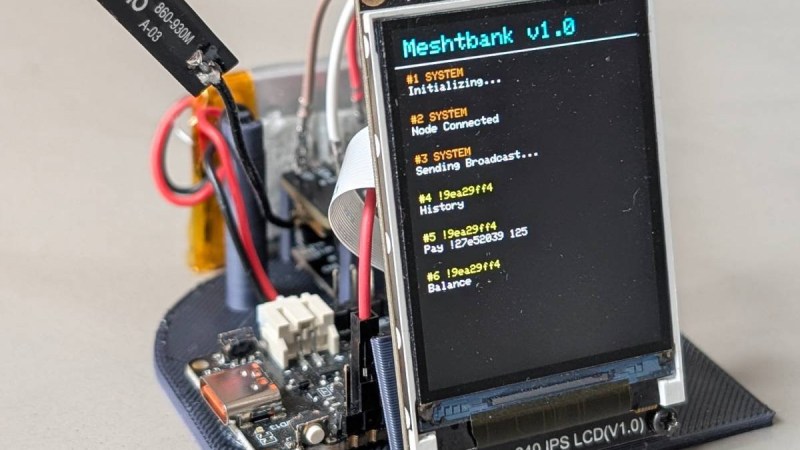
An effective currency needs to be widely accepted, easy to use, and stable in value. By now most of us have recognized that cryptocurrencies fail at all three things, despite lofty ideals revolving around decentralization, transparency, and trust. But that doesn’t mean that all digital currencies or payment systems are doomed to failure. [Roni] has been working on an off-grid digital payment node called Meshtbank, which works on a much smaller scale and could be a way to let a much smaller community set up a basic banking system.
The node uses Meshtastic as its backbone, letting the payment system use the same long-range low-power system that has gotten popular in recent years for enabling simple but reliable off-grid communications for a local area. With Meshtbank running on one of the nodes in the network, accounts can be created, balances reported, and digital currency exchanged using the Meshtastic messaging protocols. The ledger is also recorded, allowing transaction histories to be viewed as well.
A system like this could have great value anywhere barter-style systems exist, or could be used for community credits, festival credits, or any place that needs to track off-grid local transactions. As a thought experiment or proof of concept it shows that this is at least possible. It does have a few weaknesses though — Meshtastic isn’t as secure as modern banking might require, and the system also requires trust in an administrator. But it is one of the more unique uses we’ve seen for this communications protocol, right up there with a Meshtastic-enabled possum trap.












If only we had a payment system that used no power, was private and secure, cheap to create. A system that did not record transitions. Could be placed in your pocket and could not be hacked and spent more than once. And could not be stolen by a hacker.
“secure” -> counterfeits exist.
“cheap to create” -> pennies costing more than face value to make.
“could not be stolen by a hacker” -> You can get robbed by people, might even be a hacker.
There’s always pros and cons. In this case, it’s a nice intermediate between cash and the honor system for smaller communities as stated in the article. :)
Who still uses pennies?
Vengeful people who have a debt at the DMV
https://www.buzzfeednews.com/article/mbvd/worth-every-penny
You’ve never played penny poker?
You’ve never smashed a penny for a souvenir?
So pennies only get used once and thrown away?
For the people who are interested in this, Hackerspaces in the Netherlands have used a similar system for more than a decade called Revbank. It may not suit your needs, as it doesn’t have user authentication/authorization. But it works well for a community like a Hackerspace to purchase a Club Matte and pay for small consumables or machine time.
https://revspace.nl/RevBank
As you can’t solve a social problem with technology, I believe Revbank if fit for purpose where it is currently used. Security just adds friction, and reasons for people to attempt to break it.
“you can’t solve a socil problem with technology” i’m not even sure that’s 100% true but you have definitely located the heart of the issue!
You can use technology to socially isolate people, which makes the social problem go away.
No community, no problems.
Oh absolutely, but someone will have to come in later and clean up for the next person.
https://unimersiv.com/on-the-problem-of-vr-and-addiction-337/
No, I meant the usual way. Like, you don’t like the long lines at the bank – swap the bank for an online service and shut down the branch office. There, you no longer have to line up because you can’t.
There’s nowhere you can go to demand service in person, which solves all the social problems like getting stuck behind some demented granny, or getting held up on gunpoint by a bank robber. It’s just you and the bank’s mobile app, and the bank’s chat bot to offer you unhelpful answers in case the app doesn’t work.
I thought so too, and left the heater socket on my parking space unlocked.
Then one afternoon I found gypsies had parked an RV in the space, and were using the socket to iron their laundry.
Jeff Foxworthy once recounted an interaction with a fan who said, “Hey Jeff, I once had a nipple bit off by a beaver at a wedding.” To which Foxworthy replied, “Sir, you have my undivided attention.”
Roaving “Gypsies” in an RV, ironing clothes powered by your car heater plug?
Sir, you now have my undivided attention
Well, they happened on that parking lot on their way and went around looking for the first electrical box that wasn’t locked, then parked there. Not much else to it.
There are people who know people will let them do anything to avoid too much hassle – and call you a racist and start trouble if you don’t, until the police show up. That’s basically their day job.
Cash is king! And it has a pretty good privacy policy.
I remember when i found out about wheresgeorge.com, almost 30 years ago, i immediately bought the stamp because i couldn’t actually believe that each dollar bill lives a specific life and not an anonymous generalized life. I only stamped a few dozen bills before i got bored of it but even so i started to get hits back. Doesn’t really prove anything but it really changed the way i think about the anonymity of cash. In hindsight that was one of the first times isaw that individual participants in random and difuse processes nonetheless have specific histories, which still astonishes me sometimes.
What’s that quote? Americans spent millions of dollars to invent a pen that writes in space…Russians simply gave their astronauts a pencil
… and the reason why the Americans didn’t, was to avoid broken off pencil tips floating into your eye or getting stuck inside the equipment panel in zero gravity.
The quote is a reminder that people are ignorant and foolish. An American spent their own money to develop gas cartridge pens that operate in microgravity and can handle variable air pressures without bursting. The Russians risked their safety every time they wrote something down by using sticks of conductive graphite that shed powder into their capsules where it could lead to a short or fire in the (admittedly much safer than Apollo) atmospheric gas mix.
Great project, although something like MeshCore or Reticulum would probably be more suited, given that MT doesn’t have the greatest message delivery reliability.
AI identifies multiple problems with the project:
Limited battery capacity vs need for continuous ledger operation
Display consumes power but improves usability
LoRa bandwidth too low for financial transaction reliability
Admin authentication via PIN may be insecure
Jumper cable connections unreliable
Firmware flashing errors disrupt usability
Lack of scalability for multiple users
No guarantee of usefulness in real-world
Protip.. if someone wanted to ask an AI something, they have exactly the capability to do so that you do. You aren’t special. If you’re going to criticize someone’s project, at least do it from your own thoughts.
Right, let’s all ask an LLM to poke holes in our project ideas so we never even bother starting them. Good idea! I’d have so much more free time!
If you have no specific or particular experience or knowledge in the subject matter, why are you commenting at all? (If you have to get your comments from an LLM, you probably have nothing to say).
It’s a LETS system in a box, but for Meshtastic folks! Very cool.
(for more on LETS, https://en.wikipedia.org/wiki/Local_exchange_trading_system )
I’ve always thought this could be entirely off the grid.
The user (with internet access) makes a transaction then sends a copy signed by a trusted party over whatever near by link.
I.e. the machine doesn’t need internet access it simply needs the public key for the trusted party that confirms the transaction happened.
It’s basically equivalent to coin/cash.
Instead of trusting the complex anti counterfeit features you just machine A just checks that “£X sent to machine A” is signed by the trusted party and not already in it’s spent database.