
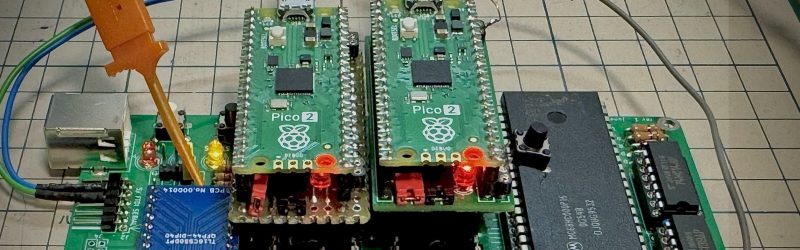
Nothing lasts forever, and that includes the ROMs required to make a retrocomputer run. Even worse, what if you’re rolling your own firmware? Period-appropriate EPROMs and their programmers aren’t always cheap or easy to get a hold of these days. [Kyo-ta04] had that problem, and thanks to them, we now all have a solution: Pico2ROMEmu, a ROM emulator based on, you guessed it, the Raspberry Pi Pico2.
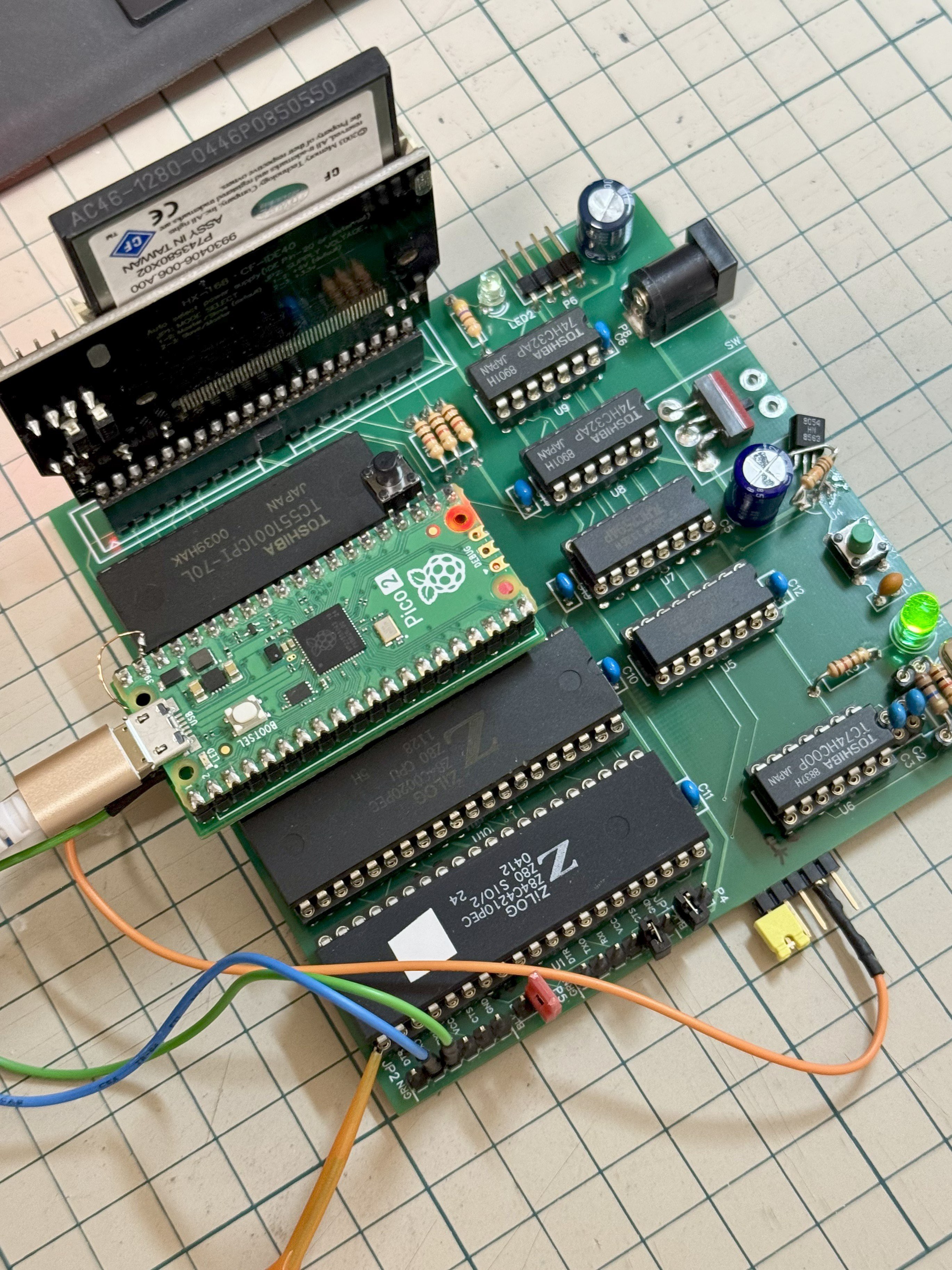
The ROM emulator has been tested at 10MHz with a Z80 processor and 12MHz with an MC68000. An interesting detail here is that rather than use the RP2350’s RISC-V or ARM cores, [kyo-ta04] is doing all the work using the chip’s powerful PIO. PIO means “programmable I/O,” and if you need a primer, check this out. Using PIO means the main core of the microcontroller needn’t be involved — and in this context, a faster ROM emulator.
We’ve seen ROM emulators before, of course — the OneROM comes to mind, which can also use the RP2350 and its PIOs. That project hasn’t been chasing these sorts of speeds as it is focused on older, slower machines. That may change in the newest revision. It’s great to see another contender in this space, though, especially one to serve slightly higher-performance retrocomputers. Code and Gerbers for the Pico2RomeEMU are available on GitHub under an MIT license.
Thanks to [kyo-ta04] for the tip.












One cannot use the PIOs without using both other cores. The RISC-V is used to start and stop the PIOs and the ARM core to feed the PIOs program.
That the low-level logic is dealt with by the PIOs does not mean the other cores are not involved.
The sentence “Using PIO means the main core of the microcontroller needn’t be involved” is wrong.
By using the PIOs one off-loads the big-banging from the ARM core.
The One ROM project recently switched to using PIO in multi DMA mode. The CPU cores themselves are not really involved once the image is loaded into RAM and DMA is setup. There is no other way to hit that io performance using the CPU on the same silicon.
https://www.youtube.com/watch?v=Y8RODQZM2HY
Can’t you just buy a matching EEPROM chip from TME or Farnell?
maybe. the point, as i understand it, to these virtual roms is that you can reprogram them easily, as if it was a usb-programmable eeprom. and if you want to do crazy bank switching hacks, that’s covered too heh
You cant:
– instantly reprogram EEPROM in system, while its running
– use EEPROM to spy on running system, getting detailed access map and execution trace
You can, but that needs you to unplug, program, plug for every development cycle, plus there are emulators which give you the capability to monitor program flow, change content on the fly, halt execution etc.
Stop using LLMs to come up with comments. If you have nothing to say, we certainly don’t want to hear about your ridiculous experiments with “AI”.
I built Ben Eater’s kit but I use a 2350 to jump on the bus prepopulate the RAM. It also handles the clock so I can watch the address bus and stop the clock when I hit a breakpoint.
Wonderful!