
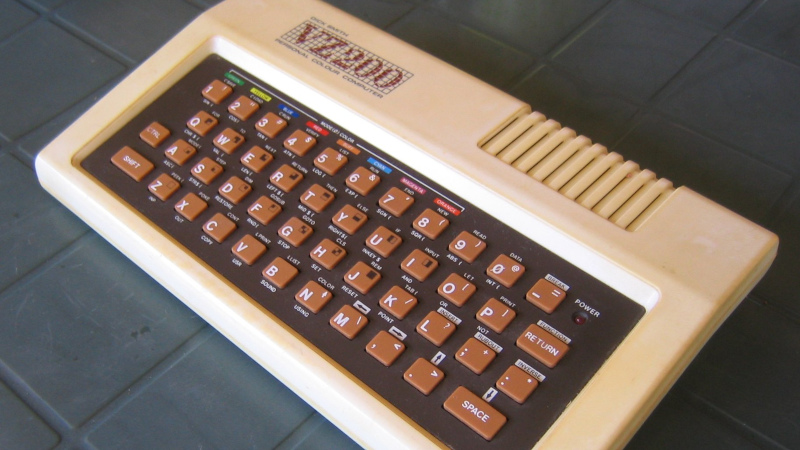
There are plenty of well-known models among the 8-bit machines of the 1980s, and most readers could rattle them off without a thought. They were merely the stars among a plethora of others, and even for a seasoned follower of the retrocomputing world, there are fresh models from foreign markets that continue to surprise and delight. [Dave Collins] is treating us to an in-depth look at the VTech VZ-200, a budget machine that did particularly well in Asian markets. On the way, we learn a lot about a very cleverly designed machine.
The meat of the design centres not around the Z80 microprocessor or the 6847 video chip, but the three 74LS chips handling both address decoding and timing for video RAM access. That they managed this with only three devices is the exceptionally clever part. While there are some compromises similar to other minimalist machines in what memory ranges can be addressed, they are not sufficient to derail the experience.
Perhaps the most ingenuity comes in using not just the logic functions of the chips, but their timings. The designers of this circuit really knew the devices and used them to their full potential. Here in 2025, this is something novice designers using FPGAs have to learn; back then, it was learned the hard way on the breadboard.
All in all, it’s a fascinating read from a digital logic perspective as much as a retrocomputing one. If you want more, it seems this isn’t the only hacker-friendly VTech machine.
John Dalton, CC BY-SA 3.0.











Thanks. We have Wikipedia, though, no need for AI slop. ;)
https://en.wikipedia.org/wiki/Gforth
Sometimes, I’m writing prompts so hard, I rip the skin.
It was mmandatory in the 1970/80’s that all address decoding must be done with a ‘138/139
They really are useful chips! I use a 139 in another SBC. I designed about a year ago 😁
Looks like an Acorn BBC Micro and Sinclair ZX Spectrum had a child.
It really does!
A VZ200 was actually my first computer. I found it on council cleanup along with all its manuals, program tapes and a green phosphor screen. It was maybe 1998? I Eventually found an Amega 500, then an Apricot 386 before i could save up enough for a modern machine in the 2000’s
My first computer was the c64 I think I was 7 so that would have been Christmas 1987. I remember the first game we got was defender but the store was sold out of joysticks because we didn’t get one for another week. So I couldn’t play the game for a bit. I used the heck out of that manual to write all the basic programs in there.
It was also my first computer, was sold in Australia by Dick Smith electronics and had a custom boot image of said person’s face :-) learned basic programming on it.
I wonder how many people owe their careers to basic, and the learning experience that started on a little home computer? It boggles the mind; I bet it’s a very large number!
All computers should come out of the box with just an IDE and some basic libraries.
Computer literacy would go thorough the roof!
I never heard of this home computer. My first computer was the Commodore Vic-20 then C64. In Canada, Commodore was popular; I did hear about VTECH from work in the 1990s though.
I discovered it when Adrian Black repaired his on Adrian’s digital basement. I thought it was such a cool design especially since it was all off the shelf parts. So I decided to build my own :) it’s certainly been an interesting journey 😁
VTech are still around, they make heaps of kids educational toys, “MyFirstLaptop” type of stuff.
As an aside, if you ever needs examples of really neat design pull some kids toys apart, they are some really clever people making that stuff.
I used to have this little z80 that ran basic assuming level ii on a single line of text can’t remember what that was but it was Vtech also. Neat thing to have when I was a kid. Think it ran D cell batteries
If there was something available like that enclosure with a simple keyboard with just TTL output and enough internal space to put other small boards inside, I believe it would sell a lot among electronics enthusiasts. Making the front panel interchangeable and modular would add more versatility: like the one depicted, or tighter keys with added function, arrows and numeric keypad, smaller keyboard (arrows+enter+cancel+a few functions) plus standard 3.5/5/7″ LCD screen frame mounts (IoT terminal), full small keyboard plus screen (LoRa terminal), panel with LCD, then rows of knobs and keys (MIDI controller/synthesizer) etc.
So for .my recreation it’s a work alike that is on a modular backplane that has all of the address decode with GAL. This way it’s easy to recreate new platforms by simply changing the GAL programming around.
“If there was something available like that enclosure with a simple keyboard…”
There is, electronic typewriters, telex machines, desktop calculators. If you rip out the printing part, there’s a lot of space for your own creations. Bonus: a keyboard that doesn’t break your fingers and often a built-in power supply.
I recently had a hell of a time with my VZ-200…
https://hackaday.io/project/204602-laser-vz-200-lazarus-daughter-board
That’s awesome! So basically a daughter card to reproduce the memory section if it is damaged. Thanks for sharing that! Idk if they have it up on the wiki but I’ll check that’s so cool
This brings back lots of memories. They were big in New Zealand and Australia, sold by Dick Smith. I wrote ham radio software for them to do RTTY and CW out the cassette audio port via an interface using XR2206 and XR2211 to do FSK modulation and demodulation.
I was reading about all of the uses for HAM. Its interesting to think about how people were using computers wirelessly long before established Internet :)