
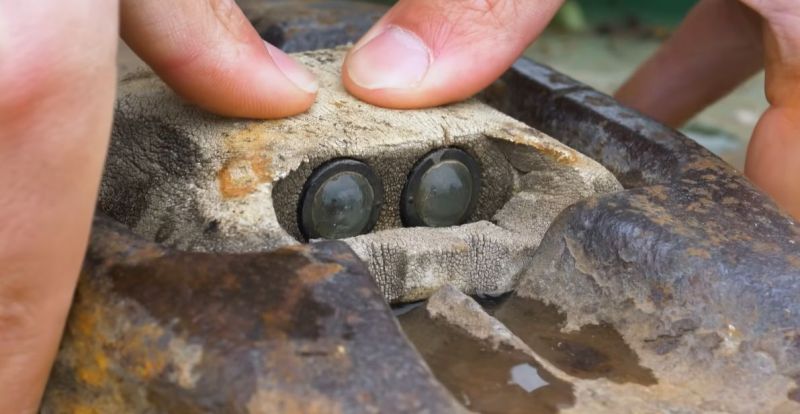
Although most people manage to navigate roads without major issues during the day, at night we become very reliant on the remaining navigational clues. The painted marks on the asphalt may not be as obvious in the glare of headlights, not to mention scuffed up and/or covered by snow and hidden by fog. This is where cat’s eyes are a great example of British ingenuity. A common sight in the UK and elsewhere in Europe, they use retroreflectors embedded in the road. Best of all, they are highly durable and self-cleaning, as [Mike Fernie] details in a recent video on these amazing devices.
Invented in the 1930s by [Percy Shaw], cat’s eyes feature a sturdy body that can take the abuse of being driven over by heavy trucks, along with a rubber dome that deforms to both protect the reflectors and wipe them clean using any water that’s pooled in the area below them. They also provide an auditory clue to the driver when they pass the center line, which can be very useful for night-time driving when attention may be slipping.
In the video the cat-squishing cleaning process is demonstrated using an old cat’s eyes unit that seems to have seen at least a few decades to road life, but still works and cleans up like a charm. Different color cat’s eyes are used to indicate different sections of the road, and modern designs include solar-powered LEDs as well as various sensors to monitor road conditions. Despite these innovations, it’s hard to beat the simplicity of [Percy]’s original design.











Solar powered cats eye to go with a solar powered road.
Why? Current cat’s eye need no power at all, no electronics, and are made from materials that last decades, if not longer.
Alas, our primitive ancestors in the 1930s had no idea of the limitless possibilities of blockchain, subscriptions, CEAAS (Cats-Eyes-As-A-Service), built-in obsolescence…
Tempting to think that if the Cats Eye retroreflector were to be invented from scratch in 2025, it would have all of the above, require a power source and frequent software updates, and need to be reset at regular intervals.
Or perhaps I’m just overly cynical today.
Joking aside, they’re a great invention; I grew up with them literally as part of the scenery, and having moved recently to the States has made me realize just HOW good they are. Here in the PNW, the painted road markings are hidden completely by even a light film of water at night, making navigation of unfamiliar curves or multi-lane junctions very much a game of “guess where the lane is”.
Haha
http://www.roadstudlight.com/solar-road-stud/road-cats-eyes.html
It exists
Well, yeah, see my other reply, I can even direct you to a few roads where they’re in use.
Planned obsolescence. Once those batteries die, you’ll need new ones.
I section of road in the Garden route in South Africa had just that. A small solar panel on top of the cats eye with LED lights that flashed. It was like driving on a runway. I don’t say it was better than the ordinary reflectors, but it gives you the impression they want to warn you of a dangerous condition. It probably worked. A rural road back in South Africa can have many wild huge animals or pedestrians. Of you see a gap in the reflectors, better to slow down! It helped me many times to avoid a nasty.
They trialled ones on the A628 Woodhead Pass that as I remember blinked when the road was icy, and they also lit up ahead of you on sharp curves, before your headlights hit them. I thought they were good, but they were removed, I assume because they weren’t as robust as the unpowered ones, dunno.
They’ve been installed for several years on a number of UK roads I regularly use around Cheshire and Shropshire (I’m sure other areas have them too).
I like them a lot, they’re a useful improvement over the traditional retro reflector ones in normal driving conditions but are much better in weather conditions where traditional cats eyes are poor.
Sadly, I doubt they’ll last anywhere near as long as the passive ones but they seem to be doing well so far
cheshire cat eye, you say?
There was a book of humorous roadsigns published a few years ago that had, as its cover, a photo of a veterinary practice somewhere in England. Right underneath the sign with the name of the practice on it & their offered services (“HEALTH CHECKUPS”, “NEUTERING”, etc.), was an unfortunately-placed Highways Agency temporary sign bearing the legend: “CAT’S EYES REMOVED” 🙄
Other than the fact that surface-mounted style of reflector are more prone to being knocked off than the embedded cat’s eye style, the solar ones work pretty well – they tend to be put in high-risk zones so that they can be seen from further away, I’ve also seen versions that detect the passing of a car and then blink for a period afterwards to alert the next car.
They only have to power themselves, unlike Solar Freakin’ Roadways which are supposed to generate useful power for the grid but are mainly a terrible and dumb idea.
Near me there’s a road where the two lanes are separate, through a nature area over a few bridges (also separate bridges for each lane) with no lighting other than these solar-powered cateyes (all white) in curves. There is a left-right-left section with bridges and some earth dams inbetween so you only see the curves at a late moment.
However, for some unexplicable reason the first to curves have the lit cateyes on the right and the latter has them on the left! I almost drove off the road first time I was there at night.
SOLAR FRIGGIN ROADWAYS ! !
Occam’s refkector:
https://www.parkingzone.com/reflective-traffic-markers1.html
I always wanted a few. I got a vintage trike and people think It’s small so they don’t give me space. Regular reflectors just don’t seem to work as well.
Retroreflective tape is a lot cheaper than it used to be, if you can make that fit in with the vintage bit?
Otherwise, watch out for a road being resurfaced and ask the crew nicely if you can have an one cos they almost always just throw them away and fit new instead.
Looks like you can buy the retroreflective prism that’s used in these on Aliexpress…. search for “retroreflective cube”.
If only they could survive a snow plow….
Snow plow resistant ones do exist.
There are also installation means to make them more resistant to breaking with snow plows.
Most jurisdictions just don’t bother because it’s an added cost over the simple ones you see so commonly in warmer climates.
https://en.wikipedia.org/wiki/Raised_pavement_marker
These are cool. I’ve seen similar in Florida and liked the clear signals. We can’t have them in New York – the snow plows would hit the protrusion and rip em out.
Skip ahead to 7 mins in the video. You’re welcome.
You mean the point where he turns his baseball cap backward?
Makes him look like an ignorant hick.
In the US a similar thing called bot’s dots or something very similar. Just reflective bumps. In areas where it snows they are simply glued into the bottom of a shallow grind-out in the road. They work well. No cleaning or anything required