
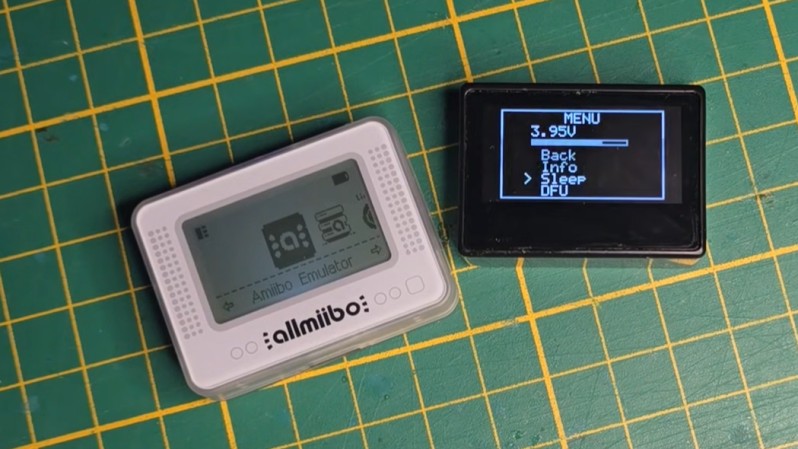
As technology marches on, gear that once required expensive lab equipment is now showing up in devices you can buy for less than a nice dinner. A case in point: those tiny displays originally sold as Nintendo amiibo emulators. Thanks to [ATC1441], one of these pocket-sized gadgets has been transformed into 2.4 GHz spectrum analyzer.
These emulators are built around the Nordic nRF52832 SoC, the same chip found in tons of low-power Bluetooth devices, and most versions come with either a small LCD or OLED screen plus a coin cell or rechargeable LiPo. Because they all share the same core silicon, [ATC1441]’s hack works across a wide range of models. Don’t expect lab-grade performance; the analyzer only covers the range the Bluetooth chip inside supports. But that’s exactly where Wi-Fi, Bluetooth, Zigbee, and a dozen other protocols fight for bandwidth, so it’s perfect for spotting crowded channels and picking the least congested one.
Flashing the custom firmware is dead simple: put the device into DFU mode, drag over the .zip file, and you’re done. All the files, instructions, and source are up on [ATC1441]’s PixlAnlyzer GitHub repo. Check out some of the other amiibo hacks we’ve featured as well.











I’m intrigued. I didn’t know know that Amiibo emulators were a thing. So Pixl.js is a battery-powdered nRF52832 doohicky, Nintendo homebrewers turned it into an Amiibo emulator, then ATC1441 made it a spectrum analyzer firmware. Pretty cool for $20 hardware
the real Pixl.js is a board with LCD running Espruino https://www.espruino.com/Pixl.js then someone wrote the nfc amiibo emulation for it in javascript, then some guys made similar hardware and custom firmware and still kept the pixl.js name despite no longer having anything related to Espruino/javascript or the real pixl.js.
To close the circle Espruino was ported back to this ‘pixl.js’ hardware with display and also to those very cheap keychain nrf5282 amiibo tags (at some time they were for about $3-$4 on aliexpress) https://github.com/orgs/espruino/discussions/7574
I’m not interested in the Amiibo emulator. I’ve never seen such a thing… Off to scour the internet….
*MORE… I’m MORE interested.. not “not”. Why can’t we edit comments?
Me neither. A bag of suitable blank nfc tags was less than $5.
Seeing comments where people are surprised things like amiibo emulators exist on THIS SITE is wild. Do y’all never leave your bubbles?
I’ve already created Amiibo with NFC tags and Tagmo. This never came up when I was searching, these devices are only a few years old.
Wow this is the person that also wrote the $3 Xiaomi BLE temperature sensor firmware replacement that removes the encryption so they integrate with Home Assistant without the pairing key. Another awesome replacement!
Believe it or not, some of us here don’t play video games. I had to search to find out what Amiibo was.
My “bubble” isn’t limited to video games. I’m pretty sure there are plenty of things I could tell you about about which you’ve never heard.
Just by reading this post i now know what am Amiibo is and what am Amiibo emulator is.
Really cute device. Would love to own one but as always i don’t have a use for it