
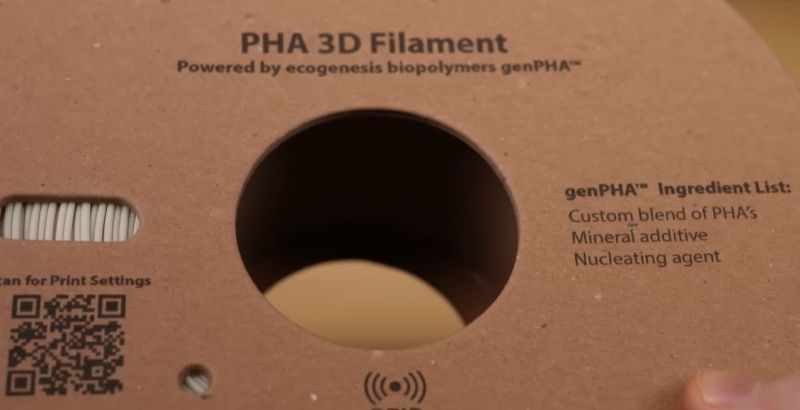
PLA (polylactic acid) has become the lowest common denominator in FDM 3D printing, offering decent performance while being not very demanding on the printer. That said, it’s often noted that the supposed biodegradability of PLA turned out to be somewhat dishonest, as it requires an industrial composting setup to break it down. Meanwhile, a potential alternative has been waiting in the wings for a while, in the form of PHA. Recently, [JanTec Engineering] took a shot at this filament type to see how it prints and tests its basic resistance to various forms of abuse.
PHA (polyhydroxyalkanoates) are polyesters that are produced by microorganisms, often through bacterial fermentation. Among their advantages are biodegradability without requiring hydrolysis as the first step, as well as UV-stability. There are also PLA-PHA blends that exhibit higher toughness, among other improvements, such as greater thermal stability. So far, PHA seems to have found many uses in medicine, especially for surgical applications where it’s helpful to have a support that dissolves over time.
As can be seen in the video, PHA by itself isn’t a slam-dunk replacement for PLA, if only due to the price. Finding a PHA preset in slicers is, at least today, uncommon. A comment by the CTO of EcoGenesis on the video further points out that PHA has a post-printing ‘curing time’, so that mechanical tests directly after printing aren’t quite representative. Either you can let the PHA fully crystallize by letting the part sit for ~48 hours, or you can speed up the process by putting it in an oven at 70 – 80°C for 6-8 hours.
Overall, it would seem that if your goal is to have truly biodegradable parts, PHA is hard to beat. Hopefully, once manufacturing capacity increases, prices will also come down. Looking for strange and wonderful printing filament? Here you go.












PLA and PHA? Those are 6502 op-codes!
Yes on with the commodore pet
Wow. Someone more geeky than me. Rockwell AIM65 and Commodore 64.
Compukit UK101
Very interesting stuff!
Anything that requires a curing time won’t become the default for 3D printing. It may be another option, but will never replace PLA.
It’s the default for resin, there you always have to cure (but I assume you mean FDM printers)
Resin curing time is measured in minutes, not hours, so there’s a qualitative difference.
I don’t know – so many 3d printed products are made of PLA as they don’t need to be a more engineering plastic and those sit on shelves, in shipping, etc for more than enough time for this PHA to passively reach its expected performance (assuming the article’s 48 hours is correct in all conditions). So it won’t matter to those prints. And for the regular home printer most of what people are printing has very little or no structural requirements beyond holding its own shape, so unless the right off the printer or during print reduction in mechanical properties is really really significant it won’t matter to them either.
Ultimately PHA may well largely replace PLA if the price and ease of printing is close or better, which become the case as production methods mature and/or the various mooted environmental recycling focused law ideas happen and put added costs on other filaments.
This is a misunderstanding of the note about curing in the article. Their mechanical properties change SLIGHTLY after 48 hours. Prints are usable right off the bed, unless you’re using them at their mechanical limits.
Well, the brightly colored, glow-in-the-dark additives in the filament that consumers will ask for don’t exactly make the stuff valuable compost. Same as all the other “bio degradable eco friendly growing in nature” plastics, this crunchy material should ideally end up in a thermal plant.
I dunno, maybe if you got enough strontium aluminate in your compost you could finally make that old myth about carrots helping you see in the dark true
It’d be a bit naive to say PHA will replace PLA, but having more sustainable and even less toxic solutions are extremely valuable. The average consumer may print in whatever filament is cheapest, the cost is certainly not a dealbreaker for when you want safer filaments and worried about microplastics. Printing for/with kids, for example.
Eventual disposal shouldn’t be burying it, however. But when things end up in the environment, it’ll at least not stay there forever.
The issue with labeling what ever plastic as “fully biodegradable” will result in people caring less about throwing what ever plastic in the landscape, because “It will become fertile soil”. Being composable should be a side note but never the selling point of brightly colored filament, which will happen sooner than later.
Yes, it is good to have a (better) biodegradable filament, but I have heard that story of being environmental friendly too often in my life…
We agree, it is not and should never be a “get out of jail” card type claim that defers proper EOL for these materials. Far from it.
PHA is recyclable, but just like the vast majority of “Recyclable” plastic packaging, but it won’t be simply because it has no value as a recycled material. So no one it going to do it.
Its also fully compostable, in all conditions. However, no one is going to compost it. Why? Because compostable polymers do not bring or add value to a composting facility. So why would they do it? The main reason is the what-if scenario, and if this material does in fact end up in the environment, just like the estimated 19% of all plastics consumed in the US. Then what? This is were PHA offers the safety net, it simply won’t make things worse, it won’t add microplastics, it won’t add ecotoxicity to the biomes. It simply be re-assimilated just like cellulose in all environment, including the most sensitive. Marine, our lakes, streams and waterways.
And you are 100% correct in being skeptical. As there are no US standards currently in effect for biodegradability. That’s why we use EU standards, they are years ahead of what the US market is allowing.
Because its ESG bull rush ?
You can green wash everything if you try hard enough.
Carbon offsets and planting trees is so yesterday!
I offer mercury offsets with aquatic seawater cultures. Bonus: If the fish are under the allowed limits they double as food source.
The ecogenesis genPHA does not come (and never will) in bright colors, or glow-in-the-dark, or CF blended or even glass Fiber blended. That would defeat the purpose of being biodegradable.
All colors (only 6 of them) are TUV Austria Marine Biodegradable Certified.
PHA is grown in nature, its one of the only polymer that is actually found in nature. It was not invented or created. But simply a polymer used by bacterial to store excess energy when they find their favorite food.
Good to read that you take the eco friendliness serious. However I am not confident that your competitors will stick with that non blended filament philosophy.
But I don’t agree that this is the only polymer in nature. Silk or DNA are other examples.
Why would glass fiber be an issue? The ocean is full of glass (diatoms, sand)
Preheating could present an Achilles Heel in that you preheat more than you use, and the remaining amount cools, then gets heated again and then the remainder cools…
I think you are confused on the pre-heating and its intent.
You can pre-heat the filament all you want, it won’t have any effect on the printability. Matter of fact, it does not even require drying as it is naturally hydrophobic.
The finish printed object will not be fully crystalized (also called Nucleated in the polymer industry) till roughly 24 to 48 hours after it is printed. If you don’t want to wait that long to feel its full hardness. You incubated (what you are calling pre-heating) for 6 to 8 hours at 70~80c in a heated chamber or similar. Then it will be fully crystalized.
Naturally hydrophobic! I know a million other things matter but to me that seems like it should be the headline
Thing about the PLA filament concept (and I’m the inventor) wasn’t that everyone should biodegrade their PLA. The idea was that you could safely bury it. If it got out, it would biodegrade. If it got into an organism, being biocompatible and non-toxic, it would be biodegraded there. That pretty much fixes the microplastic problem (much to the relief of anyone who has had a PLA-based dissolving surgical suture).
No, the point was that you could safely bury that organically-derived carbon for decades if not centuries and keep it out of the atmosphere. The tricksy biodegradability is not a bug. It’s a feature.
Good to hear the input of the OG.
Thank you for explaining this. I use your invention every day. The bio degradable didn’t make any sense to me before. I have a PLA part in the water basin of my toilet as a replacement for a broken part, that’s in and out of water constantly. I’ve printed motorcycle parts in PLA without any issue, some have spent years outside on bikes. I even buried a benchy years ago to see if it would biodegrade, which it hasn’t so far.
micro-plastic from PLA is shown to cause harm as well not being biodegradable in marine ecosystems. it also causes different impact than petrol based ones… just take a look at emergent research being done on this topic [0] and if i’m not mistaken, PLA micro-plastic also has impact on plants phtosynthesis efficiency
this whole propaganda of PLA being green feels like calling PET plastic good for the enviroment just because you can recycle it. with that typed thank-you, i exclusively used pigment-less PLA or those transition PLA remnants of manufacturer facilities since my very first print till today
[0] https://www.nature.com/articles/s43247-025-02806-z
Many things have been played up as “ecofriendly”, and the level of BS in advertising is guaranteed to make superficial decisions easy. Meaning you can’t just take the advertising at face value, just like anything else. (Disclaimer: my work experience has been almost 3 decades in government forest products applications research, with short stints in the private sector. I worked with scientists studying biobased adhesives and polymers, alone, and in combination with polymers based on petrochemicals.)
That “overplaying advantages” doesn’t make PLA a “bad choice”. For starters, the source material is not pumped out of the ground, so if that matters to you, PLA meets that metric. PLA does hydrolyse back to lactic acid, unlike the petroleum derived polymers which leave either persistent plastic bits, or the source monomers.oligomers, some of which can be toxic. Lactic acid is food for microorganisms, just not on the time scale of the composting assessment tests. Testing done in our group making PLA-nanocellulose films and subjecting them to wood-decay fungi soil bottle tests showed minimal weight loss in 12 weeks, but there were shifts in the melt rheology properties that are consistent with some hydrolysis of the PLA backbone. It has already been shown that composites made of wood flour and polypropylene need extended exposure to wet conditions for the moisture to get into the composite and allow fungi to attack the wood flour. So when they sell you plastic composite deck boards as “maintenance-free” compared to treated wood, just remember that doesn’t mean the product is immortal, it just means it will take longer for it to start looking bad. Moral of the story: thermoplastic polymers with desirable properties aren’t perfect. If they don’t absorb much water to begin with, it will take a lot of time for any biodegradation to begin.
Then you should also know that PLA is toxic to marine life.
PHA isn’t
PLA is a man made polymer invented in the 1970’s.
PHA was discovered in the 1920’s as a natural process used by hundred of different bacteria for thousands of years
PLA is compostable safely in a very specific condition that aren’t found in nature. Per ASTM6400, this requires specific temps (above Tg), O2 levels, Humidity levels, ect..
PHA follows the same natural biodegradability as Cellulose. Same biodegradation path and nearly the same rate.
Cellulose is the standard used to measure a passing grade for Marine Biodegradability, PHA is as fast or faster than cellulose (Of the same mass).
I….. Think I may have found the peak troll comment on hackaday.
I find biodegradable materials to be a funny concept.
Sure, I don’t want trash accumulating. I don’t want microplastics polluting nature and certainly don’t want them in my blood and tissues.
But…
Did we not come up with plastic in the first place because we wanted something that wouldn’t rot while we are still trying to use it? Just this last fall for example I spent my last several warm weekends rushing to tear apart my shed, replace several rotten boards, put it back together and paint it. Believe me, I would have jumped on the chance to rebuild it with plastic decking if that stuff wasn’t so expensive just to ensure this does not have to be done again in my lifetime.
Maybe materials that don’t break into pieces so small that they insert themselves into our cells nuclei and an end to this awful throwaway culture might be better goals.
Time and place for all materials really – that shed might well be a good choice to make in UV stable plastic, or steel, aluminium, or concrete – lasting a good long time with no maintenance makes the material involved and costs associated with it rather irrelevant, and the pollution of them is largely confined to creation and destruction of the structure…
Though worth pointing out even the most biodegradable stuff can last a very very long time in the sort of conditions humans generally prefer existing in, if they are going to be exposed to harsher conditions, or used to store something you could call harsh conditions for something that bio-degrades other plastics are likely a very good choice, but the vast majority of the stuff made in plastic could be a cellulose or similar relatively biodegradeable option, and so probably should be.
Well said