
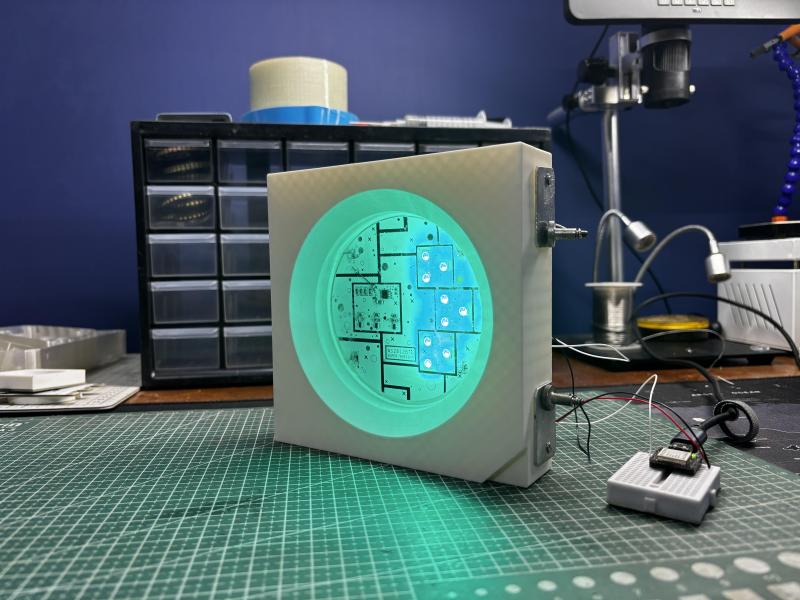
Neopixels and other forms of addressable LEDs have taken the maker world by storm. They make it trivial to add a ton of controllable, glowing LEDs to any project. [Arnov Sharma] has made a great tribute to the WS2812B LED by building the NeoPixel Giant Edition.
The build is simply a recreation of the standard 5mm x 5mm WS2812B, only scaled up to 150 mm x 150 mm. It uses a WS2811 chip inside to make it behave in the same way from a logical perspective, and this controller is hooked up to nine standard RGB LEDs switched with MOSFETs to ensure they can deliver the requisite light output. The components are all assembled on a white PCB in much the same layout as the tiny parts of a WS2812B, which is then installed inside a 3D-printed housing made in white PLA. Large metal terminals were added to the housing, just like a WS2812B, and the lens was then created using a large dose of clear epoxy.
The result is a fully functional, addressable LED that is approximately 30 times larger than the original. You can even daisy-chain them, just like the real thing. We’ve covered all kinds of projects using addressable LEDs over the years, from glowing cubes to fancy nature installations. If you’ve got your own glowable project that the world needs to see, make sure you notify the tips line!












This is silly in a good way and also adorable. I love it
No, no, no, no! It should have three reds, three greens and three blues. It doesn’t look right with 9 chips all the same color.
Working on Version 2 that has three individual LEDs !
Also, to operate more efficiently:
Put the three reds in series, three greens in series, etc and feed with 12v. This is much more efficient than running them in parallel from 5v
Don’t share a current limiting resistor between parallel LEDs (or in the case of what I described above, an LED chain) – Manufacturing differences between LEDs will result in slightly different Vf values. Not a problem if each series chain has its own current limiting resistor, but a potential problem if you have multiple parallel LEDs sharing a resistor. In fact based on the schematic shown over on Instructables, I’m kinda surprised that you haven’t either burned out your reds or found the blues/greens not lighting, since you’re sharing current limiting between colors and red LEDs have significantly lower nominal Vf than blue and green.
Awesome! Something to use for floodlights in our holiday light display… Carry on!
Ok, but is it 30 times brighter than the original?