
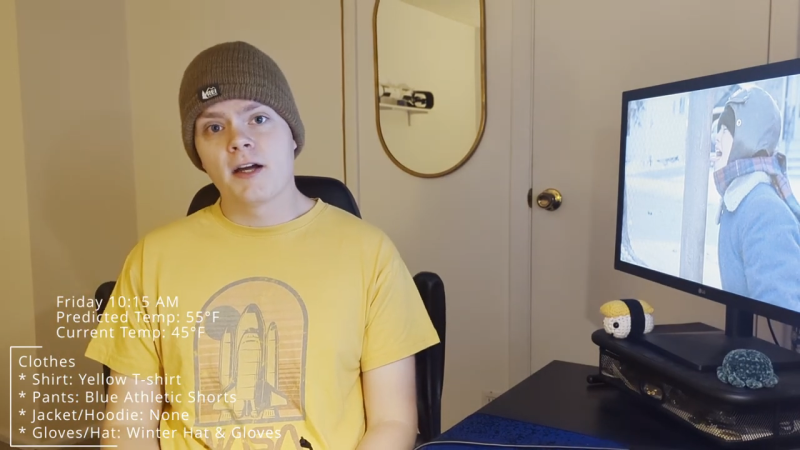
Most of us choose our own outfits on a daily basis. [NeuroForge] decided that he’d instead offload this duty to artificial intelligence — perhaps more for the sake of a class project than outright fashion.
The concept involved first using an AI model to predict the weather. Those predictions would then be fed to a large language model (LLM), which would recommend an appropriate outfit for the conditions. The output from the LLM would be passed to a simple alarm clock which would wake [NeuroForge] and indicate what he should wear for the day. Amazon’s Chronos forecasting model was used for weather prediction based on past weather data, while Meta’s Llama3.1 LLM was used to make the clothing recommendations. [NeuroForge] notes that it was possible to set all this up to work without having to query external services once the historical weather data had been sourced.
While the AI choices often involved strange clashes and were not weather appropriate, [NeuroForge] nonetheless followed through and wore what he was told. This got tough when the outfit on a particularly cold day was a T-shirt and shorts, though the LLM did at least suggest a winter hat and gloves be part of the ensemble. Small wins, right?
We’ve seen machine learning systems applied to wardrobe-related tasks before. One wonders if a more advanced model could be trained to pick not just seasonally-appropriate clothes, but to also assemble actually fashionable outfits to boot. If you manage to whip that up, let us know on the tipsline. Bonus points if your ML system gets a gig on the reboot of America’s Next Top Model.












This is really cool! Also I could never
I think Albert Einstein got this one right: get many copies of the same outfit so you don’t have to bother with such trivialities.
Who’s Abandon?
AI was probably going by youtube/tiktok/etcetera outfits with that T-shirt and shorts and hat and gloves.
I can see how a bodyless entity would get confused.
I’ve seen it in real life, many times, it’s 4 degree Celsius with a cold breeze and people come out in t-shirt and shorts, when at other times it’s 12 degree Celsius with zero wind and people wear thick coats and ear-warmers and Baklavas.
Note that these are not imaginary examples or temperatures.