
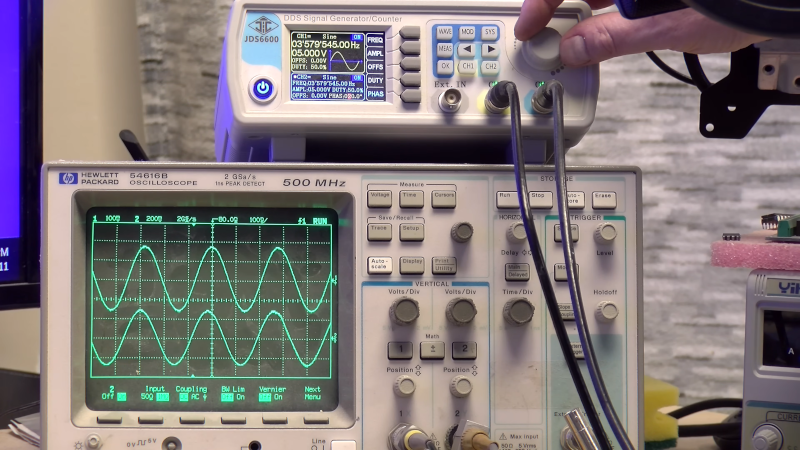
We’ve often said that some technological advancements seemed like alien technology for their time. Sometimes we look back and think something would be easy until we realize they didn’t have the tools we have today. One of the biggest examples of this is how, in the 1950s, engineers created a color image that still plays on a black-and-white set, with the color sets also able to receive the old signals. [Electromagnetic Videos] tells the tale. The video below simulates various video artifacts, so you not only learn about the details of NTSC video, but also see some of the discussed effects in real time.
Creating a black-and-white signal was already a big deal, with the video and sync presented in an analog AM signal with the sound superimposed with FM. People had demonstrated color earlier, but it wasn’t practical for several reasons. Sending, for example, separate red, blue, and green signals would require wider channels and more complex receivers, and would be incompatible with older sets.
The trick, at least for the NTSC standard, was to add a roughly 3.58 MHz sine wave and use its phase to identify color. The amplitude of the sine wave gave the color’s brightness. The video explains why it is not exactly 3.58 MHz but 3.579545 MHz. This made it nearly invisible on older TVs, and new black-and-white sets incorporate a trap to filter that frequency out anyway. So you can identify any color by providing a phase angle and amplitude.
The final part of the puzzle is to filter the color signal, which makes it appear fuzzy, while retaining the sharp black-and-white image that your eye processes as a perfectly good image. If you can make the black-and-white signal line up with the color signal, you get a nice image. In older sets, this was done with a short delay line, although newer TVs used comb filters. Some TV systems, like PAL, relied on longer delays and had correspondingly beefier delay lines.
There are plenty of more details. Watch the video. We love how, back then, engineers worried about backward compatibility. Like stereo records, for example. Even though NTSC (sometimes jokingly called “never twice the same color”) has been dead for a while, we still like to look back at it.









Remember the fat McGraw-Hill book I use to have explaining all this. There was a lot in the details.
Basic Television – Principles and Servicing (Grob).
Close (BTW Internet archive has that book). Grobs* were my go to back then.
https://www.amazon.com/Television-Audio-Handbook-Technicians-Engineers/dp/0070047871
*https://www.abebooks.com/products/isbn/9780070249288?
What surprises me is why did they delay the signal receive side instead of at the transmitter?
It seems simpler and more robust.
That’s exactly what I wondered too.
Maybe because then the color carrier would bleed over the parts of image that are supposed to be dark or black, and the B/W set would interpret that as a ghost image.
Besides, the luma information is basically low-passed to get rid of the color carrier so you wouldn’t see the checkerboard pattern as much, and the chroma signal is high passed to get rid of the luma signal.
So what happens if you delay the luma signal at the transmitter and then low-pass it at the receiver as well? Well, it gets double delayed.
I have a similar question for stereo FM. Why isn’t the demultiplexer matrix at the transmitter? Putting it into the transmitter allows ultra-accurate components to be used for a few dollars in one place, and the demultiplexer in the receiver can be perfect for zero cost. As it is, the demultiplexer matrix in the receiver is the limiting separation factor in stereo FM tuners.
One reason is that the luminance delay has to match the delay in the color signal processing chain of the receiver. That’s not going to be exactly the same for all receivers.
I learned about color TV back in high school. We had a good program at that school the teacher started out that year explaining FM stereo, then moved on to B&W TV and on to color TV theory, complete with live working examples….
For a lot of us growing up in the 60s and 70s the TV was a source of “walking around money” as us young Wiz-Kids could make a bit of that keeping the neighbor’s TVs, and other electronics working…
On a related subject….
I went to Asia back in the early part of 2000s. Got a taste of PAL color TV… I couldn’t watch it without getting a headache. The 50HZ refresh rate is too slow for my eyes, this made watching TV impossible.
So, by the 2000s, they didn’t have 100 Hz CRTs or LCD panels already? That’s interesting.
Here in Germany, the bigger CRT TVs which weren’t compatible with NES era light guns
or polarized 3D glasses were likely not running on native 50 Hz anymore.
Such higher-end TVs appeared in the 90s over here, had a digital framebuffer, I think.
Though the little Asians might not have them at home, perhaps.
Anything smaller than 20″ in size probably was still running at native 50/60 Hz.
Not in the 4 star hotel I was staying in Thailand.
CRTs only; the computers down in the Internet cafe had flatscreens.
My issues with television go back a long way…
As a child I couldn’t deal with ether the 60HZ flicker, or the 15750HZ whine from the high voltage supply. I spent more time listening to the radio or reading books,
to my benefit….
I could handle TV in small doses…
Later on as I was in high school I had discovered the joys of money;
From the age of ten or so everyone I knew had one or more (usually two or three ) TVs. and people constantly complained about the color quality. I got real good at doing color setup, and convergence, and word got around.
The best TV field techs knew this bit of trivia….
Get the head of the household involved in setting up the TV…
When doing the gray scale adjustments you ask the head of the household to tell you when he sees pure gray…. From that point on the color temp… will be to your customer;s liking.
You might even get a tip when you are finished….
Just got to remember not to draw the curtains or switch on/off any additional lights in the middle of the adjustment, and keep their eyes fixed at the TV set. You don’t want to spoil the illusion.
If the screen is a little bit off-grey to your liking, you can get the owner of the set to agree by swinging it all the other way and having them watch if for 15-30 seconds while you explain something inconsequential, and then returning it back to the middle, to where you want it, and they’ll agree it’s now perfect.
Interestingly enough;
everybody sees grey different, believe it or not….
As for line voltage instabilities; in some homes that was an issue. In those cases you would spend more time to get things right, your reputation is what matters.
When I was in college I met someone who became a good friend, he worked for the local Curtis Mathis outlet. They always went out and set up the set in the new owner’s home. Oscar gave me a valuable tip, the tip was to encourage the new set owner to put the set on the east or wast wall in the living room. The reason for this was the CRT and deflection system would be less effected by the change in the earth magnetic field. This turned out to be true….
I still miss the true black, and the rare earth phosphors that were used in both RCA and Zenith picture tubes… RCA was the best.
I kept my nice 19″ Vewsonic monitor, I took it out of service when I started to get folding in the vertical sweep….. ReCap time and then it will be good again and I will have the good Blacks, and the closer to true colors…..
Once you had Video Black, you never want to go back…..
Television – another Scottish invention.
John Logic Baird (1888-1946).
Logie.
John LOGIE Baird, although that would have been a killer middle name
Along those lines, from the It Actually Happened file, radio DJ John Records Landecker. No quote marks because it was his actual parent-given middle name.
love me some nominative determinism.
Really? That makes sense to you?
;-)
I remember my first homework assignment in Signals and Systems in college: describe the modulation of the color television system. Before I went to college, I had developed an interest in such things, so this was an easy assignment. We went on to learn and derive AM, FM, PM, PAM and QAM. ADPCM wasn’t there yet, so I had to wait for a project at work to figure that out.
That’s back when they actually cared about backwards compatibility and made sure everything would work with old sets. When the shift to digital happened in 2009 they obviously couldn’t make it compatible, but they did provide viewers with a free path to backwards compatibility with free converter boxes. It was also an easy sell; just put the best analog set next to a digital set and it was a clearly better choice.
Here we are less than 20 years later and they want to move to this ATSC 3.0 “Nextgen” mess. Not only do they not care about backwards compatibility, they don’t even have a free path for viewers to use their old sets with the new standard. They don’t even have a dongle/converter that costs less than $100, and they have all sorts of ugly DRM crap and tracking stuff in the standard. Oh, and Sinclair broadcasting – who is one of the ugliest broadcasters out there – owns key patents for the tech. If it’s adopted they’ll get rich.
OTA television is becoming increasingly irrelevant anyway
Yup..
Sad isn’t it?
We now live in a planned throw-away world.
I want the country I grew up in….
The boxes weren’t really free. The U.S. government provided a $40 rebate check to purchasers of a converter box, and the cheapest converter boxes were $40. Considering how badly the dollar has been inflated, that’s equivalent to about $70 now.
If it weren’t for the abomination that is DRM, ATSC 3.0 would be an unambiguously superior system.
The video codec is superior and the modulation scheme, if not abused, is equivalent to (I think) a 3 dB stronger signal.
Somewhere I have an old popular electronics magazine that describes how to build a color wheel to mount in front of the CRT, speed synced to the horizontal refresh, I believe. This was with a round CRT TV.
I remember seeing that system as a child, the colors were all washed out. the video looked like watercolor……
To what end?
There was a frame-sequential system that did not end up becoming the standard.
The original Color Slow Scan TV was frame-sequial, too.
https://www.youtube.com/watch?v=1q66zazyJLU
And it was backwards compatible to original 8sec b/w SSTV, too.
The predecessor to Robot 8.
Users of b/w equipment simply picked the green frame.
Because it was closest to grayscale.
To see color TV on a black and white TV.
I saw a commercial model of this on display in the TV museum in Toronto. Little screen in a box with a big hump to contain the colour wheel.
I think the (CBS?) sequential-scan system was 144Hz and if you needed to make a large set, you were looking at a multi-horsepower motor to spin a disc the size of a full-grown person.
At about the 9:30 mark he makes the statement that dropping from 3.58 to 3.579545 shifted the ‘dot’ pattern on alternate lines, but that’s not the case. I’m sure later on he goes into the real reason for the freq change, but what actually causes the dot shift is that the subcarrier freq is an odd multiple of the line rate. For a really obscure take on this: escmdxi.wordpress.com/2025/08/24/color-framing/
As Commanding General of the Color-Burst Liberation Army, I was very happy to see this fine video. I have shared it with other members of the CBLA: https://soldersmoke.blogspot.com/2025/12/why-3579-mhz-for-old-color-tvs-origins.html Thanks!
Good Stuff……