
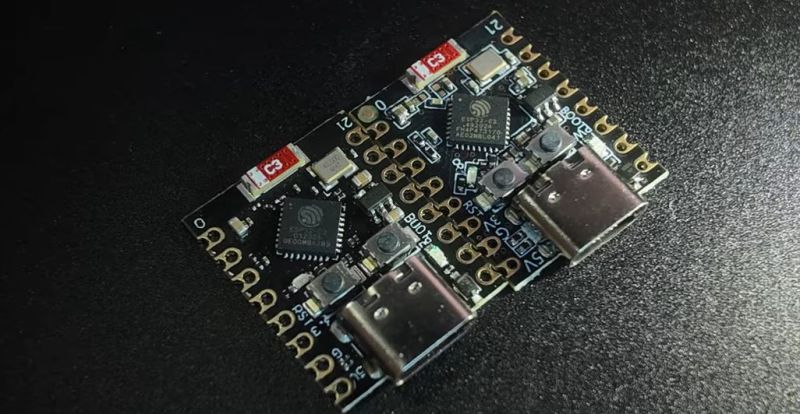
Everyone loves tiny microcontroller boards, and the ESP32-C3 Super Mini boards are no exception. Unfortunately if you just casually stroll over to your nearest online purveyor of such goods to purchase a bunch of them, you’re likely to be disappointed. The reason for this is, as explained in a video by [Hacker University] that these boards are equipped with any of the variants of the ESP32-C3. The worst offender here is probably the version with the ESP32-C3 without further markings, as this one has no built-in Flash for program storage.
Beyond that basic MCU version we can see the other versions clearly listed in the Espressif ESP32-C3 datasheet. Of these, the FN4 is already listed as EOL, the FH4AZ as NRND, leaving only the FH4 and FH4X with the latter as ‘recommended’ as the newest chip revision. Here the F stands for built-in Flash with the next character for its temperature rating, e.g. H for ‘High’. Next is the amount of Flash in MB, so always 4 MB for all but the Flash-less variant.
Identifying this information from some online listing is anything but easy unless the seller is especially forthcoming. The chip markings show this information on the third row, as can be seen in the top image, but relying solely on a listing’s photos is rather sketchy. If you do end up with a Flash-less variant, you can still wire up an external Flash chip yourself, but obviously this is probably not the intended use case.
As always, caveat emptor.











No FLASH no comment.
Being able to attach an external flash in an easy to swap way might even be a feature I would like to have in some contexts.
Wasn’t there a way to switch ESP8266 to boot from SDIO? Was this ever documented well enough to be usable? Do ESP32ers have such too?
$THEY just should call that a feature and be honest about the chips used! I really would be curious enough to get some! Flashless with all pins broken out would be even better!
Let there be choice and honest descriptions in shops.
I’m still scared to dive into all these ESP products, because there is too much variants of possible boards, with flash of different size, some MCU’s installed have strange letters in end of their name. Also, proper online information about if it’s a standalone module, board or MCU chip is rather scarce. And, you know, documentation quality is low beyond allowed here to express.
Is there practice of reading from ESP chip to define the module name, or even board model somehow?
“Is there practice of reading from ESP chip to define the module name, or even board model somehow?”
Yes, lately I was testing a bunch of small boards, and to make sure what I’ve got I ran “esptool chip_id” (or “esptool flash_id”?) on each. It gives you the chip model, list of features (e.g. embedded flash or embedded PSRAM if present) and the detected flash size.
The documentation is much better now and if you go to espressif website the table listing all the variants/series makes sense. If you’re just starting pick some popular board from a reputable seller. I think the S3 is quite a common choice these days.
One thing to note, only the ESP32 (no suffix) variant has classic bluetooth. All the others (-S3, -C3, -C6 etc) have LE only!
Can’t go wrong with Seeeduino boards.
Yes, ESPConnect is browser based. I installed it and first thing I checked all the ESP32 I have for the “real” details. https://www.youtube.com/watch?v=m8ZJMGhcokE
Can’t get where you’re going if you don’t take that first step. Spend $5 on one and get your blink program running. Then you’ll have a better idea how to spend the next $5.
Nearly all microcontrollers are available in a range of different packages as well as with variations in features sets and onboard flash.
The ATMega AVR family of 8-bit microcontrollers by Atmel (now owned by Microchip) is no exception, even if the naming scheme is a little less vague.
You shouldn’t be too worried. I’m new to the ESP range and managed to get a WiFi based Access Point up and running easily with some help from ChatGPT. Im no programmer and found it a great experience.
If you have some of these and don’t want to wire in external flash, I think it’d be possible to get them to run the bluetooth and (low-speed) wifi driver esp-hosted from RAM. It’s currently too big and not designed for that, but with enough stripping…
Bought a whole bunch without knowing. Luckily all worked as desired. Great little units but the wifi is weak. Badly designed inbuilt antenna
Someone try to make a buck by buying up the distressed inventory and make a board. This is quite common in China. SIM800 is another example, the networks for supporting the technology have completely dismantled in China long ago and they dump the distressed inventory to the market, someone made the development board and sell it at crazy price (although it looks cheap) but it is much much higher than price they paid for the distressed inventory.
It’s more the deception that is the problem.
Distressed inventory getting made available is mostly a win-win: someone who needs 30,000 units a year for the life of a product probably has zero interest in EoL parts; but unless there’s something really awful about that revision someone who is just tinkering with once-offs is probably just fine with them. In the SIM800 vein, if you are in an area with 2G service, being able to get really cheap 2G modules is no bad thing.
If vendors are deliberately obfuscating what part you are getting, though, that’s just begging for an asymmetric information scam. In this specific instance it’s also a problem because the flashless parts would be much more usable on dev boards that have pads to populate your preferred flash; but since all the dev boards are intended to look like they feature the embedded flash version the bodging required to add flash is likely to be a real hassle vs. the pittance it would have cost to have empty pads waiting for a suitable part.
I doubt they are practical for DIYers let alone cheap, but setting up a low-power “micro cell” with 2G or 3G cellular connectivity over a small area is probably still an option for businesses with the expertise and money.
And it might be possible to establish point to point links with a proper setup that won’t significantly interfere with mainstream cellular services
Just bought a stack of c6 minis.. should probably check the single c3 I have. I understand “profit” but why make a board that doesn’t work. You made at most $1 on garbage then shipped it across the globe, then the ewaste will get dumped elsewhere. I could buy it for 2x$ “locally” but it’s the same garbage. What’s the solution?
The solution could be to ask more of our suppliers, and less of our expectations. The article says quite rightly that the information is all there but often the supplier doesn’t detail these finer points. We pay so little, next to nothing really, but expect more than next to nothing. Then write articles and comments about getting next to nothing.
Paying more or making your own is usually the solution.
Buy those where the Flash size is clearly mentioned. All those that have external SPI-RAM are good. search for ESP32 N16R8 or N8R2 or N8R4 … N ist for non-volatile (Flash, in mbits) and R is for RAM (SPIRAM in mbits) -> N16R8 is 2MByte Flash 1MByte RAM
Thats wrong.
Its MB, not Mb.
So N16R8 means 16 MegaByte Flash and 8 MegaByte PSRAM.
Same for N8R2 or N8R4.
Dam, glad this was fed to me when it was. i was about to buy a batch for a project, i r noob and would of been really set back. Thanks Maya! And havker university
Wasn’t there a thing with bad PCB design around the antenna? As well esp32c3 chips also get hot?
was not good as I wanted them for environmental sensing. Any one have a good source of small cheap modules? need ble and low power.
For BLE and low power go with nRF52, eg. nRF52840. The ESP chips are not particularily low power.
Yeah. There are a lot of boards with bad antennas or U.FL sockets that need a 0 ohm link to be moved before it can be used.
I’ve bought a ton of these and never had one without flash. Guess I just got lucky since I assumed all C3s had flash. Need to make sure in the future.
I like to get the ones with ufl jacks but found early on that it wasn’t connected. Remove the chip antenna and a bit of wire wrap wire and it’s ready to go. Wish I could get a schematic of the boards but never found one that actually matches. Can’t complain too much when the modules are under $4 USD.
I’ve never noticed them feeling warm to the touch. But that seems irrelevant anyway; if you’re building a temperature sensor you’ll need to calibrate it. As long as the waste heat is pretty steady, calibration can account for it.
Unless you mean an IR occupancy sensor being fooled by its own heat? If that’s a concern there are very cheap mmwave occupancy sensors that work well with the esp32 ecosystem.
The question of whether Waymo uses
flash memory in its systems cannot
be directly answered from public
information, as specific details about
the type of memory hardware (such
as RAM, flash storage, etc.) used in their
on-board computers are not disclosed.
Publicly available information focuses on
the software stack, sensor suite, and
high-level computing partners: FDD
system:
The term “FDD”
…
In short, while flash memory is common
in computing devices for storage, there
is no public confirmation of its specific
use or role within the proprietary Waymo
FDD (Fréchet DINO Distance, or general
system) hardware stack.
Thanks , AI-generated non sequitur!
I’m going to have to check my stash of these now. I bought a load from the jungle website that say they have 4mb flash. I was only planning on using them for esphome
The module in the image are the worst contenders. The antenna chip is too close to the oscillator, causing a dramatic range loss at more than 50% transmit power. The range at 25% power output can be more than twice the range at full power.
Honestly using a few of these for various home project (tasmota) and never realize that these are fake or does not have flash.
I have a few of these scam boards. Wasted hours thinking I was doing something wrong… sigh…
Upon closer look, no “F” on the chip part number.
Wondering though, if I could attach a 4MB SPI flash from an old ESP32 donor board?
(I’d lose some pins/functionality, but at least they’ll be usable for something.)
How does the programming work? If these ‘no flash’ chips are still legit, they SHOULD be able to talk to an external SPI flash, no? Just like earlier gen ESP32 modules?
Sad there are no pads on the bottom, but hrm… Gonna check it out tomorrow.