
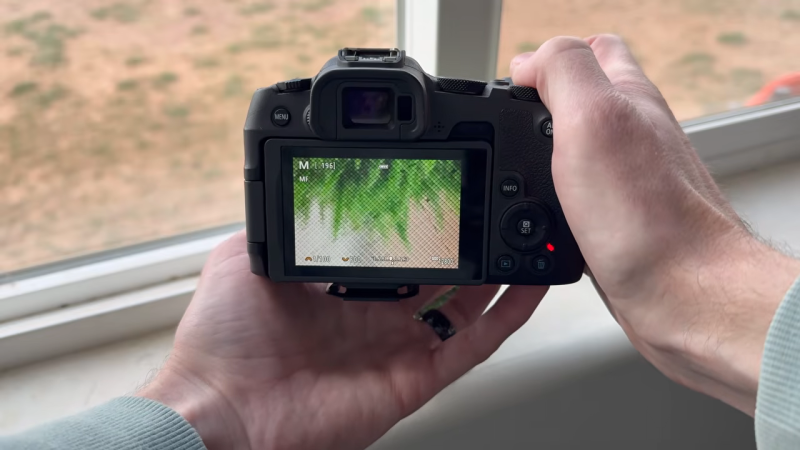
We seldom talk about 3D printing lenses because most techniques can’t possibly produce transparent parts of optical quality. However, you can 3D print something like a lens, as [Luke Edwin] demonstrates, and get all kinds of crazy pictures out of it.
[Luke’s] lens isn’t really a lens, per se. There’s no transparent optical medium being used to bend light, here. Instead, he’s printed a very fine grid in a cylindrical form factor, stuck it on a lens mount, and put that on the front of a camera.
The result is effectively a set of parallel tubes that guide light on to the camera’s image sensor. With the lack of any sort of focus mechanism, you can’t use this “lens” to photograph anything more than a few centimeters away. Get something up close, though, and you can take very simple, very grainy images that are reminiscent of classic pixel art. [Luke] demonstrates this in some fun ways, using it to take photographs of money, a plant, and his own eye. The images look almost like art assets straight out of a 16-bit game. He’s got the STL file up for sale if you want to print your own at home.
We’d love to see this concept explored further, maybe with some supporting optics for more versatile use. In the meantime, you might explore other ways of using 3D printers for photographic gain.











I did something like this a few years ago, but the “straws” converge into what I called a “virtual pinhole” outside of the print body, and it has basically infinite focus like a pinhole, except you still confusingly (no pun intended) have a sort of circle of confusion because of the channels diameter covering multiple pixels.
I pitched it to my friends saying that it was the first time an image resolution was limited by the resolution of the lens instead of that of the sensor.
I think it would be really interesting to use lithography to produce really small versions of this – it gets more light than a pinhole and you shouldn’t have diffraction problems if the channels get really close to the sensor.
This type of collimator is used in some types of nuclear (x-ray, gamma) imaging and sensor systems, where lenses can’t(*) work. It’s very effective.
(* A pedant will pop in here to point out that some classes of lenses are possible in certain types of x-ray and gamma imaging systems. Acknowledged.)
Meta made a prototype of VR goggles with what they called “Light Field Passthrough” https://www.youtube.com/watch?v=O15wUC5D7zE I wonder if that could add the missing focusing ability to this 3d printed mesh lense.
I don’t know the first thing about photography but wouldn’t it be better to take the cleanest photo possibly, then use software editing techniques/filters to create this effect?
If it’s just for fun, this may be more fun to play with than a digital effect.
The power of SLR camera’s is that you get a very good view of what the photo is going to be before you click. So you can look around through your viewfinder and find the best subjects for this effect.
Ah that makes sense. The closer the view in the viewfinder is to the final product, the better
Even better are the non-SLR mirrorless ones, like the one shown and used here — the sensor itself is used for the viewfinder, not some intermediate screen and complex folding optics that alter (e.g.) vignetting and depth of field. Not that either are an issue in this case, admittedly.
My currogated cardboard cat bed also has this lensing effect!
I bought a Canon R8 not too long ago. And a new Bambu A1 just this month. Kismet?
Self-declaring as someone with considerable disposable income. Nice.
With open paths passing all the way through, what protects the sensor from tiny sensor-eating worms (or whatever)?
Put a UV filter on it if you’re worried the sensor’s own cover glass isn’t enough!
Back in the Olden Days(TM) we used coffee stir ‘stick’ straws to do this. (small diameter black straws, about 1.5 mm dia, 150 mm long).
Then I discovered the activated carbon grid filters used as ozone filters in laser printers and photocopiers. They worked great for this effect.
These grids are really effective when used on light sources. To make these, black Coroplast (5 mm thick corrugated signmaking plastic) works great: laminate a bunch of 30-50 mm wide strips together to make the parallel holes. Can’t get black plastic? Spray paint the entry and exist faces with flat black paint: you just need the first few mm of the tubes to be black.