

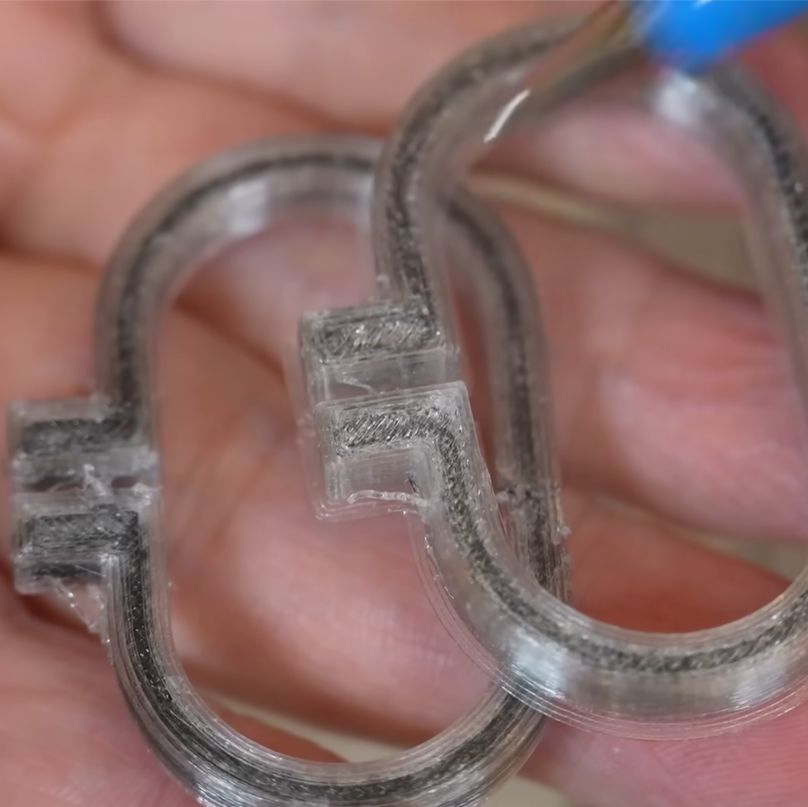
 Although you can purchase many types of FDM filaments containing ‘carbon fiber’ these days, they are in no way related to the carbon fiber (CF) composite materials used for rocket hulls and light-weight bicycles. This is because the latter use continuous fibers, often in weaved CF mats, whereas the FDM filaments just use small, chopped, fragments of CF. Obviously this will not result in the same outcome, which makes it interesting that a company called Fibre Seek is now running a KickStarter for a very affordable co-extrusion FDM printer that can add continuous CF to any part. They also sent a few test parts to [Dr. Igor Gaspar] for testing against regular FDM CF prints.
It should be noted here that continuous CF with FDM is not new, as Markforged already does something similar, though at a ‘Contact us for a price quote’ level. The advantage of the Fibre Seek solution is then the co-extrusion that would make printing with continuous CF much more flexible and affordable. Based on the (sponsored) [CNC Kitchen] video of a few weeks ago at a tradeshow, the FibreSeeker 3 printer is effectively a standard CoreXY FDM printer, with the special co-extrusion dual print head that allows for CF to be coated with the target thermoplastic before being printed as normal.
Unfortunately for [Igor] he did not have a FibreSeeker 3 to print on, and the print request for his usual test samples got mixed up by Fibre Seek, leaving him with only 4 out of 10 items to test with. This makes this a bit of an abbreviated test, but should still provide some useful data relative to the Polymaker PETG-CF filament that was used for comparison.
Based on the limited test set, it can be said that the FibreSeeker 3 parts did generally better than the PETG-CF parts, albeit with a few asterisks. Accordingly, [Igor] is left feeling somewhat confused by Fibre Seek, but sees the potential of this new co-extrusion technology. It just feels like the FibreSeeker 3 printer is not quite finished yet, and that the true value of this approach and this new printer will have to prove themselves.












Chopped fiber adds a relatively small additional strength, at the cost of perhaps being hazardous waste. I’m very interested in continuous fiber tooling; it’s not new, but it’s pretty expensive. It would be nice to see improvement in that space.
It’s almost like a misunderstood concept, or perhaps deliberately so. Fiber-reinforced plastic works because the fibers are randomly distributed and form an interlocking fabric. No FDM printer can randomly distribute the fibers across layers.
There was studies showing that certain plastics do not form a good friction boundary with the chopped fiber and weaken the part like pla cf. However part of that also mentioned that the voids that weakened the plastic also formed across layers. That kind of makes me think that there is at least some sort of mixing across layers. Maybe it depends on the timing between layers passing over the same point, if the plastic is still molten enough to let any fibers on the boundary melt into the layer below.
In the video he makes the observation that the continues fibers don’t really connect with each other.
This is more of an embedding, than fibers that are glues to each other.
On the Kickstarter page, I couldn’t find much information on the creators. The product is so complicated and the campaign so slick that it reminds me of “Kickstarter is not a storefront” plays I’ve seen in the past. Bottom line: it looks like an awesome product, but this is hardly “two guys and a garage.”
Part of that could be that this type of printer isn’t really new, this looks a lot like the markforged continuous fiber printers that I’ve seen back in 2014. Not complaining, just pointing something out. I for one, welcome some competition in this particular flavor of FDM printing
Kickstarter: ’nuff said. Never, ever again will I crawl into that dark tunnel.
I wish them the best…It is a very litigious area of 3d printing they are in. Markforged recently had to deal with this too. Some companies have no other business model than patent suits.
All that aside…I have always felt this method has limited use case. I suspect it is likely stronger in the directions that were already strong and just as weak (or possibly weaker) in the others. As others have said this has no cross layer bonding…and IMHO (and as testing in other HaD articles showed) it may introduce voids which could overall weaken a part in certain use cases and/or printing orientations.