Investigating Annealing As Fix For Poor CF Adhesion In 3D Prints

After recently publishing a few videos covering research into the poor adhesion between chopped carbon fiber (CCF) and the thermoplastic filaments as used with FDM 3D printing, some of the feedback received by [I built a thing] included the idea that the missing step to make CCF additives work was post-print annealing. Naturally this claim had to be investigated, both through the resulting physical characteristics as well as on a microscopic level in the same scanning electron microscope (SEM) as before.

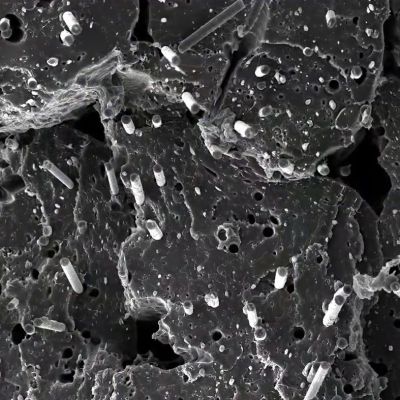
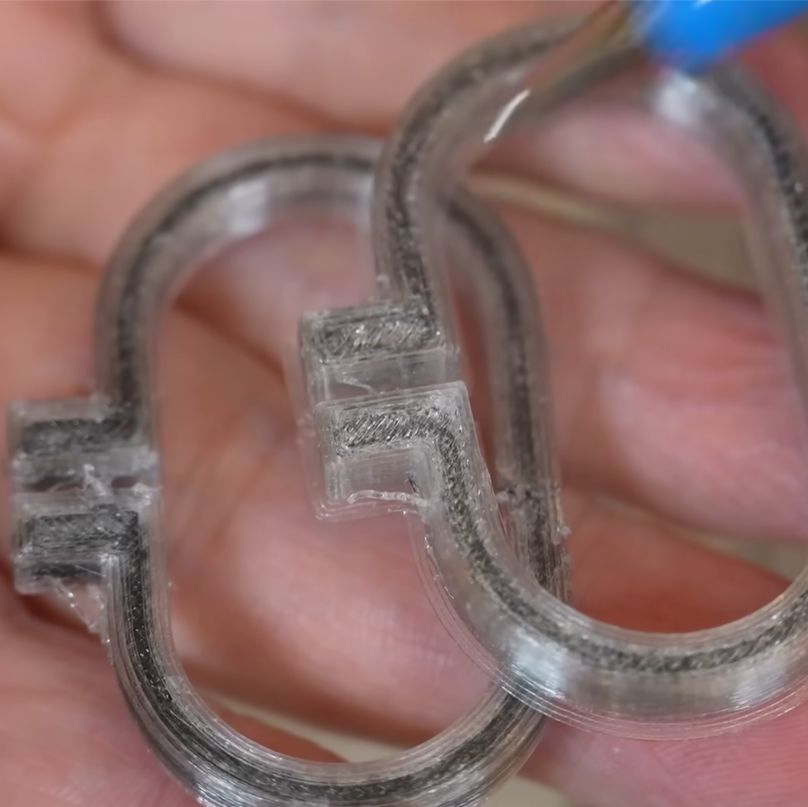
Post-annealing SEM scan, showing clear voids. (Credit: I built a thing, Youtube)

Theories as to why annealing the parts would help here seem to focus on increased bonding and filling of voids in the printed CCF-infused material, while there are the typical worries with annealing such as parts warping and shrinking to also take into account as potential downsides of this treatment.

For the sample materials PETG and PETG-CF, as well as PLA and PLA-CF filaments are used, with each filament type featuring an annealed and not annealed version. These were then tested for tensile strength, stiffness and failure type, as well as dimensional accuracy and warping, before being examined under the SEM. A total of 160 samples were used, with 20 samples per material and annealing state.

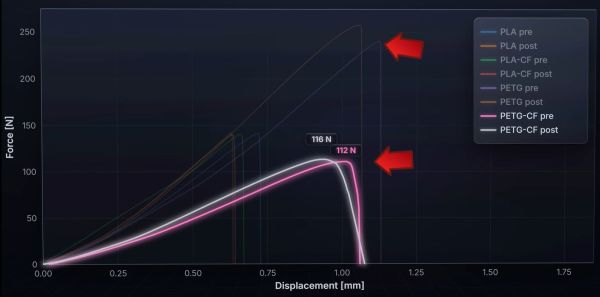
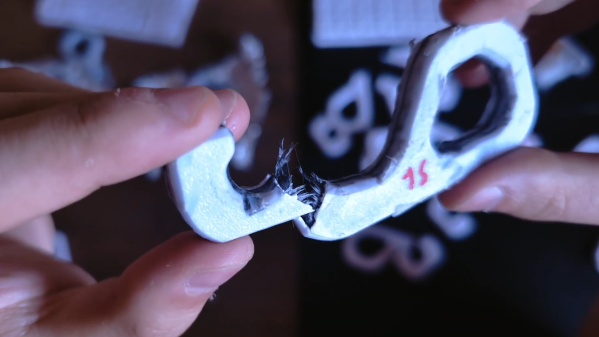
Perhaps the biggest surprise here was how much PETG benefits from annealing, making it much more resilient to breaking, whereas neither PLA nor PLA-CF seemed to see much benefit. Shocking was how much worse PETG-CF performs than PETG, with the former being worse than both PLA and PLA-CF here.

In terms of dimensional accuracy, annealing caused a Z direction expansion while shrinking the samples in the  other directions. The CCF addition here actually prevented much of the shrinking and expansion, showing the first clear benefit of this additive. Yet despite annealing at right above the glass transition temperature as is proper, this would seem to be the limit of this approach in terms of practical benefits.

Compared to the previous research that focused on PLA-CF, PETG-CF would seem to make the case even more strongly that there’s no real purpose to CCF additives, especially since you can already account for parts shrinkage during annealing before printing. That there’s no improvement to the CCF and thermoplastic interface adhesion is also no mystery, considering the science behind how e.g. thermoset materials create bonds with CF.

Continue reading “Investigating Annealing As Fix For Poor CF Adhesion In 3D Prints”

Testing Whether Heated Chambers Help Brittle Filaments

Some FDM filaments are pretty brittle even if properly dried and stored, especially those which contain carbon fiber (CF) or similar additives like glass fiber (GF). This poses a problem in that these filaments can snap even within the PTFE tube as they’re being guided towards the extruder. Here a community theory is that having an actively heated chamber can help prevent this scenario, but is it actually true? [Dr. Igor Gaspar] of the My Tech Fun YouTube channel gave this myth a try to either confirm or bust it.

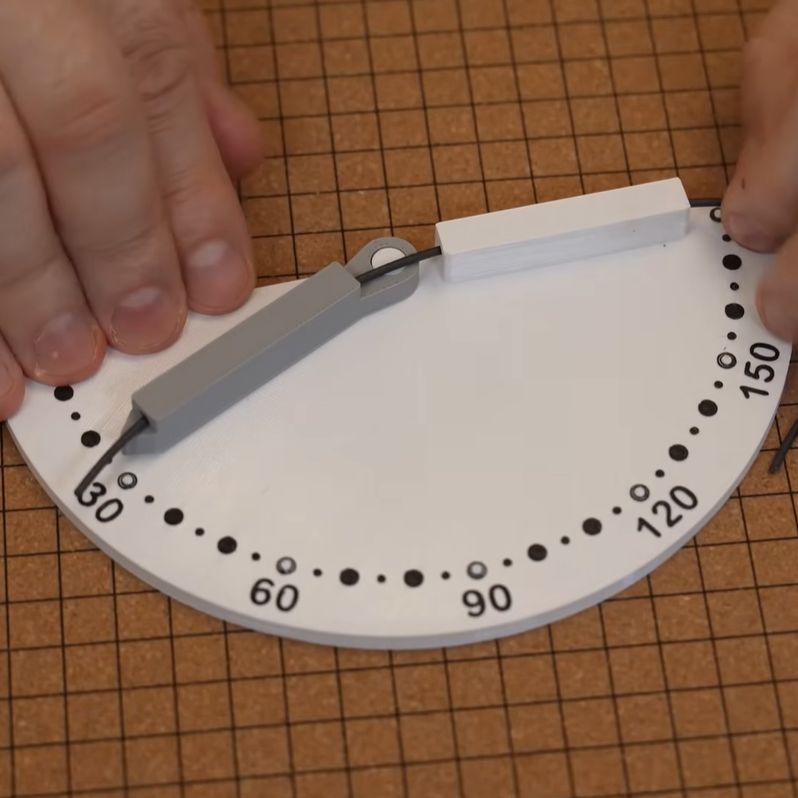
The comments suggested that heating the chamber to 65°C will help, but there’s little information online to support this theorem. To test the claim, a heated chamber was used along with a bending rig to see at which angle the filament would snap. In total five different filaments from three manufacturers (Polymaker, Qidi and YXPolyer) were tested, including Qidi’s PET-GF and PAHT-GF as the sole non-CF filaments.

A big question is how long exactly the filament will spend inside the heated chamber after making its way from the spool, which would be about 2.5 minutes with a 500 mm tube. For the test 5 minutes was used for the best possible result. Despite this, the results show that even with the standard deviation kept in mind, the heating actually seems to make the filaments even more brittle.

Considering that in general CF seems to simply weaken the polymer matrix after printing, this finding adds to the question of whether these CF and GF-infused filaments make any sense at all.

Continue reading “Testing Whether Heated Chambers Help Brittle Filaments”

Co-Extrusion Carbon Fiber FDM Filament Investigated

After previously putting carbon fiber-reinforced PLA filament under the (electron) microscope, the [I built a thing] bloke is back with a new video involving PLA-CF, this time involving co-extrusion rather than regular dispersed chopped CF. This features a continuous CF core that is enveloped by PLA, with a sample filament spool sent over by BIQU in the form of their CarbonCore25 filament.

In the previous video chopped CF in PLA turned out to be essentially a contaminant, creating voids and with no integration of the CF into the polymer matrix. Having the CF covered by PLA makes the filament less abrasive to print, which is a definitely advantage, but does it help with the final print’s properties? Of note is that this is still chopped CF, just with a longer fiber length (0.3-0.5 mm).

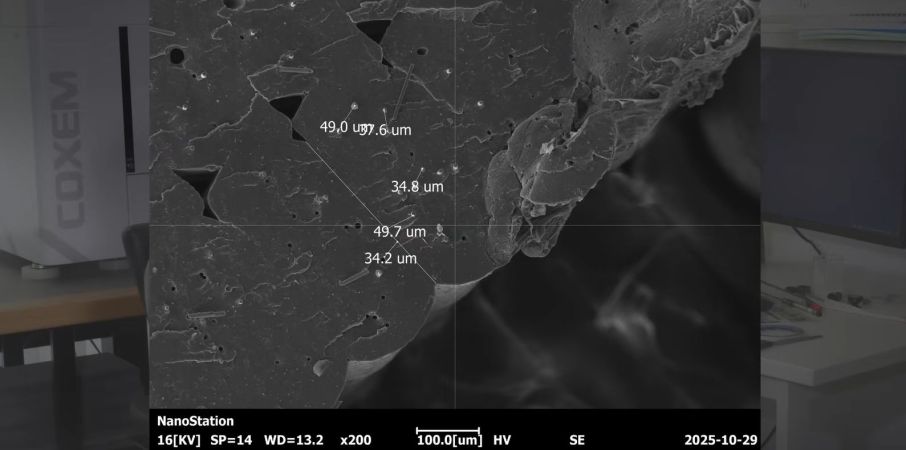
Samples of the BIQU filament were printed on a Bambu Lab H2D printer with AMS. In order to create a clean fracture surface, a sample was frozen in liquid nitrogen to make it easy to snap. After this it was coated with gold using a gold sputtering system to prepare it for the SEM.

Continue reading “Co-Extrusion Carbon Fiber FDM Filament Investigated”

FibreSeeker 3: Continuous Carbon Fiber Vs Chopped CF

Although you can purchase many types of FDM filaments containing ‘carbon fiber’ these days, they are in no way related to the carbon fiber (CF) composite materials used for rocket hulls and light-weight bicycles. This is because the latter use continuous fibers, often in weaved CF mats, whereas the FDM filaments just use small, chopped, fragments of CF. Obviously this will not result in the same outcome, which makes it interesting that a company called Fibre Seek is now running a KickStarter for a very affordable co-extrusion FDM printer that can add continuous CF to any part. They also sent a few test parts to [Dr. Igor Gaspar] for testing against regular FDM CF prints.

It should be noted here that continuous CF with FDM is not new, as Markforged already does something similar, though at a ‘Contact us for a price quote’ level. The advantage of the Fibre Seek solution is then the co-extrusion that would make printing with continuous CF much more flexible and affordable. Based on the (sponsored) [CNC Kitchen] video of a few weeks ago at a tradeshow, the FibreSeeker 3 printer is effectively a standard CoreXY FDM printer, with the special co-extrusion dual print head that allows for CF to be coated with the target thermoplastic before being printed as normal.

Continue reading “FibreSeeker 3: Continuous Carbon Fiber Vs Chopped CF”

Why Chopped Carbon Fiber In FDM Prints Is A Contaminant

A lot of claims have been made about the purported benefits of adding chopped carbon fiber to FDM filaments, but how many of these claims are actually true? In the case of PLA at least, the [I built a thing] channel on YouTube makes a convincing case that for PLA filament, the presence of chopped CF can be considered a contaminant that weakens the part.

Using the facilities of the University of Basel for its advanced imaging gear, the PLA-CF parts were subjected to both scanning electron microscope (SEM) and Micro CT imaging. The SEM images were performed on the fracture surfaces of parts that were snapped to see what this revealed about the internal structure. From this, it becomes apparent that the chopped fibers distribute themselves both inside and between the layers, with no significant adherence between the PLA polymer and the CF. There is also evidence for voids created by the presence of the CF.

To confirm this, an intact PLA-CF print was scanned using a Micro CT scanner over 13 hours. This confirmed the SEM findings, in that the voids were clearly visible, as was the lack of integration of the CF into the polymer. This latter point shouldn’t be surprising, as the thermal coefficient of PLA is much higher than that of the roughly zero-to-negative of CF. This translates into a cooling PLA part shrinking around the CF, thus creating the voids.

Continue reading “Why Chopped Carbon Fiber In FDM Prints Is A Contaminant”

Industrial 3D Printing Uses Layers Like We’ve Never Seen Before

We’ve seen FDM printers lay down layers by extruding plastic in a line. We’ve seen printers use sintering and lithography to melt or cure one layer at a time before more print medium moves into place for the next layer. What we’ve never seen before is a printer like this that builds parts from distinct layers of substrate.

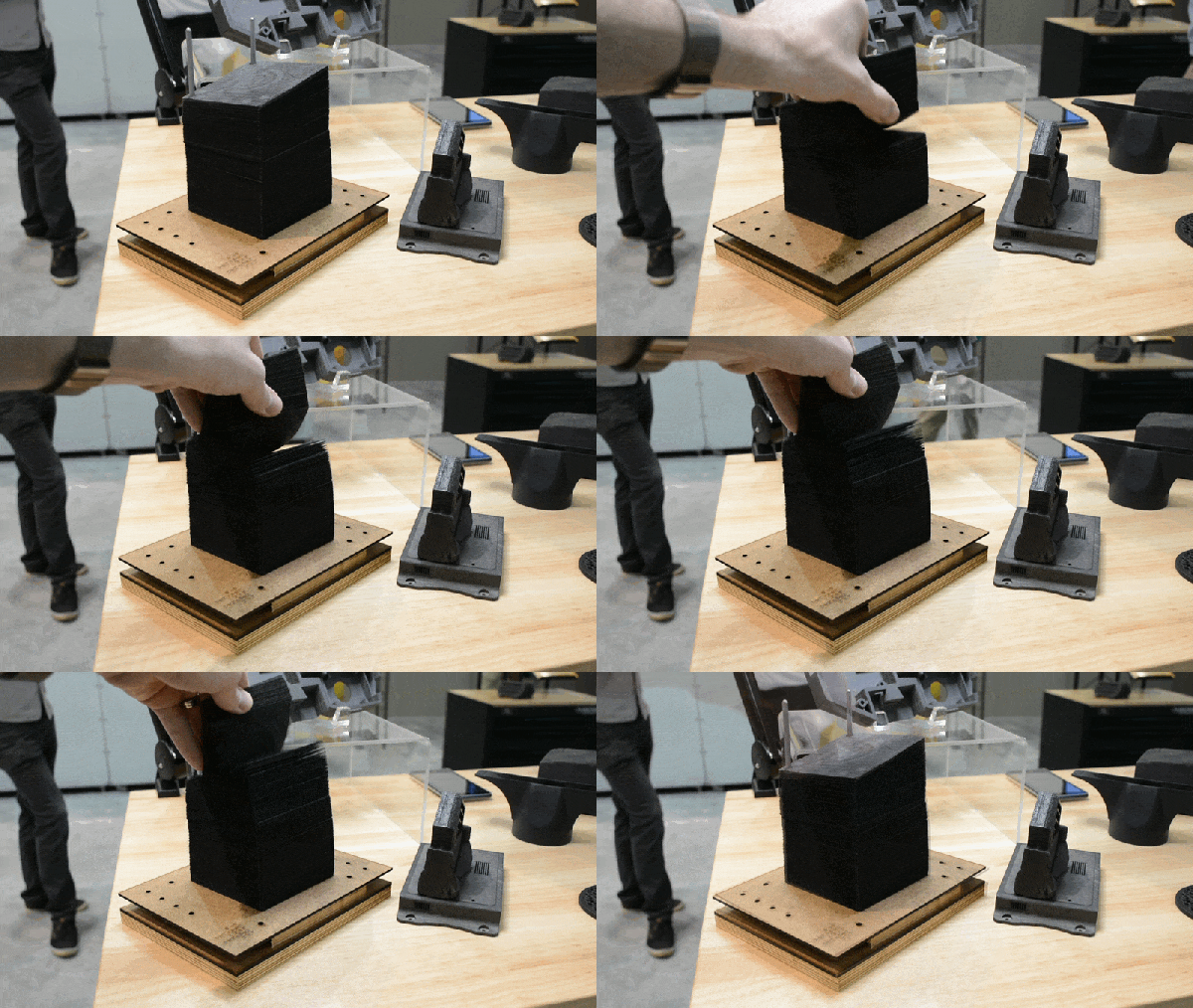
At the International Manufacturing Technology Show last week I spoke with Eric of Impossible Objects. The company is using a “sheet lamination process” that first prints each layer on carbon fiber or fiberglass, then uses a hydraulic press and an oven to bake the part into existence before bead-blasting the excess substrate away. Check out my interview with Eric and join me below for more pictures and details.

Continue reading “Industrial 3D Printing Uses Layers Like We’ve Never Seen Before”

3D Printering: Aramid And Carbon Fiber Infused ABS

Last week, we had a look at a carbon-infused PETG filament. This week, I’d like to show you two composites based on a more common thermoplastic in 3D printing: ABS. Among a whole lot of other engineering plastics, the french company Nanovia manufactures Kevlar-like aramid-fiber-infused and carbon-fiber-infused ABS 3D printing filaments. These materials promise tougher parts with less warping while being just as easy to print as regular ABS. Let’s check them out!

Continue reading “3D Printering: Aramid And Carbon Fiber Infused ABS”