
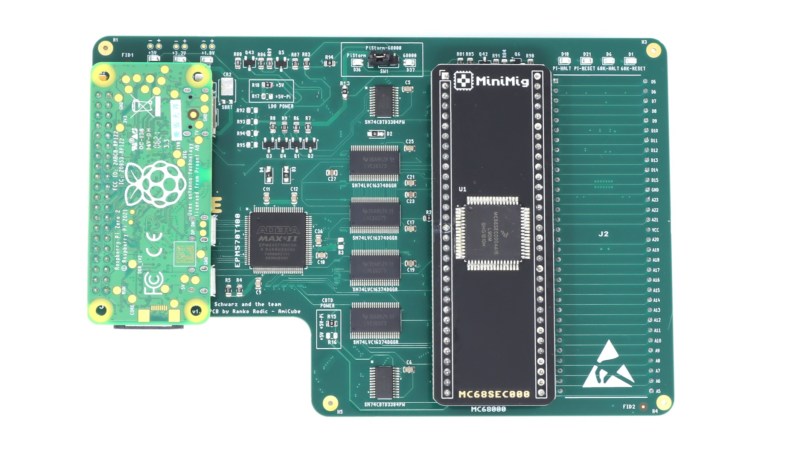
[AmiCube] has announced their new PiStorm68K special edition MiniMig accelerator board. This board was developed to replace the 68000 CPU in a MiniMig — a recreation of the original Amiga chipset in an FPGA allowing a real genuine 68000 CPU to operate.
The PiStorm68K itself can host a real genuine 68000 CPU but it can also host various Raspberry Pi models which can do emulation of a 68000. So if you combine a PiStorm68K with a MiniMig you can, at your option, boot into an emulated environment with massively increased performance, or you can boot into an original environment, with its reliable and charming sluggishness.
In the introduction video below, [AmiCube] uses the SYSINFO utility software to compare the CPU speed when using emulation (1531 MIPS) versus the original (4.47 MIPS), where MIPS means Millions of Instructions Per Second. As you can see the 68000 emulated by the Raspberry Pi is way faster than the original. The Raspberry Pi also emulates a floating-point unit (FPU) which the original doesn’t include and a memory management unit (MMU) which isn’t used.
If you’re interested in old Amiga tech you might also like to read about Chip Swap Fixes A Dead Amiga 600 or The Many-Sprites Interpretation Of Amiga Mechanics.










Wish that instead of these things that nobody is really waiting for, they’d fix the bus arbitration stuff so that we can properly run a pistorm on a CD-TV.
You just might have conflated ‘I personally don’t need this’ with ‘nobody in the entire world wants this.’ Personally I think it’s a nice bit of work even if my collection of antique computers doesn’t have an Amiga in it.
You are free to fix the bus arbitration stuff yourself if you really want to.
Complaining that nobody else does the stuff you do not even do yourself is a bit silly isn’t it. But there are always excuses, like: I don’t have the tools, I don’t have the experience, I don’t have the time.
So how are you able to decide what choices true developers make. Developers that have plenty of other silly issues to solve, plenty of other complaint to handle. For them (even though they might make a profit from it) are doing this because the like doing it, fixing issues for a hardware base that is a minority (because face it, the CD-TV hardware is pretty rare and not many owners of these adorable machines want to put a pi-storm in it). So I can imagine some things just don’t have priority.
Why haven’t you fixed cancer yet?
I’m not complaining, I’m just wishing, I used that very word. Obviously I don’t know myself how to fix the bus arbitration. Obviously there are people who do. But they are setting different priorities. That’s their good right. It’s their time, and they can only spend it once.
But I still wish they would fix the bus arbitration instead of making pistorms for every Amiga and their modern, FPGA or otherwise, -derivatives.
I love the minimig, it’s a great open source project. But does it need a PiStorm plugin extension board, or would everyone be better off having a Minimig PCB version built purposefully around the PiStorm? That would bring the Minimig up to actual usable specs, other than running old software and games.
The bus arbitration is actually fixed on the Atari ST port. But they removed any code that supports the Amiga. So that port isn’t usable.
Also, in 2021 there was a promising statement (not a promise, mind you) that the bus arbitration would be fixed in the PiStorm32 code, and the PiStorm and PiStorm32 code would be unified. That unification is still waiting to happen, unfortunately.
So, the knowledge is there, with the people who know what is necessary to fix it. But the priority and motivations are not there.
All I wish is for that priority and that motivation to appear.
By the way, I am a true developer. Just saying.
Just not a developer who knows the ins and outs of the Amiga hardware, and doesn’t have the time to catch up with 30 years of Amiga hardware development and 5 years of PiStorm development.
1577 MIPS seems high for an emulator running on a 1Ghz processor like in the Pi 3 or Pi Zero. I’m skeptical whether this benchmark measurement translates to real-world workloads.
Indeed, I’d rather they ran some real world tests, SysInfo is tired.
Maybe a render in Vista or Imagine, FPS in Frontier, etc.
Forget about the Amiga, how about one for the SE/30
What do people do with these super fast Amigas, other than run SysInfo?
While I can somehow understand people putting some ARM-based emulation for CPU (or even graphics) into their real Amiga to get fast performance or better graphics in a nostalgic package (and some legacy I/O), I don’t see a use to combine a modern FPGA-Amiga with an emulated CPU.
It neither has the nostalgic form factor (case, keyboard, floppy, other legacy I/O) nor does it make sense economically. Both solutions can reimplement/emulate Amigas quite well on their own: FPGAs (Mist/Mister/FPGA/Apollo Vampire V4-SA) can implement beefy Amigas with 32 Bit CPU performance, AGA and RTG graphis, and even a cheap Raspi Zero 2 can emulate high-end Amigas.
I understand people who wish for high performance in their real Amiga to get a cheaper “Turbo-Board” then real 68030/40/60 or expensive FPGA-based solutions like Apollo Vampire can provide, so PiStorm is a way to get your good old real Amiga to fly without spending a fortune on rare and fragile 68060 and overclock them to >=100 MHz.
But this MiniMig-remake is somehow the grand-daddy of Amiga-FPGA reimplementations, from times, when “reasonably priced” FPGAs could just handle the OCS chipset and a real SMD 68EC000 with up to 48 MHz was cheap to get some beefy 16/32-Bit machine. Motorola/Freescale/NXP was still providing those.
Later people put a full 32Bit 680×0 (68020 ISA) on a Terasic DE-Something Altera Cyclone 3 FPGA togeter with Minimig HDL and clocked it up to match some higher clocked 68020/30 Turboboards, added AGA, RTG, cycle exact 68000 etc. and put it on MiST and later MiSTer and other FPGA retro boards. So IMHO this is the most future proof way to get some HW that is faster then most real Amigas and very close to the real thing preserved for the future.
Most people are happy with software emulation from *UAE.