
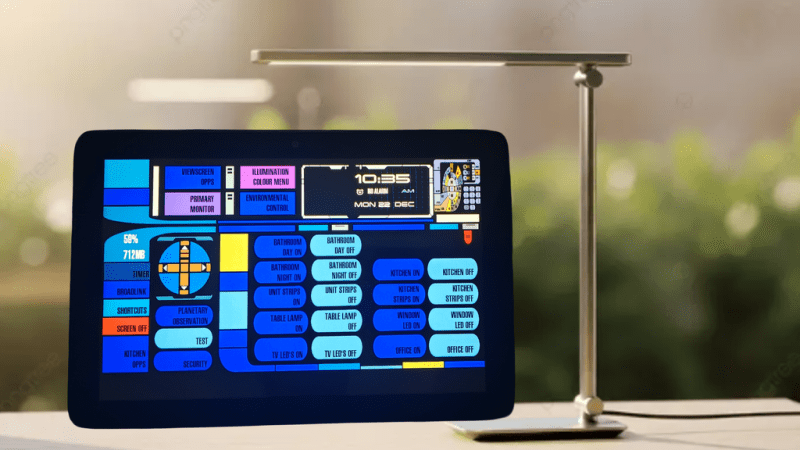
At the risk of starting a controversy: is there anyone who goes to the effort of setting up Home Assistant who wouldn’t really rather be living on the Enterprise-D? If such a person exists, it’s not [steve-gibbs5], who has not only put together a convincing LCARS dashboard on an Android tablet, but has also put together an easy-to-follow Instructable so you can too.
In case you’ve been monkishly avoiding television since the mid-1980s, LCARS is the high-tech touchscreen interface used on Star Trek: The Next Generation and its sequels. It’s an iconic, instantly-recognizable aesthetic, and we think [Steve] nailed it, even if he was taking design cues from Voyager, which is… not everyone’s favorite trek, to put it mildly. Though perhaps the haters are looking back on it a bit more fondly when compared to some more modern adaptations. Check it out in action in the video embedded below.
The secret to getting your Android tablet looking like a 24th-century terminal is an application called “Total Launcher“, which allows one to customize one’s homescreen to a very high degree. [Steve] shows us how he styled Total Launcher, but that custom home screen isn’t enough on its own. Those futuristic buttons need to do something, which is where a second app called Tasker comes in. Tasks in Tasker are linked to the LCARS interface and the smart home features — in [Steve]’s case, Amazon Alexa, but it looks like Google’s spyware or the open-source Home Assistant are equally viable options.
We saw Star Trek style on Raspberry Pi back in the day, but nothing says your smart home has to be Trek-themed. You could even control it via a dumb terminal if that’s more your style.








LCARS is an interface designed for an imaginary world.
It belongs to stay there
There are many applications with an LCARS GUI, though.
Even for DOS and Windows 3.1x.
They date back to the 90s when TND/DS9/VOY were current.
Some are even really usable, such as ***** 24 or DeskWork.
The latter was a popular DOS GUI here in Germany, made by young students.
Here’s an interview from 25+ years ago: https://www.youtube.com/watch?v=3_VoM8An6v8
And a demo video (using Qemu): https://www.youtube.com/watch?v=ZaSgLKptnrk
Could you please elaborate this a little more, please?
Your opinion is fine, but I’m curious why you feel that way. :)
The problem with LCARS is that it’s an interface designed to look futuristic and cool, with no consideration for the actual user experience. It’s hard to read the text and the colors tend to be rather garish.
Ok, but it can’t be potentially worse than current iOS or Android or can it? 🤷♂️
As a former PalmOS user I think both are pretty horrible.
Even classic Symbian OS made more sense, I think.
Especially considering the meaningless icons, which lack skeuomorphism or any recognition factor for the matter.
A good UI guideline was defined last time in the 90s by Apple when System 7 was current or so, I guess.
Before that, in the late 80s, IBM had defined the SAA standard.
That’s what I vaguely remember.
Counter argument. Having a LCARS interface sparks joy, so it definitely belongs in my homelab.
Geez, even though this guys a dork, if he wanted to do it – let him live. It looks cool to me.
I’ll take Voyager with its “nucleonic radiation” babble over Enterprise.
enterprise solved the biggest problem with voyager. ship just fought the borg and the ship looks like it rolled off the showroom floor in the next episode. when the nx-01 got trashed, it stayed that way until they fixed it, which could be several episodes later.
Meh, Voyager was two centuries more advanced and had replicators.
Speaking as a one who had a massive crush on Mrs. Columbo (Kate Mulgrew) back in the day, imagine my delight to discover that the sexiest ship in the fleet (until Enterprise E) was captained by the infatuation of my youth!
I was enamoured with that ship from the premiere of the show, and I can honestly say that I would be happy aboard the Voyager (the name of my PC) even if it never made it back to the alpha quadrant.
You may now proceed to trash-talk me to your heart’s content.
If Janeway happens to break the temporal prime directive again and invite you onto Voyager… mention my name too!
“At the risk of starting a controversy: is there anyone who goes to the effort of setting up Home Assistant who wouldn’t really rather be living on the Enterprise-D? ”
Oh absolutely, who wouldn’t love the exploding consoles.
galaxy Note 7?
No worse than a Chinese EV.
Not me.
It happens I got my start on the Original Series, and happen to be very familiar with the original Enterprise NCC-1701 herself.
Same here. One of the reasons I built the original series desktop computer and keep enhancing it little by little. Clunky, blinky lights, buttons. What’s not to like?
Still above project is neat. It’s a hobby after all :) .
How about 23rd century “LCARS” then? :)
http://lcars.org.uk/TOS_panels.htm
Same here, but a row of unlabeled paddle switches, unlabeled knobs and aray of gem colored lights would be a less practical and less flexible interface for Home Assistant.
What’s with all the TNG hate? LCARs inspired voice assistants and touch screens. Replicators inspired 3D printing. The holodeck inspired virtual reality. The exploding computers and lack of ship damage is just the time of shows. Most shows (especially medical) had all sorts of things that didn’t make sense. It’s entertainment. It’s retro. Enjoy.
Yeah, come to think of it.. When TNG aired, the Amiga 500 or Windows/386 were current.
There’s a site that even mentions that. https://tinyurl.com/4fh2avpt
+1
Though certain things also did exist before, I think.
KIT the talking car from Knight Rider predates TNG, the touch screen had existed before.
Besides light pens, there had been designs using a matrix of light barriers mounted on a frame in front of a CRT, or capacitative plastic films etc.
There’s a car from 1986 that had an excellent touch screen UI:
https://news.gm.com/home.detail.html/Pages/topic/us/en/2025/mar/0319-retrorides.html
A year earlier, in 1985, this home automation system came out. It had touch screen, too.
https://www.techspot.com/news/61823-home-automation-system-1985.html
The holodeck inspired VR for sure,
but a real-world holodeck would perhaps involve holography using lasers and fog.
The 3D printers are perhaps also linked to the development of early 3D model scanners (laser based) of the 70s or 80s (for CAD, CAM).
Speaking of VR, I miss the data glove with haptic feedback.
Back in early 90s, the development was a bit further in this regard.
Nowadays world is too focused on high-DPI LCD screens and visuals, maybe.
But that being said, Star Trek in 20th century really inspired and motivated people.
It wasn’t just another random “franchise” the way it’s perhaps now,
but real people involved in tech and social fields were influenced by it.
You had fans of Star Trek working in engineering, on mainframes, at space agencies etc.
It also inspired philosophers, psychatrists (don’t make fun of it), social researchers and so on.
And not just in the US, but globally.
The world of Star Trek made people think “what if..” more than any other franchise did.
Not just because of the technology in ST, but because it painted a believable, positive picture of future of society.
It was a world someone wanted to live in, it was something worth to aim for.
That’s why many find it “unrealistic”, also, because it differs from our current state of society.
Maybe more than it did in the 90s, even, because 90s used to be a tad bit closer to the peaceful, optimistic world of 24th century.
And maybe that’s why certain people living in the 21th century do prefer DS9 or NewTrek, also.:
A more dystopian, more miserable looking StarTrek makes them feel better when comparing it to their own sad lifes .
(Just think of STD, where everything is bleak and everyone’s crying or the J.J. Abrams movies).
That’s in contrast to people from the 90s who were still happily looking forward to the year 2000 and the utopian world of TNG.
I’d say that there were attempts at VR long before the Holodeck in TNG, but I just remembered that Star Trek TAS (1973) already had a holodeck… (IIRC the episode was The Practical Joker – not sure though).
But who knows Star Trek TAS? I’ve been a Trekkie since I was a kid in the mid 90s, watched Voyager beginning to end and only learned about TAS in like 2010… as did the TOS Nazi Planet episode (I remember watching Futurama and that episode was referenced and I knew nothing about it – how comes there’s an episode I don’t know exists?) – well it seems to have been banned in Germany until the late noughties. They hadn’t even synchronized it, so I watched the episode with different voice actors… TAS however had the same voice actors as TOS.
Hi there! I’m quite new to TAS, as well! 😃
Interestingly, though, it apparently had been translated to German language many years ago already.
The way the voice actors sound makes it sound that way, at least.
That style (fine pronounciation etc) is very 70s or 80s, at least.
Some hints on the internet exist that it aired on ZDF in 1976, also.
https://www.fernsehserien.de/die-enterprise/im-tv
About that one episode, yes, I’ve seen it in late 90s or early 2000s first time as well.
Originally, the German syndication of TOS happened in 1972 by ZDF or so?
But then was a second dubbing happening in early 90s by Kabel1?
I once read the original dubbing by ZDF was more funny/playful, less strict.
Anyway, as a younger German I really wonder what the fuss about censorship was all about.
We learn in school about WW2 since the 60s or so and we’re certainly not vulnerable to that old ideology.
Even our parents or grandparents were open to discuss that topic.
So it’s confusing why the censorship happened in first place.
Was it because older generations still felt offended in the 70s or considered the topic to be a taboo?
Or was it because of the symbolism (the cross, salute and the uniforms)?
Or was it because of rules in syndication? Were the allies worried about it?
Before the re-union we still had cold war, after all.
On other hand, Wolf3D was still indexed as harmful medium in the 90s because of WW2 symbolism and violence.
My wife had a 1989 Riviera back when we were dating. That touch screen was so cool!
Hope whoever owns the trek IP doen’t find this. There was a neat Android app years ago called Tricorder that would display output from various phone sensors. They made him take it down, not because of the name, but because it had a trek like UI.
The APK isn’t entirely lost, though. Just nolonger on the store.
But being an 32-Bit application it needs Android 11 or earlier, so it’s vintage anyway.
It was from Android 4.0.4 or 4.4 era, I think. Just saying, for the sake of trouble shooting.
Since this is HaD (tinkering etc).. The audio scope was really useful, actually.
So if anyone has an old and spare Android device,
the mic input could be connected to an optocoupler or AF transformer.
That way, it could visualize all sorts of audio signals.
Useful in the ham shack, maybe.
Tricorder-wise, I knew people who actually wanted to build something that would do some basic healthcheck (pulse, etc) in that form factor. I think they went as far as combining all the budget-available sensors and reading then with ESP8266, but lost track of that project. I’ve suggested they add ultrasound, too, and combine ultrasound readings with the other sensor’s readings and extrapolate things indirectly.
Would have been a nice project now that I think of it.
I made a little widget library for X11 back in 2002 and built a few apps for my ipaq with it. Alarm clock, metronome, txt reader, mp3 player. Enjoyed using those apps for years, kept using them on my nokia n810. The UI conceit did not detract from them at all.
So…the thing i want to say is. In LCARS, the corners are single-radius. They aren’t splines or interpolated radius between the vertical and horizontal scales. Just one radius. There’s some room for debate about what that radius should be, but they should look like sections out of a circle rather than sections out of an oval. Really upset when people get this wrong, and this isn’t the first one to do that.
And, take it from someone who did a lot of freeze frames of LCARS…there’s a lot more yellow and a lot less purple :)