
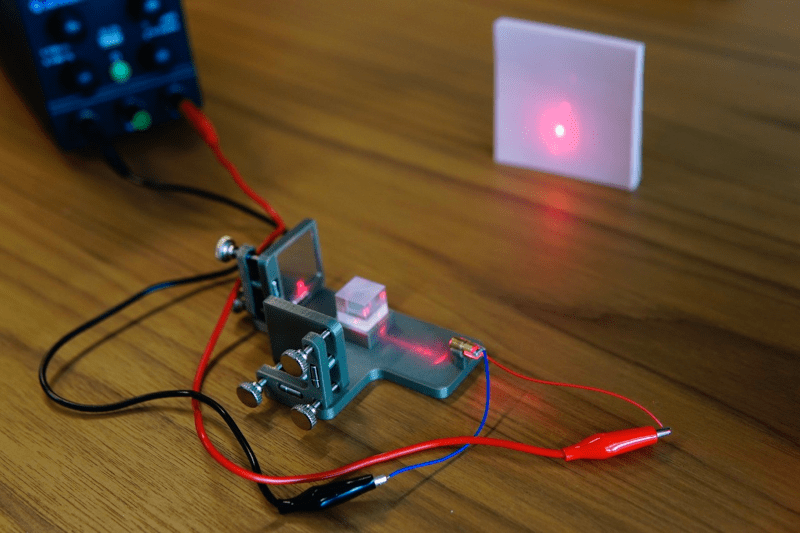
We suspect there are three kinds of people in the world. People who have access to a Michelson Interferometer and are glad, those who don’t have one and don’t know what one is, and a very small number of people who want one but don’t have one. But since [Longest Path Search] built one using 3D printing, maybe the third group will dwindle down to nothing.
If you are in the second camp, a Michelson interferometer is a device for measuring very small changes in the length of optical paths (oversimplifying, a distance). It does this by splitting a laser into two parts. One part reflects off a mirror at a fixed distance from the splitter. The other reflects off another, often movable, mirror. The beam splitter also recombines the two beams when they reflect back, producing an interference pattern that varies with differences in the path length between the splitter and the mirror. For example, if the air between the splitter and one mirror changes temperature, the change in the refraction index will cause a minute difference in the beam, which will show up using this instrument.
The device has been used to detect gravitational waves, study the sun and the upper atmosphere, and also helped disprove the theory that light is transmitted through a medium known as luminiferous aether.
The tolerances for such a device are tight, but within the capability of modern 3D printers. The CAD files are online. The key was the mirror mounts, which use springs and thumbscrews. So you do need some hardware and, oh yeah, a laser, although that’s not as hard to obtain as it once was. You obviously can’t 3D print the mirrors or the beam splitter either.
The post claims the device is cheap because the bill of materials was roughly $3, although that didn’t include the beamsplitter, which would bring the cost up to maybe $20. The device, in theory, could detect distance changes as small as one wavelength of the laser, which is around 650nm. Not bad for a few bucks.
Not all Michelsons use lasers. The man behind the Michelson instrument also worked out how to do Fourier analysis with a mechanical computer.












You left out several groups, Al:
People who have access and wish they didn’t.
People who have access and don’t know it.
People who have access and don’t care.
People who have access and think it makes them better than you.
… we could go on.
People who spent enough time peering through inteferometers in lab courses for an entire lifetime
AI doesn’t count, it’s not Human, and Never Will Be.
The writer’s name is Al, as in, short for Alfred (not saying that’s his full name, but as an example).
I usually tell people it is long for A….
when you call me
You can call me Al….(tin whisle solo)
Please give Edie my regards.
Well heck, Al, you missed the perfect opportunity to combine the two, and point out that a Michelson interferometer can be used with the Fourier transform to perform spectroscopy — most commonly in https://en.wikipedia.org/wiki/Fourier-transform_infrared_spectroscopy , where it outperforms the more usual dispersive type spectroscopy.
I wouldn’t say outperforms. It depends on the wavelength of light. FTs have an issue where they spread noise all over the spectrum.
IIRC you have to take data while a mirror is moving, which has to be precise. Starting from the null. Usually with a monochromatic light (like laser) used in paralleled as a reference for displacement. So I don’t know if you would strictly call it a Michelson Interferometer. Maybe a Dual MI with a Twist – a DMIT.
Ten years ago: https://hackaday.com/2015/04/22/a-diy-fourier-transform-spectrometer/
These things are not at all difficult to set up. The only aspect you need to worry about is vibration.
If you mount one mirror on a piezo buzzer element, you can build a feedback mechanism that keeps the interference pattern fixed by adjusting the voltage, and this gives you a voltage measurement for whatever the interferometer is measuring.
For example, an interferometer makes a sensitive microphone. Mount a corner cube reflector on a window and you can use the window as a microphone and record conversations inside the room.
Or an earthquake detector. Or a moon phase detector. Or an optical liquid level sensor.
These things are very good for measuring small changes in things.
In this case you have more to worry about then vibration. Humidity, temperature and creeping due to use 3d printing would introduce some challenges here
Robert Forward when he was at Hughes Research mounted one mirror on a piezo crystal and drove with known displacement oscillation. Using correlation – at that time a lock-in amplifier – he was able to measure extremely fine movements. It was part of his active noise reduction experiments to improve sensitivity of his gravity gradiometer, and he hoped for a long baseline interferometer in space to search for gravity waves. This was at or before 1970. I have his publications and some private correspondence on this somewhere handy.
I think they use the technique with LIGO.
Usagi Electric just did an article about using this technique to align one of the devices that he was working on recently. Pretty cool video!
Cool! ive seen a lot of hacks like these over the years. I think their mounts could be improved a bit, but it’s not worth it given their source material. Love to see dime store optics at work! Maybe I should post some of my stuff. Eh… Nah the world isn’t ready
The Michelson-Morley Experiment may still have more to offer – https://x.com/AshtonForbes/status/1792267439985602606
Cool. So that clearly illustrates that, when you turn a large, fairly complex and relatively flimsy optical assembly upside down in a 1 G gravity field, components can shift by 5 microns!
For some reason I’ve believed that the poor coherence length of cheap diode lasers prevented building practical interferometers. But apparently the coherence length is 10-20 cm even for the cheapies.
Crap;
I need one of these to do the turbo mod to my Encabulator.
I should have not started this project it’s more complicated than loading code into a micro I didn’t write.
The distance measurement sensitivity is much higher than you say. Yes the wavelength is 650 nm, but if you move one arm 1/4 this distance then you go from the brightest signal (constructive interference) to the dimmest (destructive interference) as the light travels twice the distance moved extra. So if you have a binary measurement you get 650/4 = 165 nm sensitivity, if you have some intensity sensitivity you can easily get to the 10 nm range.
One additional point you don’t actually NEED a laser, any old monochromatic light source will make an interferometer. However, with an incoherent light source you need the arms to be the same length, to roughly a wavelength, whereas with a laser you get to have them different by the coherence length of the laser. For a old fashioned gas laser this might be 100’s m, for a cheap diode laser it is likely a few 10’s cm.
Check https://hackaday.io/project/202423-jasper-ftir
Many years ago I used the piezo bender approach to make sub-nm measurements with a Michelson interferometer. I added a couple of acoustic optical modulators and converted it to a heterodyne interferometer with noise levels much below 0.1 nm. A tremendously simple yet fascinating device.
Very interesting indeed
4 me, Michelson Morelly experiment was the enterence to the facsanating wortd of modern physics