
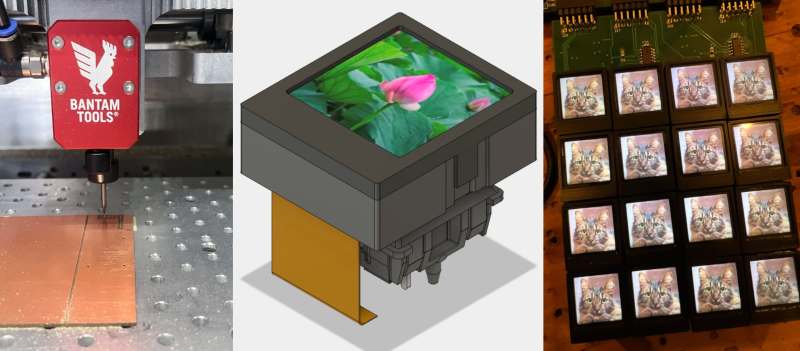
Although arguably redundant on a typical computer keyboard, the idea of embedding small screens into the buttons on devices like audio production gear that often have so many buttons can make a lot of sense. As exemplified by devices with a UX that regularly degrades into scrolling through options on a tiny screen. This was basically the impetus for [Craig J Bishop] a few years ago to set out on a design project called the SoundSlab audio sequencer/sampler/synthesizer and slab that would make those buttons much more functional.
Obviously, the right way to start the project is to bulk buy hundreds of 0.85″ 128×128 LCDs so that you’re firmly locked into that choice. Fortunately, it turned out that the most annoying part of this LCD was the non-standard 0.7 mm pitch on its flat flex cable (FFC). This was worked around with an PCB adapter milled out of some copper-clad FR-1, which gave it a convenient PMOD interface for straightforward hook-up to a Xilinx Artix-7 FPGA board.
The buttons themselves were designed as 3D printed key caps for the LCDs that clipped onto typical Cherry MX-style mechanical keys. This also revealed that the original FFCs were too short, so they had to be replaced with new FFCs, that also adapted it to a standard 0.5 mm pitch. With this a 4×4 button prototype board could be constructed for testing.
Since that prototype [Craig] has built a full-sized SoundSlab grid, with a custom FPGA board and HDMI input, of which a preview can be seen in the post, along with a promise by [Craig] to soon post the rest of the SoundSlab development.
Thanks to [JohnS_AZ] for the tip.











Worth noting that if you absolutely need buttons with screens, they have been around for a while.
I got to play with some of these recently: https://www.digikey.com/en/products/detail/nkk-switches/ISF15ACP4/360-3378-ND/5056758
Pretty neat, and properly rated to be a button (1 million cycles) but very expensive ($80/switch even in quantity)
Almost $100 each? I won’t be designing a keyboard with these any time soon.
.. and if you need a basic grid of buttons with screens that connects via USB and can be customized using Linux (as well as PC or Mac), Elgato’s Stream Deck series of devices is substantially more affordable, at less than $150 for something with 15 buttons.
(I’m in no way suggesting that a Stream Deck is comparable to this impressive project – it’s a closed source, medium-sized usb macro pad, not an extensible fpga-powered synth – but it’s handy for other hacks well beyond its intended audience)
I can see it being handy when making gangsta rap.
There’s the recent waveshare mk10 and mk20 devices which look interesting. They are dual MCU devices, one running QMK and the other running Linux. Weirdly the config software is not available for Linux.
I’m hoping they drop a bare key module, or at least release the source for the tooling.
Something like a pair of the mk20’s could be awesome as a split keyboard.
I really like the buttons. I’m just worried about their durability. How long will they last? Moving parts, and displays is a combo that I just don’t trust very much
I have a few elderly family members who will be well served by a TV remote control with very clear labels on each button