
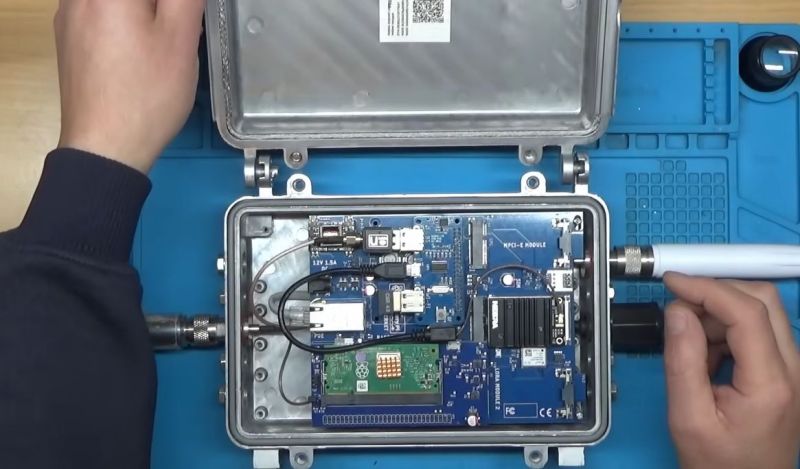
After the swivel by Helium Inc. towards simply running distributed WiFi hotspots after for years pushing LoRaWAN nodes, much of the associated hardware became effectively obsolete. This led to quite a few of these Nebra LoRa Miners getting sold off, with the [Buy it Fix it] channel being one of those who sought to give these chunks of IP-67-rated computing hardware a new life.
Originally designed to be part of the Helium Network Token (HNT) cryptocurrency mining operation, with users getting rewarded by having these devices operating, they contain fairly off-the-shelf hardware. As can be glanced from e.g. the Sparkfun product page, it’s basically a Raspberry Pi Compute Module 3+ on a breakout board with a RAK 2287 LoRa module. The idea in the video was to convert it into a Meshcore repeater, which ought to be fairly straightforward, one might think.
Unfortunately the unit came with a dead eMMC chip on the compute module, the LoRa module wasn’t compatible with Meshcore, and the Nebra breakout board only covers the first 24 pins of the standard RPi header on its pin header.
The solutions involved using a µSD card for the firmware instead of the eMMC, and doing some creative routing on the bottom of the breakout board to connect the unconnected pins on the breakout’s RPi header to the pins on the compute module’s connector. This way a compatible LoRa module could be placed on this header.
Rather than buying an off-the-shelf LoRa module for the RPi and waiting for delivery, a custom module was assembled from an eByte E22 LoRa module and some stripboard to test whether the contraption would work at all. Fortunately a test of the system as a Meshcore repeater showed that it works as intended, serving as a pretty decent proof-of-concept of how to repurpose those systems from a defunct crypto mining scheme into a typical LoRa repeater, whether Meshcore or equivalent.










My friend got into this pyramid in 2020. The base station he put in my house died a couple years later. i opened it up, and it was not nearly as integrated as this one. It was just a regular full-sized rpi, i think 4. It had a microSD card (which had died, presumably from writing logs to it!, and which was non-replaceable because it had a magic key on it). The radio was a hat. Not sure if you would have any more luck with that hat but the hat was a stand-alone product in its own right. The box was just a regular tall pi+hat box, with a sticker over the ports they didn’t want you to use.
So the moral of the story is that the institutional customers who cornered the market on rpi in 2020-2021 included a lot of fools who don’t know to mount the sd card read-only and log to ram.
Aaand, due to the “HaD effect”, the prices of these will start rising in ….
The enclosure is way cooler than the electronics.
I just want the box.
i’m working on doing a similar thing with the outernet boards. unfortunately they seem to be much harder to find, though. it took me quite a while of looking to come across the v2 + v3 i ended up with.
“outernet boards” Talk about a CLUSTER!! That guy (outernet) changed his mind everyday!!
After the 2nd board(or was it the 3rd??), I gave up on Outernet.
what’s done in that video can also be done without soldering anything on the device itself, by choosing a few different pins. wehooper4’s Zebra Hat (https://github.com/wehooper4/Meshtastic-Hardware/tree/main/ZebraHAT) connects to that 40 pin thing without modifications to the miner. https://helium-repurposed.deobfuscated.org/Devices/Nebra/Outdoor%20Miner has some notes on it