
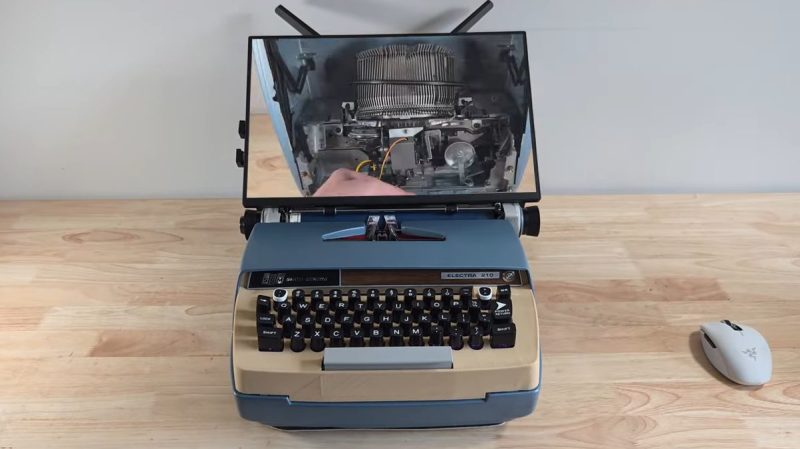
Go back a couple of generations, and rather than a laptop or a luggable, the office accessory of choice was a portable typewriter. As the 20th century wore on, the typewriter became electric before eventually being eclipsed by luggable and laptop computers. On YouTube, [Prototype] is turning back the clock, by turning an old Smith-Corona electric typewriter into a luggable computer– with a stretch goal of still being able to type.
Yeah, just gutting the typewriter and shoving an SBC inside wasn’t ambitious enough for [Prototype]: his goal is a working typewriter and an x86 gaming PC. To facilitate this, he guts the Smith-Corona keyboard, and 3D-prints a new top plate to add a little more vertical space in the old typewriter. The new top does recreate the original layout and the Corona switches get printed adapters to fit them to mechanical switches [Prototype] is using with a vibe-coded Arduino. Why one would bother with ChatGPT when QMK is right there, we could not say, but feel free to skip 6:20 to 15:00 if you’re watching the video but want to avoid that side quest.
Unfortunately, the “get the keyboard working” side-quest is either faked or deferred to video part II, which has not been posted yet. In this video he demonstrates that he can actuate a single hammer with a servo, but that’s a far cry from a working typewriter so, we’re really hoping he comes through on that promise in Part Two. Even if the build stops with just one hammer, that would give the tactile sound-and-feel that other builds turn to solenoids for. Squeezing a small-form-factor motherboard and graphics card into the old Smith-Corona is also going to be an interesting challenge. It’s certainly going to be a step up from using the keyboard as a terminal.
If you like this project but balk at the idea of destroying a working piece of vintage office equipment, it is possible to turn a typewriter into a USB keyboard non-invasively.
If you like this project at all, join us in thanking [Katie] for the tip. Not your cup of tea? Tell us what is, with a tip of your own.












Keebin’ With Kristina…IN HELL!
cackles evilly
I would use a broken typewriter. Oh , wait, I would fix that.
Back in the days there was a VT100 terminal with a matriceal printer instead of a screen. So it was the complementary stuff to what this dude is building. Nice memories printing guitar tabs using cat command.
But I still won’t destroy a working/fixable typewriter for this.
The flat screen ruins it.
In BRAZIL, you had the typewriter, a CRT, and a fresnel lens.
Beat me to it. And the typewriter function still worked.
Why would anyone want a portable typewriter in the office? That’s just the opposite of the way things were back when the article says “the office accessory of choice was a portable typewriter.” This was never true, the writer is just making stuff up.
I am sorry to say this may have been true. A secretary may have moved it to another room for taking dictation.
Also some of your confusion may be what ‘portable’ meant back in the day. My first ‘portable’ computer was about 40lbs and required mains power. Not quite a Compaq with a CRT, but those were ‘portables’ as well.
That’s why they made typewriter carts. And shorthand. “Come in my office with your infernal machine and make noise while I talk.” I’m not confused. I owned two portable typewriters, one an Adler one another brand name that I gave to a friend going abroad for a Fulbright. I worked in offices “back in the day” grandpa and I’m sorry you bought a silly computer. Portable typewriters were never hot the way Python is, they were never “the office accessory item of choice.”
Question. Could you use an optical gel for the strike zone and have a character recognition camera to generate key strokes? Or just put a barcode on each arm and let the camera pick that up? Would need to be one of those crazy high speed cameras though I guess.
Lol at re-inventing QMK. I always find it fascinating when literal youtubers seem to be living on a Himalayan mountain peak. How did this happen?