
Although often tossed together into a singular ‘retro game’ aesthetic, the first game consoles that focused on 3D graphics like the Nintendo 64 and Sony PlayStation featured very distinct visuals that make these different systems easy to distinguish. Yet whereas the N64 mostly suffered from a small texture buffer, the PS’s weak graphics hardware necessitated compromises that led to the highly defining jittery and wobbly PlayStation graphics.
These weaknesses of the PlayStation and their results are explored by [LorD of Nerds] in a recent video. Make sure to toggle on subtitles if you do not speak German.
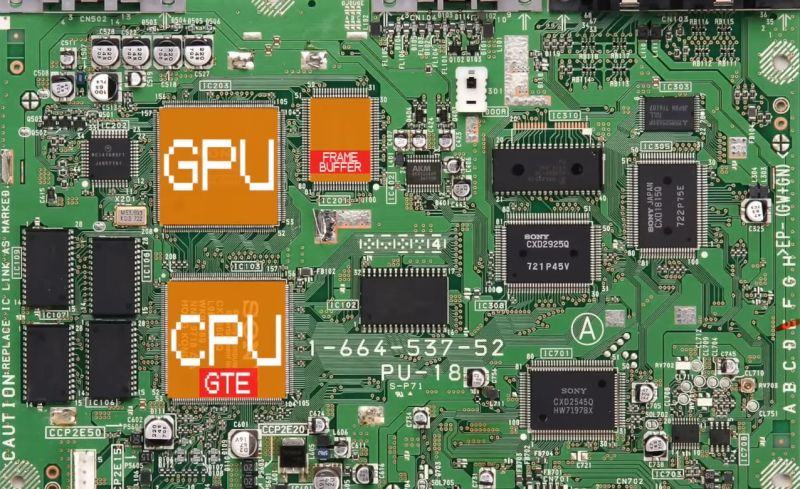
It could be argued that the PlayStation didn’t have a 3D graphics chip at all, just a video chip that could blit primitives and sprites to the framebuffer. This forced PS developers to draw 3D graphics without such niceties like a Z-buffer, putting a lot of extra work on the CPU.
This problem extends also to texture mapping, by doing affine texture mapping, as it’s called on the PS. This mapping of textures is rather flawed and leads to the constant shifting of textures as the camera’s perspective is not taken into account. Although this texture mapping can be improved, the developers of the game have to add more polygons for this, which of course reduces performance. This is the main cause of the shifting and wobbling of textures.
Another issue on the PS was a lack of mipmapping support, which means a sequence of the same texture, each with each a different resolution. This allows for high-resolution textures to be used when the camera is close, and low-resolution textures when far away. On the PS this lack of mipmapping led to many texture pixels being rendered to the same point on the display, with camera movement leading to interesting flickering effects.
When it came to rendering to the output format, the Nintendo 64 created smooth gradients between the texture pixels (texels) to make them fit on the output resolution, whereas the PS used the much more primitive nearest neighbor interpolation that made especially edges of objects look like they both shimmered and changed shape and color.
The PS also lacked a dedicated floating point unit to handle graphics calculations, forcing a special Geometry Transformation Engine (GTE) in the CPU to handle transformation calculations, but all in integer calculations instead of with floating point values. This made e.g. fixed camera angles as in Resident Evil games very attractive for developers as movement would inevitably lead to visible artefacts.
Finally, the cartridge-based games of the N64 could load data from the mask ROMs about 100x faster than from the PS’s CDs, and with much lower latency. All of these differences would lead to entirely different games for both game consoles, with the N64 being clearly superior for 3D games, yet the PS being released long before the N64 for a competitive price along with the backing of Sony would make sure that it became a commercial success.












Interesting! I’ve always wondered about the reason for the wobbliness of the PS graphics.
The N64 was less popular with developers because those cartridges were very expensive to make, compared to the low cost of pressing a CD.
As a result, outside of Nintendo’s own software, few developers had the cash to risk developing a title for the platform, while PlayStation became a flood of creativity.
Don’t forget ease of home cd copying, many bought PS because of that (and still also still bought games).
There was no ease of CD copying for the Playstation during it’s prime and there wasn’t rampant piracy. The PS launched in Japan in 1994. CD Writers didn’t start showing up in home computers until around 1997.
CD Writers before the early 2000s did not contain buffer under run technology (e.g. DRAM + Firmware) that made writing CDs reliable without an expensive CPU. Prior to this if you farted upwind of a PC writing a CD it would fail.
If you managed to make a copy of a disc you’d soon discover it was rejected by the PSX because of DRM and Piracy protections written into a portion of the disc that CD Writers could not write to. In order to play a pirated PSX disc you had to boot a valid disc and then hotswap the copy.
By the time all of this was sorted out and PSX piracy was accessible to the massed, the Playstation 2 had already launched with DVD based games and a tray loaded preventing piracy of PSX games.
Huh? Mod chips existed for the Ps1 pretty quickly after launch and were ubiquitous by 1997/8 years before PS2 launched.
It’s trivial to implement your own mod chips for the original ps1 hardware and games. You just bit bang SCEA/SCEE/SCEJ as appropriate to the right line.
Early games and hardware didn’t even bother to check if that signal was seen at the right time.
It was actually cracked fairly early on, but later game releases compensated by detecting it and refusing to run.
Though it was blown wide open when it was realized a 8 pin PIC microcontroller with carefully written firmware and soldered to specific pads in the PS would fully defeat any copy protection, as it mimicked the copy protection circuitry and giving the all-clear no matter if original or copied.
Latter definitely happened before the PSone (the smaller version) got released, which came into existence before the PS2.
My friend, commercial CD burners started showing up in homes as early as 1991. By the time the PlayStation came out, they were becoming common place.
What a load of rubbish. We had boot disks way before the PS2 came out. I had a box with literally dozens of ps1 games. And yes before HOME cd burners were common but the pirates had them.
Sony Music, which handled licensing and distribution for the PlayStation, told developers they can create a full run of a title in a week. Cartridges took months and had a waitlist. Note: Sony Music of Japan got so into the field that they started to publish games as well. Tenchu was one of them. Worldwide publishing was done with Activision.
Some 10+ years late to the party. I remember watching videos on this exact topic by many gaming technology YouTubers before.
And the reason was known already after release so I guess those videos you are talking about were like 22 years late to the party by the same logic?
I just don’t get what your post is intended for.
N64 and the PS share a commonality, midi soundfont music/sfx with basic reverb effects available. On the N64 composers had to compose the entire soundtrack with audio samples being as small as possible (several kilobytes max). The PS had the option of audio and video files which could be quite large on the CDROM. Games like FF7 are a museums worth of background art, whereas SM64 is a lesson in maximizing minimal assets to worldbuild.
Yeah, the issue with perspective is that it makes depth non-linear. If you look at the projection of a road, a point halfway between the nearest point you see and the furthest point you see isn’t halfway down the road. It’s much closer than that, since the closer part appears much bigger.
To calculate this correctly, you essentially have to multiply the vertex texture coordinates by the Z coordinates, linearly interpolate that, then divide the Z out again at each pixel to get the correct texture coordinates. This per-pixel Z divide used to be expensive, so that’s why PS1 (and several early 3D graphics cards) didn’t do it.
Lack of FPU
Lack of Z-buffer support
Lack of perspective transform for textures (meaning they have to done in linear slices)