
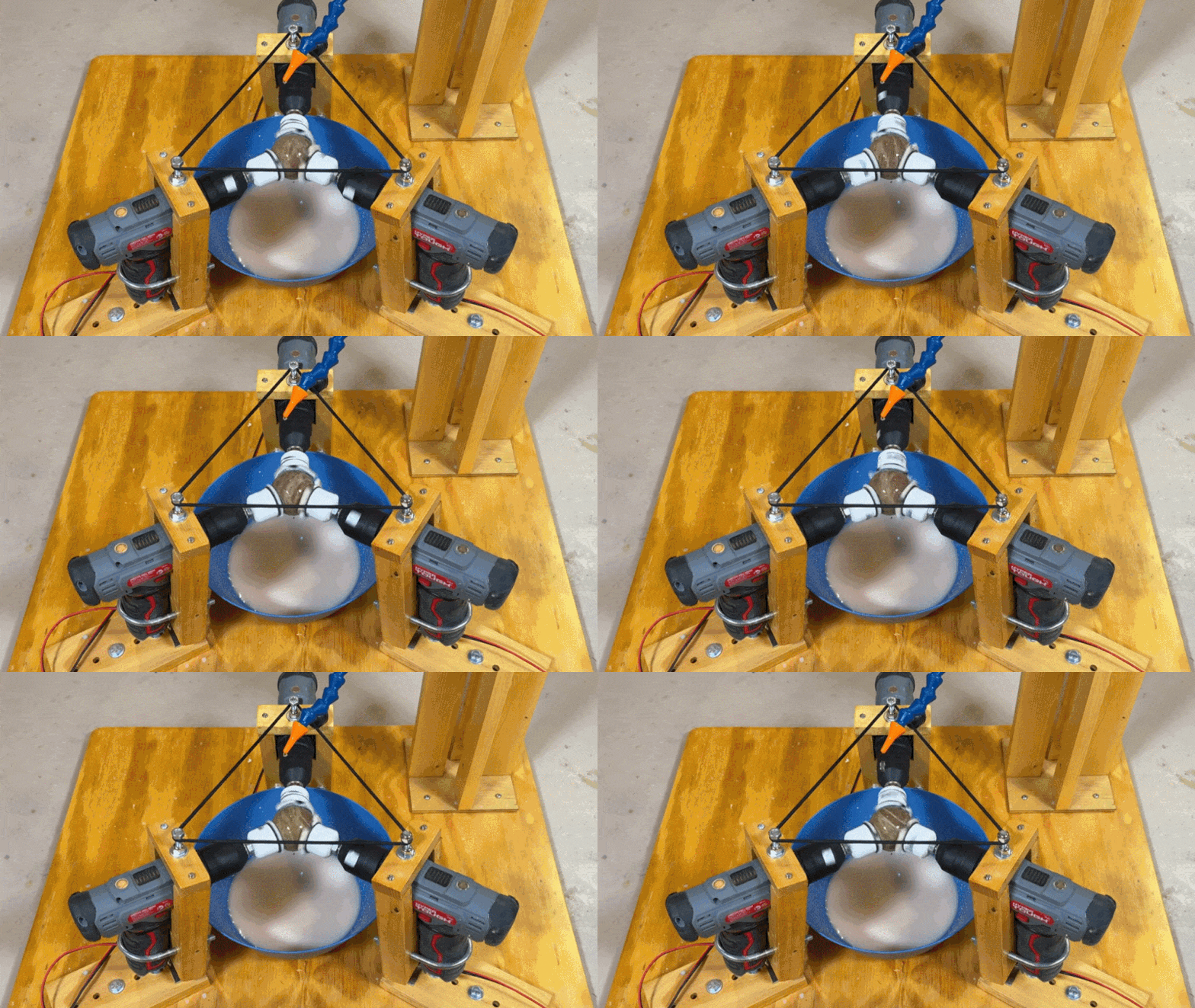
[Michigan Rocks] says he avoided making rock spheres for a long time on account of the time and cost he imagined was involved. Well, all that is in the past in light of the fabulous results from his self-built Rock Sphere Machine! Turns out that it’s neither costly to make such a machine, nor particularly time-consuming to create the spheres once things are dialed in. The video is a journey of the very first run of the machine, and it’s a great tour.
The basic concept — that of three cordless drills in tension — is adapted from existing designs, but the implementation is all his own. First a rough-cut rock is held between three diamond bits. The drills turn at 100 RPM while a simple water reservoir drips from above. After two hours, there’s a fair bit of slurry and the rock has definitely changed.
[Michigan Rocks] moves on to polishing, which uses the same setup but with progressively-finer grinding pads in place of the cutting bits. This part is also really clever, because the DIY polishing pads are great hacks in and of themselves. They’re made from little more than PVC pipe end caps with hex bolts as shafts. The end caps are filled with epoxy and topped with a slightly concave surface of hook-and-loop fastener. By doing this, he can cut up larger fuzzy-backed polishing pads and stick the pieces to his drill-mounted holders as needed, all the way down to 6000 grit. He shows everything about the pads at the 11:55 mark, and it’s an approach worth keeping in mind.
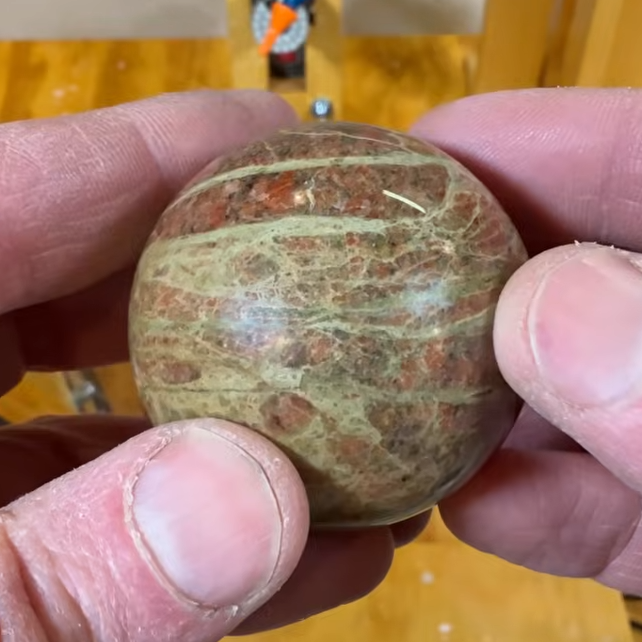
What is the end result like? See for yourself, but we think [Michigan Rocks] sums it up when he says “I wish you could feel this thing, it feels so smooth. It’s so satisfying to roll around in your hands. I’m so happy I made this machine. This is awesome.”
We’ve seen machines for making wooden spheres but this one makes fantastic use of repurposed stuff like inexpensive cordless drills, and the sort of wood structures anyone with access to hand tools can make.
Thanks to [AloofPenny] for the tip.












This is awesome
Totally. I never realized how badly I need rock spheres.
Pretty much covers exactly how i feel
About one too.
Excellent! After looking at sphere machines in lapidary catalogs for years and thinking “when I win the lottery” I gave up on the idea of making spheres. This is inspiring! Very nice project and I’m now going to go and look for parts to make my own.
I bought a used covington sphere machine with dies for 1 3/8 to 1/4 inch for $450 a few years back. I really love it, it works great. Only downside is that it cant do anything larger than the 1 3/8. So I can really only turn rocks into marbles. Id like to find a machine that can go up to 3, maybe 4 inches one day.
The setup shown in the video could easily be scaled to create 4″ spheres.
Eh kinda.
Ultimately youd be better off designing with the larger size in mind then just trying to scale this up. As you get larger there is a greater need for rigidity. Commercial sphere grinders of that size are considerably more robust than the little guy Im running now. Where mine weighs 26 pounds and runs Dual 1/21 HP motors. The next model up from mine does 1 1/4 to 9 inch and runs dual 1/3 HP motors and weights around 240 pounds.
Indeed. First limitations are the diameter of the core drills you can buy and motor power. Large diameter core drills also tend to be quite long though. For bigger diameters (> 100mm) I would probably make the lapping disks myself by modifying diamond grinding disks made for angle grinders.
For polishing, if you have a lathe then you can make lapping cups from aluminimum and embed them with various grids of diamond powder.
Custom pool balls
Hell yea that would be great.i would buy some for my table.
Core drilling bits
Thanks for the nice article, Donald. This was a really satisfying project. Anyone with moderate woodworking skills can do this. You’ll also need something to rough in the original rock. I used rock saws, but a tile saw will do the trick too.
Rob
Michigan Rocks
Amazed that I saw your vids on YT a couple of days ago, and now you’re on here. Points for you . You rock!🏆🎖
Core Drill bit
Balls
Catalonian style
For final polishing, pads from Got Grit https://www.gotgrit.com/ should be worth a try, as they are used by telescope makers. Sphere-making doesn’t require optical perfection, so ordinary red iron oxide pigment as the “abrasive” should be quite satisfactory. Cerium oxide would give faster results.
Admittedly my first thought was to make spherical glass lenses or maybe try to polish a piezoelectric crystal. I wonder about making aluminium oxide grit at home, no doubt the difficulty would be grading the particle size. I’m thinking settling it out in a column of water or with a centrifuge might be the way to go.
Small sieves down to 400 mesh are available on ebay (I avoid Amazon as much as is practical; ethics…). Search for “Set of 3 Kitchen Ultra-Fine Nylon 100/200/400 Mesh.” Stainless steel sieves are also available and aren’t terribly expensive.
For even smaller sizes, elutriation in water is quite practical; it was used over a century ago by Rev. William Ellison, amateur astronomer and author. “Amateur Telescope Making book 1” by Ingalls has Ellison’s details. However, I don’t think making aluminum oxide is practical. (Precipitate Al(OH)x, then high temps in a furnace, break up the fused mass, etc.) A pound of carefully-sized Al2O3 is only about $10.
𝘔𝘢𝘯𝘺 improvements possible. Like, using a cheap magnetic pin tumbler for the polishing stages instead of those crazy-complicated DIY polishing pads. Also, speed-regulated motors instead of the crappy drills, which will have zero consistency under load no matter how much he plays around with that tachometer. And finishing the wood before even trying the thing? Brave.
magnetic pin tumblers arent great for this application as many stones are too soft and rather than polishing will be eroded by their action. Even when the stone is hard enough to withstand their action, mag pin tumblers give a matte finish, not the desired glossy shine.
what would speed regulated motors achieve? I don’t see how the polishing would be better if the motors spun at a constant (or equal) rate. Making spheres is rather chaotic, it will not matter in the end for something like this. Maybe if you’re making lenses it would be important, but this is not the case.
I think you’re wrong on both of your quoted “improvements”.
Does anybody remember finding this machine in Gehn’s atelier in Riven the sequel to Myst
I’d half forgotten about that, it’s a good puzzle game.
Thanks for the insight! Sharing your thoughts and experience helped me to get started with my own project as I have been researching a setup and buying products to get started. My intentions are similar as I will be starting marble restoration as I am a collector. Stones as well is interesting. I’ll continue following for any updates. 12 volt system is what am also doing.
Riven’s wicked.
If you know someone who works in an industrial machine shop that has a CMM and can measure spheres, we’d love to see just how spherical this bad boy came out!
I suppose a micrometer would be a good first approximation, at least to know if it is oblong
Dude this is totally awesome I’m definitely gonna try this. Cheers to you mate for coming up with this idea.
Cordless drills are kind of a dumb choice.
They are optimized for low mass and low duty cycles.
You are literally paying extra for properties that are useless or make your project worse.
what would you use instead? just as inexpensively? dumb seems an odd choice of words (and needlessly unkind)
For a long-term setup, I’d agree. If you’re making rock balls as a full time career, you want something more sturdy.
But – as a hack? Proof of concept? It’s fine.
Very cool…i am impressed
This is great! Thanks!
Keep on doing what your doing the nay sayers say it doesent work or wasting your time,just remember we as not building a watch,it’s a rock.
Take some slightly bigger versions of this, cote them with a thin layer of clear high temperature silicon caulk. But the thin runny version. But leave a circular area uncoated with the silicon caulk on the bottom of the sphere. Let dry. Then place on the top of your wood stove on a small piece of fire brick. The sphere will soak up the heat, but the Silicon will slow down the heat coming out. Now you can hold this in your hand, and not get burned. It will act as a very good hand warmer. Not too hot, but just right. They will store about 1/2 hour of hand warming heat. You can put them in your pocket to keep warm as well. They are little heat batteries.
Clearance issues prevent me from using any larger diameter cutters than I have. My machine is tiny, tabletop sized.