
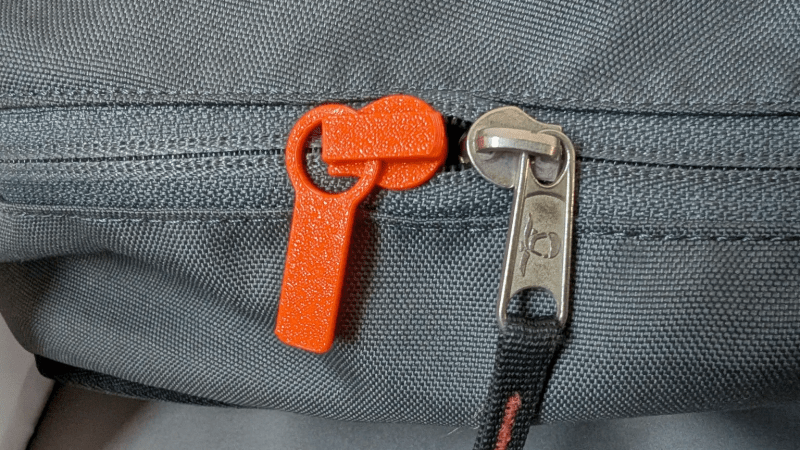
If a zipper breaks, a 3D printer might not be the first tool one reaches for — but it’s more feasible than one might think. [MisterJ]’s zipper slider replacement is the kind of 3D print that used to be the domain of well-tuned printers only, but most hobbyist printers should be able to handle it nowadays.
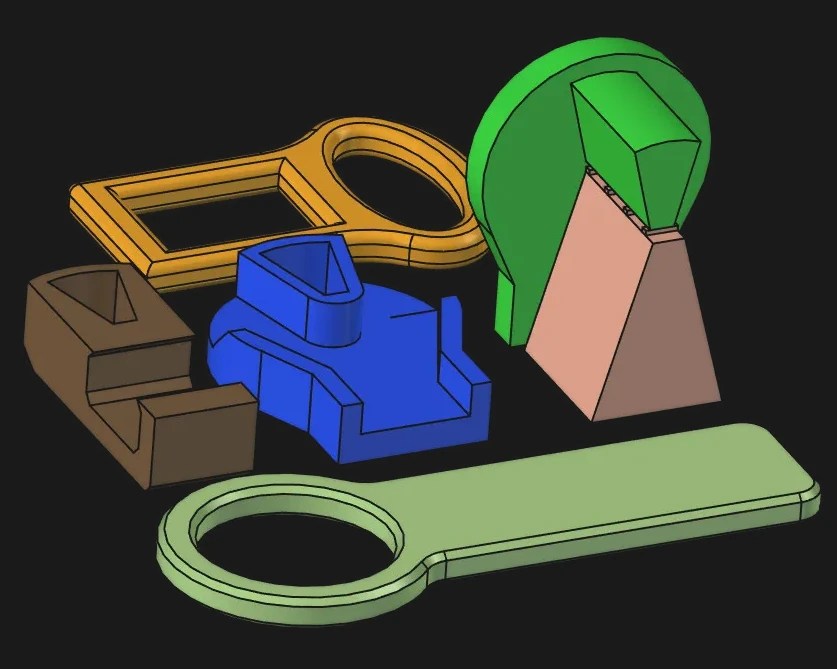
What really sets this design apart from other printed versions is its split construction. Putting a new slider onto a zipper usually requires one to free the ends of the zipper by unsewing them. [MisterJ]’s two-part design instead allows the slider to be assembled directly onto the zipper, without the hassle of unsewing and re-sewing anything. That’s a pretty significant improvement in accessibility.
Want to make some adjustments? Good news, because the files are in STEP format which any CAD program will readily understand. We remember when PrusaSlicer first gained native STEP support and we’re delighted that it’s now a common feature in 3D printer software.
[MisterJ]’s zipper slider design is available in a variety of common sizes, in both standard (zipper teeth face outward) and reverse (zipper teeth face inward) configurations. Naturally a metal slider is more durable than a plastic one, but being able to replace broken parts of a zipper with a 3D printer is a pretty handy thing. Speaking of which, you can also 3D print a zipper box replacement should the squarish bit on the bottom get somehow wrecked or lost.












Cool! Glad to know 3D printed zippers are a thing. I see a few videos on 3D printed zippers on youtube, one from 5 years ago, so I guess I’m just late to the party.
You can buy repair zippers which can open and close to go in without sewing. The ones I’ve found aren’t of high quality, though, and didn’t seem to come in the exact right size I needed.
before anyone gets their hopes up, can you print a zipper repair in parts like this? Yes absolutely, however I have had zero success with these lasting more than a few pulls. I have tried with the following filaments and none last.
PLA
PLA+CF
PETG
PETG+CF
ABS
ASA
PA6-CF
PA612-CF
Just do yourself a favor and get a good zipper repair kit from YKK or your favorite brand and be done with it. Those last.
Or change the complete zipper: when the cursor breaks, it’s always a no name crap, never a YKK/SBS brand, and teeth or insertion pin will soon fail too.
Learn to sew, it’s worth it and still a hack.
oh YKKs break too.
Some people can break almost ANYthing.
I hesitate to attempt to replace a four-foot-long zipper on a large duffle that carries a considerable amount of weight (eight mic stands, typically).
What I really need for that repair is a way to attach a new pull tab to a zipper where the hook that attached to broke off, leaving nothing to easily attach a replacement pull to. Could be as simple as something that somehow clamped to the existing zipper head to provide a place to attach a new pull. Without that, I’m not sure what would do the job and be durable enough.
An appropriately sized paperclip with a twist tie wrapped around it has lasted my stiff waterproof zipper on my winter coat all winter and shows no sign of breaking soon.
JB Weld?
It may not be necessary to actually replace the zip if it’s a purely practical application. Remove the old slider with pliers or whatever and sew the new zip direct to the old one…saves the grief of unpicking. Cut off the old teeth with a hot knife or soldering iron if you want…after the replacement is done. Not so pretty but elegant and practical; it can be done.
yeah that was my thought reading this…i would never do it because it’s not playing to the strengths of 3d printing, but rather to its weaknesses. i am impressed if someone got it to work but i’m also skeptical. especially as a two-part design!
i’m with Tweepy — i just replace the whole zipper. pulls do fail but usually by the time i’ve worn it out, but usually i kill the teeth. Even YKK zippers fail for me if they’re under-sized to the task, or used every day. If you don’t care how it looks, it’s not much work to replace a zipper, and you can use a bulkier zipper that lasts much longer. I default to YKK #10 for backpacks and YKK #8 for jacket zippers and i almost never have to replace the replacement. These things are designed to last 2-5 years but they’ll last decades with a beefy zipper!
A full pulls is honestly better than I’d have expected – I’d have thought maybe printing in a resin printer so its pretty much isotropic in material performance would get you something with that little bit of life in it, but even then unless you can also make it rather bulkier trying to replace a metal part with plastic it is just always going to be the point of failure again in short order.
the meditation on layer line strength continues to astound me. Zipper pulls have to be made out of metal. The layer lines are not the problem. You could use molded (one piece, no layers) PLA and it would still be unsatisfactory. You need a combination of rigidity, strength, hardness, and abrasion resistance which are each individually nearly impossible with common thermo plastics, let alone in combination. There’s a reason even cheap zipper pulls are made out of metal.
I agree an all plastic injection moulded zip (at least when designed as a replacement for the metal version rather than for the material) would be poor, but it would actually work a fair few times before the wear kills it. Where the 3d printed in the same material the layer lines being so so vastly weaker and it having such tiny surface areas between each layer actually having enough bonding for the zip to survive be pulled once without exploding along those seams is impressive – both suck, but at least one is realistically useable for a little while.
OTOH, it being a quick & inexpensive print makes it a decent temporary option if a repair kit isn’t available locally.
Unsewing isn’t a thing. The word you needed was unpick
You knew what he meant though, so the word served its purpose :^)
why don’t you go unpick yourself ?
IMHO, Story of YKK is quite a read how mad rush outsourcing eventually ended up awarding pretty much the only monopoly on earth, now rivaled by cheap makers in China, but still unquestioned/unchallenged monopoly.
Kinda similar how local textile making self-destroyed to the point where only few places on earth now can make profitable textiles (with slaaaave laabor no less, btw). Textile making used to be done near cloths making because one way or the other you NEED these as one uninterrupted process. Breaking them apart in order to make them cheaper actually adds to the costs, and what’s weird that such idiocy continues unabated up to this day.
Sorry, I get what you mean by hook now. If that par its gone, I got nothing.