
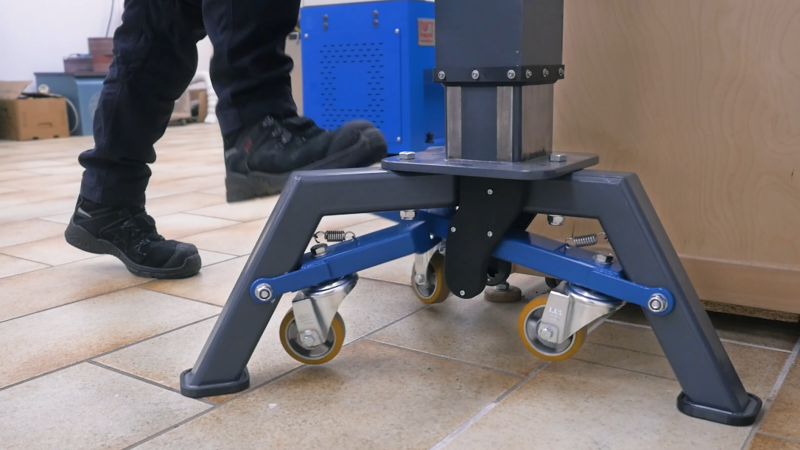
Old shop tools have a reputation for resilience and sturdiness, and though some of this is due to survivorship bias, some of it certainly comes down to an abundance of cast iron. The vise which [Marius Hornberger] recently restored is no exception, which made a good stand indispensable; it needed to be mobile for use throughout the shop, yet stay firmly in place under significant force. To do this, he built a stand with a pen-like locking mechanism to deploy and retract some caster wheels.
Most of the video goes over the construction of the rest of the stand, which is interesting in itself; the stand has an adjustable height, which required [Marius] to construct two interlocking center columns with a threaded adjustment mechanism. The three legs of the stand were welded out of square tubing, and the wheels are mounted on levers attached to the inside of the legs. One of the levers is longer and has a foot pedal that can be pressed down to extend all the casters and lock them in place. A second press on the pedal unlocks the levers, which are pulled up by springs. The locking mechanism is based on a cam that blocks or allows motion depending on its rotation; each press down rotates it a bit. This mechanism, like most parts of the stand, was laser-cut and laser-welded (if you want to skip ahead to its construction, it begins at about 29:00).
Unlike locking caster wheels, this provides significant grip when the wheels are retracted; considering the heft of the vise [Marius] restored, this must be helpful. If you’re more interested in building a vise than a stand, we’ve seen that too.
Thanks to [Keith Olson] for the tip!












That mechanism is awesome. I was skeptical at first, something about it looked shaky but it’s brilliant. Dang I wish he was my neighbor. He has all the tools I wish I had and don’t.
This is just stupid. I have never used a vise that I did not have to put huge amounts of lateral pressure on and I have honestly never seen anyone use one that as well did not have large amounts of lateral pressure (with the possible exception of a wood vise but that is not this) So yeah neat job, but worthless for almost all applications except youtube clickbait.
Yea 90% of us are not abusing our bench vices as half assed hydraulic presses. So therefore a tripod 3x the footprint and basically the same weight of the vice + the vice planted on the floor is pretty good enough
Agreed. I am not saying this is the same thing as a vice bolted to a concrete slab or something. But a lot of what I do with a vice is clamp something to sand, saw or drill it. I am not sledgehammering perpendicular to the axis it’s mounted on. My most widely used vice weighs about 10 pounds and isn’t fixed to any surface.
“90% of us are not abusing our bench vices as half assed hydraulic presses”
But the other 90% of us are.
It just looks too tippy for my tastes. When I saw the video, my first impression was that I wouldn’t use the design for a bench vise, but that it would work pretty well for me as a bench grinder or polisher stand. I rarely put as much force against a grinding wheel as I do my vise.
I can see it having some value as a vise stand for light duty purposes, but my bench vise is not stranger to big hammers and wrenches. That reminds me, I need to look for a bigger vise.
“this is stupid because I personally have never had this use case” ….. You should probably snip your comment and keep it handy if you are going to continue reading Hackaday :-)
Bennington already make the “Smart Caster”, which has the same pen-like click-in-click-out mechanism, but entirely self-contained within the caster body.
A very similar mechanism is in a lot of youtube video’s about movable workbenches. I really like the idea of making the wheels retractable (like airplane gear) instead of putting the whole thing on wheels and then attempting to block the wheels for when you want it to be stationary.
But for a vise… yes, this works quite good as long as you don’t need to put too much pressure on your work pieces, such as holding things while working with an angle grinder or welding. If you need more stability, then I thought of putting the vice on a big (double) sheet of plywood with a few claw nuts and bolts. It’s a bit more work to setup (but much easier to make) and when you are also standing on the sheet of plywood, then it won’t move when you’re putting pressure on the vise. The sheet can have some hinges so you can double or even quadruple it up when it’s not in use. Then put the vise in the center, so it holds the pieces flat.
Or you do something simple such as mounting the vise on a saw horse. This one from Marius is well designed and solid, but it’s not practical for many applications. It’s for example too heavy to move it to a (temporary) job site.
“But for a vise… yes, this works quite good as long as you don’t need to put too much pressure on your work pieces, such as holding things while working with an angle grinder or welding.”
So it works as designed, but doesn’t work for your needs. True of many many projects out there, but you got to have a read or watch the video and be interested, maybe stimulated some thoughts, and all for free! Everyone wins.
I wasn’t complaining, just sowing some seeds for alternatives. I’m fully aware that different people have different use cases.
I definitely wouldn’t use it for a vise either but can see it being used for many applications in a small shops where realestate is a premium and machines need to be corralled when not in use.
I mean, we are all grown ups and know this was just a commercial for the xtool fabricator. I would have enjoyed it more if there was more actual skill involved and a grumpy person doing it with simple tools in a dirty workshop.
The design which I presume was by the influencer seems nice at first but as others have pointed out lacks practical applications and durability. If he would have figured out a way to make the mechanism without a complicated cut out, I would have been impressed.
Also, all that and no adjustable feet?
I have a small work table from a family friend that came from McClellan Air Force Base in the ’50s. It has a similar mechanism that drops wheels out of the feet when you step on a lever that activates a scissor mechanism to drop them. I have always admired how genius it was and the fact that it is rock solid since it it so old.