
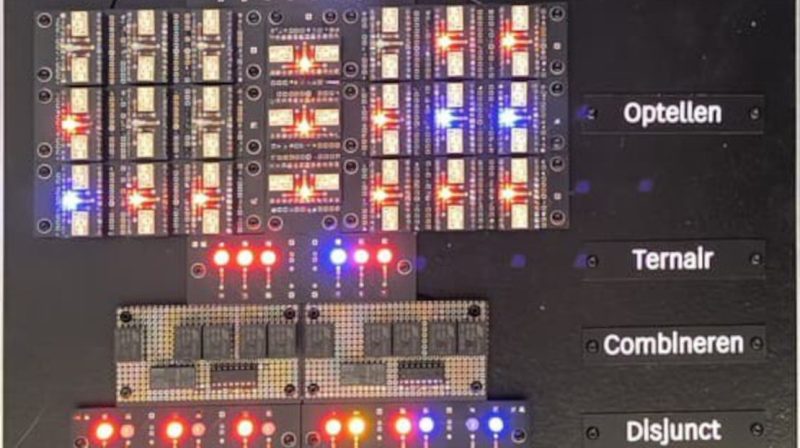
If you’re at all familiar with digital computing, you’ll know that computers represent everything in binary values of one and zero. Except that’s not technically the only way to do computing! You can use any numerical system you like if you build your hardware to suit, as [Jeroen Brinkman’s] ternary adder demonstrates.
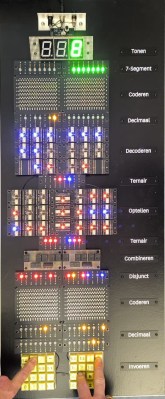
As you might guess from the prefix, “ternary” refers to a base-3 numerical system. In this case, [Jeroen] implemented a balanced ternary system, which effectively uses values of -, 0, and + instead of just 1 and 0. The adder is built using relay logic, and is designed to handle 4 trits—the ternary equivalent of bits, where each trit can have one of the three aforementioned states. On a hardware level, trit states are represented with voltages of -5, 0, or 5 V in this case, and are handled with special tri-state switching elements that [Jeroen] constructed out of simple SPDT relays.
[Jeroen]’s write-up does a great job of explaining both ternary basics as well as the functioning of the adder. It’s also quite intuitive because it’s possible to see the relays clicking away and the LEDs flashing on and off as the circuit does its work to add values stored in ternary format.
If you’re trying to get your head around ternary computing from the very lowest level, this project is a great place to start. We’ve seen base 3 hardware built before, too—like this simple ternary computer lashed together from accessible components.
If you’re cooking up your own computing apparatus that uses some weird number system or something, remember—we’d love to hear about it on the tipsline!












i was impressed until i got to the description of brinkmans ternary adder and saw an em dash and indications it was written by chat gpt. sighs. just stop guys ok, we don’t need ai filler material in our feed.
i sense you will be relegated to the heap like all the others who shook fist at cloud during “insert technological revolution here”. sad. but we still love you.
As a LaTeX user and fan of proper punctuation usage I am sorry for having provided the AI with the training material to know when to use a en- or em-dash instead of a hyphen. The world is bigger than ASCII-127 and minus-for-everything.
HackaDay produced utter crap like a ‘twine wrapped tire table’ before LLMs were stinking up the place.
I don’t think a LLM could do a worse job if you asked it to.
Train one on Hackaday (post cool old founder grouch) and see what it pukes out.
Look back at the oldest Hackaday posts. We’ve used em-dashes for a long, long time.
…said Artificial Intelligence Williams! 😂
Uhp, looks like proper punctuation in this comment. Obvious AI is obvious.