
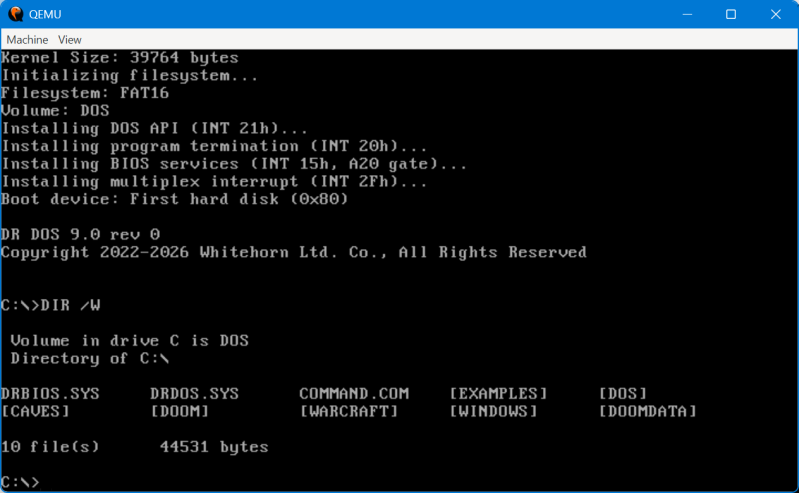
If you weren’t around for the early PC era, or were a little more casual about operating systems, you could perhaps be forgiven for not knowing that DOS is not synonymous with MS-DOS. MS-DOS was just Microsoft’s implementation — or rather, an implementation they purchased — of a Disk Operating System, one that was…let’s just say “inspired by” Digital Research’s CP/M.
Digital Research shot back with DR-DOS, an operating system that was both compatible with and much superior in some ways to MS-DOS. The last version was released in 1991, after Novell bought the struggling Digital Research. Now it’s back, or at least, it’s on its way back with a fully clean-room implementation by a fellow who calls himself [CheeseWeezel] on Reddit.
He’s gone so far as to purchase the trademark, so this re-creation is the official DR-DOS. In any case [CheeseWeezel]’s DR-DOS is considered version 9.0, and is currently in Beta. The clean-sheet re-implementation of DR-DOS’s API was sadly necessary due to the rather tortured history of the IP after DR was bought by Novel, who sold DR-DOS to Caldera, who briefly open-sourced the code before retracting the license and selling on. Some of you may remember a controversy where a previous rights holder, DR DOS INC, was found purloining FreeDOS code in violation of the GPL. Perhaps because of that, [CheeseWeezel] isn’t using any old code, and isn’t open-sourcing what he’s done. Right now, the beta of DR-DOS 9 is free for non-commercial use, but as is standard for EULAs, that could change at any time without warning. [CheeseWeezel] is still working full compatibility, but at this point it at least runs DOOM.
Still, given the origins of DOS in Digital Research’s early work on CP/M, it warms the heart to see what many of us thought of as the “true” DOS survive in some form in the 21st century. Arguably it already had, in the form of SvarDOS, but you can’t use that to make smug jokes about your operating system having PhD instead of a measly master’s. If you did not like DOS, we recall the joke from Mac users was that those were the degrees needed to operate the PC. Speaking of DOS, you don’t necessarily need a retrocomputer to run it.
Thanks to [OldDOSMan] for the tip!











To what end would someone need this, other than to relive the past.
offhand, I’d say keeping old industrial equipment running..
FreeDOS
Correct.
At this exact moment we have about 74 robotic systems running DOS 6.22.
For us, those machines are a mission-critical application, but it’s such a small niche, and they are so optimized for the application, that it makes no economic sense for anyone – even us – to spend a million dollars recreating the legacy app that had all the bugs wrung out of it 20 years ago to use a more modern OS.
Especially considering how absolutely robust an application in DOS can be. This is a real factor in an situation where the ‘blue screen of death’ could actually involve some real death should it happen at the wrong time.
but you do not need it, you have 6.22 and it is working, most likely you will need some capacitors and battery, not new implementation of a DOS:)
Some of us still have machines of that vintage in our personal museums… uhm, accumulated junk we can’t bear to get rid of… and newer support for their old apps is not a bad thing.
Besides, Hackaday is about celebrating the enthusiasts whether they’re doing anything actually useful or not….
Now I’m wondering whether this is a small enough system to happily port to an Arduino…
Um, not sure about an Arduino (Uno R3?) but an Raspberry Pi Pico 2040 might do.
The power is good enough to emulate a Z80 firmware of a TNC-2 (PicoTNC fork) and the hardware, at least.
That’s basically a CP/M capable single board computer in software.
A stock MS-DOS 2.11 might run with little RAM, too.
It did so way back in the 80s on an IBM PC with about 128 to 256KB of RAM.
But how about using the Arduino as a chipset only and using an 8088 clone? :D
It had been done before with a Propeller chip, I remember.
https://ve2cuy.wordpress.com/2011/01/31/mini-i86-dos-machine/
i don’t understand…i guess i must have been pirating and not known it? around 2001, i was using dr-dos as my default DOS using some distribution called ‘opendos’? caldera?? i really thought free dr-dos was old news.
Long story short, this is a new and improved DR-DOS.
https://www.dr-dos.com/documentation.html
I am also confused why anyone would bother to do this or want this, when FreeDOS is available.
I’m not sure if it’s still done, but there was a time that FreeDOS was used on USB sticks as a vehicle to re-flash the bios. And I think FreeDOS has both USB and network support, so it can probably be used for embedded systems.
Different DOSes have different strenghts, I guess.
FreeDOS is very clean and compatible, but not the fastest.
Also, once popular Novell DOS 7 was based on DR-DOS.
And Novell DOS 7 had lots of new features not found on MS-DOS.
It had DPMS, for example. Like PC-DOS had.
https://en.wikipedia.org/wiki/DOS_Protected_Mode_Services
Hi, before DR-DOS there was DOS Plus. The Amstrad PC-1512 and BBC Master 512 used it, for example.
To my understanding it was a special version of CP/M-86 that could read both CP/M and DOS filesystems
and run DOS 2.x applications via DOS API emulation (PC-MODE).
Except DOS device drivers due to lack of config.sys file, among other things. TSRs might have worked.
CP/M-86 applications ran on DOS Plus, too, making DOS Plus a migration platform of some sorts.
The PC-MODE part was used in some versions of Concurrent DOS, too, I think.
So there was a DR-DOS before DR-DOS, basically.
The real DR-DOS as we know it (DR-DOS 3.31 onwards?) wasn’t based on the older CP/M-86 platform anymore.
Well that’s just non-sense.
As someone who does a lot of opensource development. No. It’s not. It’s his choice. There are advantages and disadvantages to opensourcing something. And pretending there are no disadvantages and acting all superior and annoying isn’t helping anyone.
Now, it is a shame that this effort cannot be combined with the freedos effort. And that all this will be lost if it isn’t commercially viable. But it is still the choice of this creator. Likely because he wants to earn some money from it, which opensourcing can complicate. (Reason why aseprite went from open to closed source)
It is indeed his choice, and I don’t personally begrudge it to him– I just hope that if does prove commercially non-viable, he releases the source code before he gives up entirely. FreeDOS is great, but DR-DOS had some nice tools that might benefit that project.
That is his choice, but my interest is essentially nonexistent.
For me thats a code word for AI vibe coded these days. Tons of one man projects popping up recently that would normally take a team months to get going. Nothing wrong with AI per se, but pretending to be the author and hold actual copyright on something Claude generated is a riot.
Um, I can’t disagree. On other hand, writing a DOS from ground-up isn’t that complicated, either.
At least not that much that it can be considered unrealistic per se that a single person can do it.
Especially if it’s someone who has spent years working/tinkering with DOS.
There are many books covering the int21h API, there’s Ralf Brown’s Interrupt List..
Back in the 90s, there were a few small DOS compatible OSes used by boot managers, anti-virus boot disks etc.
There also were a few public domain DOSes, I vaguely remember. About half-finished and able to run COM files, at very least.
The commercial Wendin DOS was quickly made by a small team in the 80s and was multi-tasking/multi-user capable.
There’s an interesting story about it: https://tinyurl.com/3tt6czfu
Then there were DOS environments on Unix like OSes etc.
MS-DOS Player and DOSBox have DOS emulation, too.
“I am also confused why anyone would bother to do this or want this, when FreeDOS is available.”
Why not? I bet people are confused why I build an ’60s Star Trek computer as it is kind of ugly — but I like it :) and use it for more than just a dust collector. Or why did I write my own Basic interpreter for fun when there are quite a few out there already? Point is …. does there have to be a reason?????? Or why did Oscar design a PiDP-1 and why do people buy it???? Anyway….
Sounds like a nifty project. Keeping the old stuff alive — for the fun of it. I never did use DR-DOS as I recall. CP/M and DOS was what I used back then.
Technically Doctor, we all feed on the past.
This is not DR-DOS. Someone has bought the name cheaply and is using it to promote their own rewritten DOS project.
“I knew DR-DOS. I worked with DR-DOS. DR-DOS was a friend of mine. You, sir, are no DR-DOS.”
I was, to be blunt, confused, when they said 386+ required. That ain’t DR-DOS as I know it.
It would be interesting to see what they actually bought– if they have the rights to the actual DR-DOS products, there’s probably a line that can be drawn before the license fiascos on 8.x. They could offer the last “clean” 7.x release for 8086 users, or as a “composite” package to flesh out the new 9.x release with the extra missing utilities until they can be replaced.
I have an 80188-class project machine and run it on PC-DOS 2000 because FreeDOS is poorly optimized for <386 machines. A proper DR-DOS release would be a welcome alternative.
Do we even know if it works? How buggy is it? How compatible is it really? Was it vibe coded?
I’ll be more impressed when we know the answers to these sort of questions.
I second this. From what I can see so far, the author has some understanding of the inner workings of DOS.
The changelog is full of technical details..
https://www.dr-dos.com/releases/9.0/CHANGELOG.TXT
Free DOS exist. The world do not need another.
Hi! But if there are so many Linux distros and BSDs,
why shouldn’t there be multiple DOSes that are free and/or under active development? :)
How about PC-MOS/386 v5.01 or RxDOS v7.25?
I mean, there always had been many commercial DOSes. To give an idea:
MS-DOS, PC-DOS, Compaq DOS (OEM, 3.31 had FAT16B), DOS Plus, Wendin DOS, DR DOS (PalmDOS, Novell, Caldera, OpenDOS etc), DCP,
Concurrent DOS, Concurrent DOS-386 (incl. FlexOS, Real/32, Multiuser DOS), MOS, PC-MOS/386, Multitasking DOS v4 (proto OS/2), AlphaDOS, Sigma4DOS,
Paragon DOS, PTS DOS, DIP DOS, Datalight ROM-DOS, Embedded DOS, 86-DOS (QDOS) etc.
Here’s an article that covers the many versions of Concurrent DOS.
It’s history is about as complex as that of DR DOS line.
https://www.theregister.com/2022/08/04/the_many_derivatives_of_cpm/
And that’s not even all of it.
There were non-IBM compatible PCs that ran a copy of DOS (MS-DOS compatibles).
Such as PC-98 (NEC PC-9801/9821, Epson PC) or FM Towns.
Their DOSes varried from our western MS-DOS quite some bit, too.
There was a PC-98 version (fork?) of FreeDOS named “FreeDOS (98)” last being heard of in 2005.
In the early 80s we had MS-DOS compatibles, too, such as DEC Rainbow 100 or Zenith Z-100 that ran a custom DOS. Z-DOS, for example.
https://en.wikipedia.org/wiki/Z-DOS
It’s interesting that you so easily accept that CheeseWeezel made a legitimate cleanroom implementation, while casting scare-quotes at the notion that Tim Paterson did.