
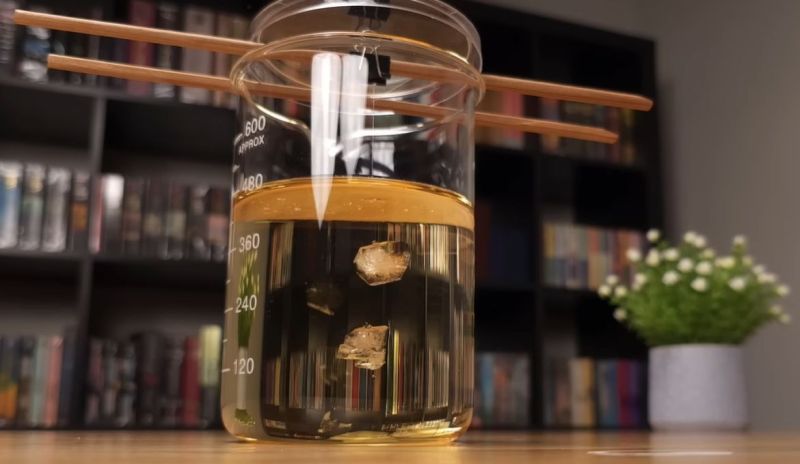
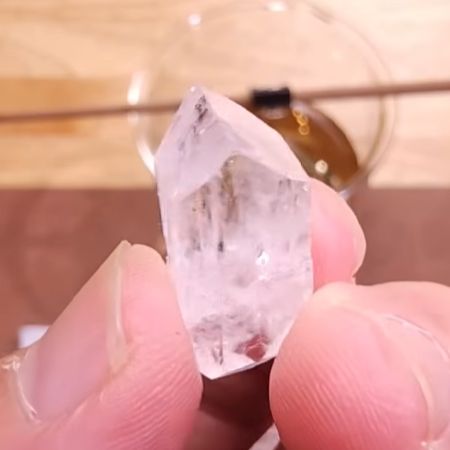
 Many substances display crystallization, allowing them to keep adding to a basic shape to reach pretty humongous proportions. Although we usually tend to think of pretty stones that get fashioned into jewelry or put up for display, sugar also crystallizes and thus you can create pretty large sugar crystals. How to do this is demonstrated by [Chase] of Crystalverse fame in a recent video.
This is effectively a follow-up to a 2022 blog article in which [Chase] showed a few ways to create pretty table sugar (sucrose) based crystals. In that article the growth of single sucrose crystals was attempted, but a few additional crystals got stuck to the main crystal so that it technically wasn’t a single crystal any more.
With this new method coarse sugar is used both for seed crystals as well as for creating the syrupy liquid from mixing 100 mL of water with 225 grams of sugar. Starting a single crystal is attempted by using thin fishing wire in a small vessel with the syrup and some seed crystals, hoping that a crystal will lodge to said fishing wire.
After a few attempts this works and from there the crystals can be suspended in the large jar with syrup to let them continue growing. It’s important to cover the jar during this period, as more crystals will form in the syrup over time, requiring occasional removal of these stray ones.
Naturally this process takes a while, with a solid week required to get a sizeable crystal as in the video. After this the crystal is effectively just a very large version of the sugar crystals in that 1 kg bag from the supermarket, ergo it will dissolve again just as easily. If you want a more durable crystal that’s equally easy to grow, you can toss some vinegar and scrap copper together to create very pretty, albeit toxic, copper(II) acetate crystals.












We did exactly this in junior school in the 1960s!
Sometimes we even went crazy and put food coloring in there.
Same, supersaturated solutions.
‘Make rock candy at home’ is still not the worst ArtsandCrafts a day article, maybe worst in the last week.
WOAT remains: ‘Wrap a junk tire in twine, attach plywood and call it a table’.
Also: ‘creator’ neglected to include his ‘surprise butt sex face’ on the thumbnail.
I wonder how much more this process can be optimized. Maybe a lot.
The National Ignition Facility (NIF), a US nuclear weapons research site, famously imported Russian know-how in the 90’s and improved the growth rate of their laser frequency multiplier crystals by a hundredfold. It turned a critical bottleneck into an key enabling technology.
They achieved growth rates of up to 50 mm per day, making single crystals 600 mm on a side, weighing 300-400 kg. They made over 100 tons of crystals for the project — this in addition to the 120+ tons of laser amplifier glass itself.
You may recognize the NIF from their recent press releases announcing net positive energy in inertial confinement fusion. (The paranoid skeptics might call this a cover story, except the announcements actually do come out of the Weapon Physics Program office.)
mmm copper(II) acetate, my favorite! Just like mamma used to make.
In northern Germany, tea is drunk in prodigious quantities and it is sweetened with Kluntje, which is rock sugar, and often looks like it is large individual crystals, although I’m not sure if this is true. It can be bought in bags there.
You are correct, Kluntje (as well as Kandis) is usually one large sugar crystal, grown over several days. I never thought about how those are made, but a quick online search suggests very similar to what the article describes.
I did this as a child to make “rock candy”.
I mean, yes? this is how they are made for centuries already. We know this as “Kandis-Zucker” in the german parts.