
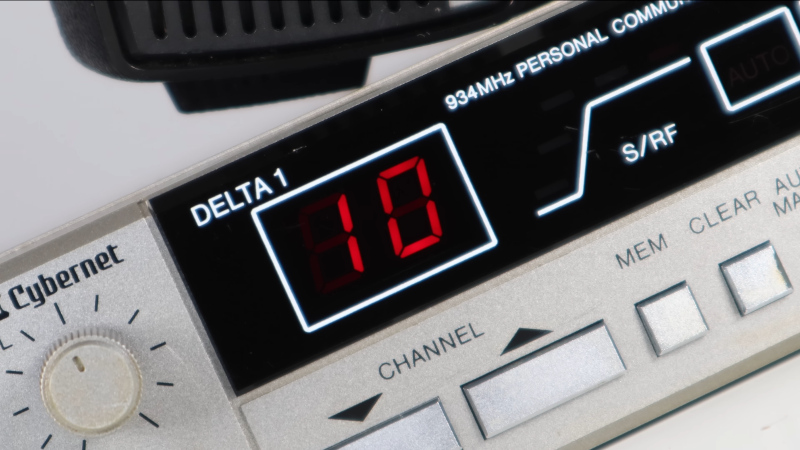
In the mid 1970s there were a spate of movies depicting the romance and lifestyle of truck drivers in the southern half of the United States. Over on the other side of the Atlantic these were naturally received not as works of drama but as documentaries, and thus began a craze for British drivers to do up their Ford Capri so in the right light and with your eyes nearly closed, it almost looked like Burt Reynolds’ Pontiac Trans Am from Smokey and the Bandit.
Such a fine automobile was of course incomplete without a CB radio, highly illegal at the time, which led to an underground CB craze and its eventual legalization in 1981. [Ringway Manchester] is here with a tale from that era, of 934 MHz CB, an odd and underused allocation that was eventually phased out for commercial services.
When UK CB was eventually legalized by the government, it was very obvious that they really didn’t want to. Brits got 27 MHz as FM only with meager power and a weird set of frequencies that nobody else had, and a second band way up in the UHF range, at 934 MHz. We remember they originally tried to make a UHF band the only allocation on purpose because it was nearly useless for mobile operation, and Brits only got 27 MHz by fighting back in the political lobbying space.
The video below tells the story of the band, with relatively scarce and expensive equipment leading to it being an exclusive band more similar to the amateur bands, with little resemblance to its raucous 27 MHz counterpart. How much activity there was depended very much on where in the country you were, which of course wasn’t where your Hackaday scribe was as a teenager even if it had been affordable. Eventually the government saw the little flashing pound signs and grabbed it back for a mobile radio service that never materialized, and now the frequencies are part of the mobile phone spectrum.
Have a watch for an odd bit of UK radio nostalgia and some 2020s illegal CB’ers, and if you want more it’s a subject we’ve touched on before.












Probably the non-standard frequencies were chosen to make it incompatible with USA equipment, to reduce the risk of higher power equipment being imported and used in the UK.
Or possibly because 27Mhz was also used for RC toys, bet that created some fun interference. I don’t remember knowing you could do CB on the band, but I’m pretty sure that was what my RC car used. Then again it was a long time ago and I was just a kid so I may have remembered the frequency wrong.
Nope, you’re right. 27MHz and 49MHz were popular for early radio control toys. (Source: I sold ’em, at a Radio Shack =))
Fun story:
Back in the 1980s (can’t remember the specific year, maybe 1986), I got a wired remote controlled car, and my brother got a radio remote car. Mine had the full left/right/forward/back while the RC was a very simple one button “push forward, push again for backwards with right turn”.
Turns out, the motors in my wired remote car put out so much RF hash that it had the effect of as if the button was being pressed on the RC car’s remote. My brother was absolutely furious.
I guess the RC used a really simple circuit that only detected whether a signal was being broadcast on the frequency the car was set for as a controller and that’s how I gained control of his car.
I remember being able to interfere with (but not control/i> ) cheap RC cars with cheap walkie talkies in Australia back in the day.
That changed 2006 and 2014 https://www.ofcom.org.uk/siteassets/resources/documents/spectrum/interface-requirements/ir_2027.2.pdf?v=335215
” that nobody else had” Except for radio control model flyers who’s hobby was disrupted badly. We had to move to 35MHz at some expense.
27 Mhz was Never a sane or safe place for RC Planes to be so much crap o there from IMSI PAGERS Plus so much more 35Mhz was a very sane move
Someone please explain what’s the point of any of this ? (CB’s, ham radio, etc) – monitoring “the bands” – all one hears is moronic conversations about one’s gall bladders, the annoying next door neighbor, what someone had for a meal …. At least if one goes into a pub , you have a slim chance of bringing home another adult for an evening of physical sensations… so the ridiculous babble has a point, an end game…. on the radio waves, babbling about esoteric rubbish – what’s the reward ? (now, this excludes the true geeks who design/build from the ground up, and are barely socially conversational – transmitting just to verify what they built works – their reward being the satisfaction of having constructed their contraption).
CB was developed to allow commercial drivers the ability to exchange traffic and weather information. GMRS and FRS function for tactical communication i.e. wherever you need to talk to a group too spread out for verbal communication to work. Off road drivers use this as well as airsoft players and sometimes hunters and fishermen. Motorcycle riders tend more towards bluetooth though. Ham is oriented far more towards the contraption building, but hams provide communication for many events. I have personally the worked the Iditarod, loads of fun that. Hams also provide an essential alternative communication system during disasters and weather events. Much of the ridiculous babble you hear is actually people learning how to listen and be heard over the radio, a skill that is much underappreaciated. Finally, and I admit the sample size is small here, I have managed to arrange for an evening of physical sensations with another adult over the 2 meter band.
In the States, 19 is the trucker band, 9 is the emergency band, and I remember the printed manual for my handheld saying “Do not use the word mayday at any time unless you are in an actual emergency”.
These days, it seems to be a complete wild west with people using 1,000 watt boosters and I really shouldn’t be able to hear “Hello from Arkansas” when I am in California. I guess the FCC just doesn’t care these days.
“band” – channel
The FCC pretty much stopped doing anything about the 11 meter band decades ago because congress wouldn’t provide the funding they needed to enforce the rules.
CH6 is useful as a beacon though. If you can hear activity there, then 10 and 12 meters are probably open too.
Obviously someone who grew up with internet and cellphones.
So.. it’s no different from the internet? ;)
Seriously, though, it’s all relative.
Back in late 20th century, CB was like social media on the airwaves.
There were all sorts of people, including those you mentioned.
It also was an alternative to a car phone to some. But that’s just half the story, really.
You also have (had) operators into DXing (contacting far stations), Packet Radio or SSTV (here in Germany from 1994 onwards).
Some use(d) parrots and repeaters, too.
Then there’s amateur radio, which is a different kind of beast.
It’s experimental by nature, so there are many different modes of operation.
Talking via FM repeater and telegraphy/SSB on shortwave is the most commonly known activity, of course.
But there’s more. Such as working various satellites (FM birds, SSB linear transponders, geostationary sats such as QO-100), microwave links and communication via lasers.
Of course, people think of the pensioners on 80m shortwave band first..
They’re not all there is, gratefully. There’s much more, though it’s not mainstream.
For example, ATV (amateur TV), DATV (digital ATV), SSTV, WSPR, PSK31, old RTTY etc.
Schools talk to astronauts on ISS multiple times a year.
The ISS sometimes sends pictures via SSTV, too. There are videos on YT.
Then there are distant stations such as Von Neumayer Station III in the antartic which use amateur radio.
They sometimes also send via QO-100 satellite using the wideband transponder (to transmit hi-res video via DATV).
Really, there are many things possible via amateur radio.
Here in Europe, there’s HAMnet, for example.
An internet (big intranet) running via WiFi links.
At the moment, there are efforts to get young people into the ham hobby/service.
Here in Germany, the N class license was recently introduced.
It’s a novice license like the US American Technician license, albeit more ambitious with more bands.
The reason why someone has interests in ham radio is very personal.
Some like wireless technology, some communications or languages, some electronics,
some are into PCs and networks, some like hiking or traveling..
Amateur radio has operstors coming from all sorts of fields.
There are radio amateurs on sailboats, too, which use Winlink/Airmail to send/receive e-mails on the oceans.
Back in the mid-20th cdntury, R/C fans used amateur radio, too.
“It also was an alternative to a car phone to some. ”
Car phones were literally “fit for a king” back then. Most other people could only afford CB or ham radio.
I know. I was thinking more about car phone style CB radios here,
such as the Stabo XM-3000, DNT C-Phone, Team TS-Phone or Conrad C-Phone. 😅
https://www.museo-cb.com/emisora/stabo-xm-3000/
https://barrynoa.blogspot.com/2012/11/altes-das-c-phone-von-conrad.html
https://www.youtube.com/watch?v=c0ni6S4syPE
I remember our local veterinarians had a mobile phone. Just one, which was used by whichever vet was on-call, and which was the size of a briefcase, weighed as much as a car battery, and only really had reception in a few places around our hilly area.
Instead, all the vets had a CB radio in their car, which had approximately the same reception, with the bonus that some local farmers also used CB to stay in contact across their farms.
(This was in the UK in the mid 1980’s)
Sounds like a legit Briefcase phone. I only learned about those recently from CelGenStudios video:
Dictograph Century II – A Real Briefcase Telephone! https://www.youtube.com/watch?v=HBiu2N9doVA
Glad to hear someone who actually knows somthing big wave from 724 central illinois land of lincoln cb kady 8833 skip land were 10-10
Frankly, CB in the 70S was just a lust fest. It was literally full of people who thrived on the hookups. Don’t ask! Let’s just say the grin is wide as I type this…
For my sins, I was ‘Electric Wizard’ with my Midland rig & K40 mag mount antenna on my teal blue MGB. Of course I modified my rig giving it twice the legal power. I once sat at the top of a hill in Surrey & chatted complete nonsense to some anonymous American in Texas using SSB at around 02:00 when the atmospheric were good.
I really take for granted my very wide privileges for ham radio. There are enough bands and modes to keep me busy experimenting till I die, and even then I won’t get around to a tenth of it.
Thank for the article- I am happy to pay some dues to the relevant organizations (ARRL, local clubs etc) to help keep access to all these bands despite the constant attempts to claw them back for commercial use.
–73
Then get into meshtastic. Help your euro friends by buying them some lora
Check first to see what is in common use in your area meshtastic or meshcore
Around here we have an FM public radio station that uses that frequency – or one close to it – for a transport link to a repeater in the western part of the state over the mountains. I heard it one night on the SDR and contacted the station to inquire as to why I was hearing their broadcast far from their assigned frequency. Their engineer sent me an email kindly, enthusiastically, and very thoroughly explaining what was going on. I just happened to be situated on the beam line between their source transmitter and the transport repeater on the mountain.
We had those where I live, when I was a kid. FCC title 47, chapter I, subchapter C, part 74.502 (b) gives a nice easy to google list of the 944 MHz to 952 MHz band. The FCC hasn’t issued new licenses for links in that band since 1984 LOL but I guarantee there were grandfathered transmitters running until at least Y2K. Technically you could stack channels and uplink a full FM channel but in practice people used plain old narrow band FM (like a regular analog scanner could receive, if you had coverage around 950 MHz). Needless to say a lost service they just use the internet to uplink now.
There are a couple of AM stations near me that still use links around 450 MHz. I can listen to them with a ham radio, but they use the old 15 KHz deviation wideband FM so the audio is distorted. They sound great with an SDR though.
In the 60s we had a transceivers, one in the restaurant, one in my Dad’s truck. KKD6728 was the license. A neighbor on the lake had one in his boat I still remember it, KBI6015 (Lysiak family – Hi!)
Years later I put one in my customized van, used it occasionally on trips. Unlicensed (nobody cared in the mid 70s)
Yah, it’s pretty common to have the studio in one place, the transmitter in another and a 900 MHz link in between. At least it was 30 years ago when I worked at such a station. I heard after I left that the link was upgraded to digital with encryption. Probably a good idea, it always surprised me that pirates didn’t try to override the old analog one! I happened to live in the path of the link too although the bigger effect came from being so close to the transmitter. It was “free hold music” on our landline.
Correlation does not imply causation. We hope :)
today everyone can send data trought CB radio using reticulum
Back in the 80’s, the US had/has? four or five CB tone control channels mixed in between standard voice channels. Some xcvrs could jumper these, so that packet modems could mike-up and run 1200 baud ASCII for a mile or two, with good antenna protocol. Best results required backing off modulation to approximately 50% (in some units) to linearize the signal tones, and of course, killing the AF compression which most CB sets wisely incorporated for obvious reasons. 10-4?
Hey, my first car was a Ford Capri… It was awesome! No CB radio though. It had an 8-track in the glovebox though, and that was good enough for my high school self :)
I didn’t get a car until I started college. It was $100 (because it wouldn’t start, but was an easy fix)….. wait for it … Pea Green Ford Pinto Station Wagon. Got me through college. It had a missing tooth on the starter ring too. Therefore always had a wrench in car, to move the crank past the missing tooth if motor happened to stop at that particular spot…. Those were the days…. No CB. But my dad got one for his car in the 70s. Nice to converse when traveling together, or see if someone was on the air when passing thru an area. 10-4 over and out.
LOL. No matter how hard you squint the Ford Capri would never resemble a Trans-Am.
Thank Dog for that. There are very few cars uglier than a Trans-Am with a screaming chicken on the hood.
#
(Flashing pound signs)
There is a reason diesel engines are frowned up for aviation….an odd side effect:
Pilot:
“Breaker one-nine…this is concrete gladiator,”
ATC:
“What?”
Why would anyone in UK need CB radio? Other than as a fun distraction from the political turmoil caused by Maggie T.
I mean, the place is a small island in the North Atlantic. Can’t you just yell to your neighbors if you really had to get a message to someone. Or just walk a few hours at worse and you’d bump into someone, somewhere. 😉
In part of the US you could drive for literally hours, or even days, at highway speeds (100+km) without finding another person or even a telephone (Montana, Nevada, Arizona, Utah, New Mexico are incredibly empty, especially in the 70s) so it made a little more sense.
Have still got the 1st CB I ever used, an Amstrad 901 – borrowed it from an uncle in the ’80s and when talking with him about it years later, he said he still had it boxed & gifted it to me!
UKFM CB can be pretty good in the right conditions. I managed a qso from a hilltop near Manchester to someone on Tenerife years ago when the sunspots were doing their thing. That was with 4watts, a coaxial half wave vertical & alarm battery.
27MHz was heavily used by people building radio-controlled planes, it was not just a “toy thing”.
Those people were, by any standard, “hackers and tinkerers” of the sort that Hackaday purports to support. In addition RC aircraft, albeit with petrol engines and /long/ before they could carry a live-vision camera, with the ancestors of modern drones.
As such, I think that the author of this piece could be a bit more balanced: particularly when standing up for drone operators after the fiascos at Gatwick and elsewhere.