
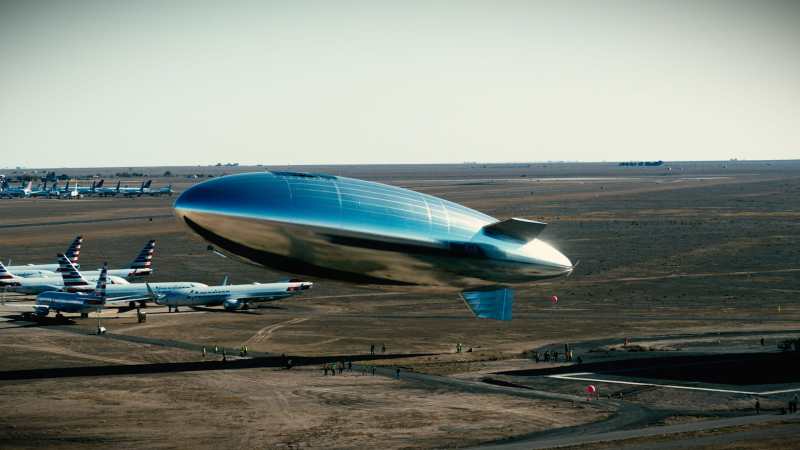
When the inevitable Kessler Syndrome cascade sweeps Starlink and its competitors from Low Earth Orbit in what will doubtless be a spectacular meteor shower of debris, the people behind Sceye and its competitors are going to be laughing to the bank. That’s because they’re putting their connectivity rather lower than orbit — in the stratosphere, with high-altitude dirigibles.
The advantages are pretty obvious: for one, the dirigible isn’t disposable in the way the very-low-orbit satellites Starlink and its planned imitators use. For another, the time-of-flight for a signal to get to a dirigible 20 km up is less than a tenth of the time it takes to get 480 km up — and that affects latency. Thirdly, the High Altitude Platform System (HAPS) concept won’t require any special transmitters. Regular cellular modems using ordinary 4G and 5G bands and speeds are usable, which eliminates a big barrier to rollout.
If this all sounds a bit familiar, and even dated, perhaps that’s because it is — Google tried to beam internet down from the stratosphere with its Loon project, before shutting it down in 2021. One of Loon’s major shortcomings was reliance on the shifting winds of the upper atmosphere, something the new generation of dirigible stations won’t have to worry about.
Of course, until the positive feedback loop of satellite collisions creating debris that begets yet more collisions that we call a Kessler Syndrome — which we’ve written about in arcade form, oddly enough–one could also use these HAPS stations as a bridge between space-based and ground-based networks.












Airships deserve a comeback because:
1.) They don’t re-enter after being a nightmare for astronomers like mega-constellations.
2.) If a terrorist does try to ram it into a building like we saw a quarter of a century ago with twinjet WMDs—-you don’t have 9/11, just a recreation of Christo’s art
https://christojeanneclaude.net/artworks/surrounded-islands/
I expected the wrapped Reichstag when you named Christo…
https://duckduckgo.com/?t=ftsa&q=Wrapped+Reichstag&ia=images&iax=images
I agree. They’re the lowest power way to be in the skies and stay in the skies. Ignored for years because of a silly disaster back in the day when people still argued if bloodletting was a viable cure or not, and cough syrup had hard drugs in them. Well not exactly but you get my point
I would go as far as to say hydrogen isn’t the worst option for this, considering we have hydrogen cars now with hydrogen “gas” stations to refuel them. If a hydrogen based cars can store and combust hydrogen safely, why can’t we make large balloons that are up tens of kilometers in the sky where they can safely destroy themselves in case of a catastrophic failure without much collateral damage.
Green, even blue hydrogen is cheaper than ever. We have no batteries to store the extra power
I don’t even have problems with hydrogen balloons. I could make my own with a battery as a kid anyway. Helium needs to stay in MRIs
Didn’t they had to scrub a launch several times due to hydrogen leaks? That stuff is hard to contain and a static spark can set it off.
A small solid canister in a car is also quite different from a giant thin balloon in the volatile atmosphere filled with electric charge.
In other news: Boeing and SpaceX are eager to build them together it’s rumored, they predict a giant boom.
Better than Musk’s starlink, and much more cost effective too, and they can have extra blimps on standby so when they need to bring one down for maintenance or refurbish work they can send one up as quickly as they bring one down so downtime is not an issue
I hope Elon Musk is green with envy
Blimps, to my knowledge, don’t take well to high altitude winds, how would they manage?
From a quick search: Goodyear speed 70mph, winds 110mph.
Wouldn’t they just drift away?
At an altitude of 20 km (about 65,000 ft) in the lower stratosphere, wind speeds are typically low and relatively steady, often serving as a minimum wind zone ideal for high-altitude platforms. An altitude around 20 km is often favored by airships and balloons because it sits above the jet stream and below the stronger, higher-altitude winds.
If you think Kessler Syndrome is an issue with Starlink or anything else at that orbital altitude, it’s probably worth picking up a book or two.
As for disposability, helium is a finite resource and will find a way out through even a metallised envelope. Equally bad for its sustainability credentials is the material of said envelope; due to the low temperatures at altitude and the jet stream, the range of suitable materials quickly narrows and Sceye seems to be using Zylon for their envelopes. This was notorious as an aramid replacement in ballistic armour with at least one individual losing their lives to premature degradation of the fibre. Worse still, it’s particularly UV and moisture sensitive so I can’t see a Zylon envelope embarrassing a Starlink satellite in terms of lifespan.
In regards to dependency on Starlink, GPS etc. in eg. Putin’s war against Ukraine I recently thought about if it were possible/feasible/practical (as a state) to have a bunch of https://en.wikipedia.org/wiki/High-altitude_platform_station on hand that can do localized GPS and high speed battlefield communication on demand.
Basically a temporary “Starlink” independent of any outside interference.
Probably not because even at 40-50km height they would be shot down and other reasons…