
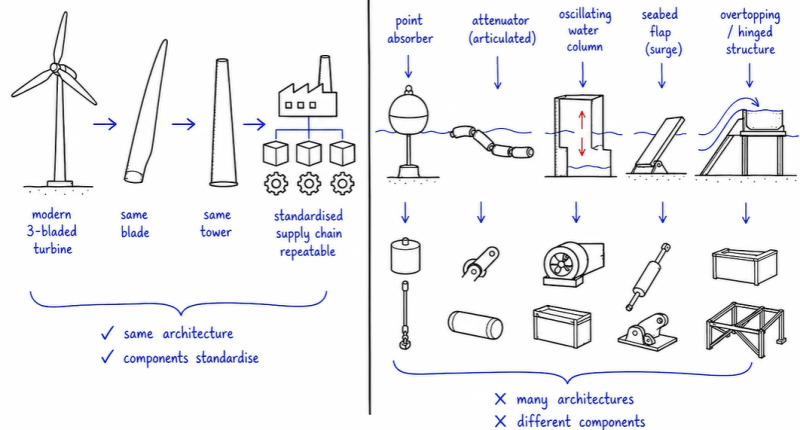
With the Earth’s atmosphere being effectively just a less dense fluid than the oceans around us, it’s reasonable to ask why we got wind turbines and wind mills quite literally everywhere across the globe to harvest the power in the wind, whereas ocean waves and currents aren’t being exploited quite as much. In a recent video by [Giordano Scarciotti] this issue with wave power is addressed, in particular the massive engineering challenges involved.
One of the main problems is simply one of cost, with wind energy having converged on a single design involving effectively the same three-bladed rotor, gondola and tower design that has been optimized for decades now. For wave energy there’s no such one-design-fits-all solution, with each attempted design having its own advantages and disadvantages that may prevent it from working in various sites, or incur high maintenance costs in the highly abusive marine environment.
Having more energy in waves than in wind is also both a benefit and a curse, as wave turbines have to work with the waves and not get demolished every time there’s a storm. Even wind turbines regularly fail in windy weather when e.g. the brakes fail, under conditions that would be considered mild in a marine context.
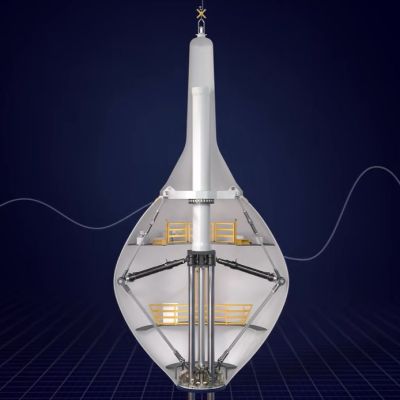
Also covered in the video is a new contender, in the form of CorPower Ocean’s new buoy-like design that bobs up and down on the surface. Here you need to carefully tune the turbine mechanism to work with the wave motion to extract the most energy. Their current design is be 19 meters tall, 9 meters wide and claimed to be capable of being installed in >40 meter deep water, producing power with a 40-60% capacity factor at 300 kW.
As yet another attempt at making wave energy turbines work, the most exciting aspect of it will be to see whether it can survive adverse weather, when careful tuning gets tossed out of the window and chaotic waves pummel what is essentially a very big hollow buoy. The single prototype has so far survived bad weather off the coast of Portugal during a year of testing, but the real test is long-term survival, as losing half your wave turbine farm to a really bad storm every five-odd years would quickly scuttle the project like it has previous commercial contenders.
Although not addressed in the video, the commercial challenge here is also not so much making the power generated over its lifetime (LCoE) economically attractive, but also its system integration cost in terms of required transmission lines, grid-level energy storage and backup power generators like baseload and standby power plants. Without equipping these wave power farms with grid-forming converters as TSOs are asking, dealing with reactive power to absorb and generate it, any resulting grid oscillations exacerbated by grid-following converters risk causing another expensive blackout as recently on the Iberian peninsula.












I remember seeing illustrations of schemes for accomplishing this in books in the 1970s, all kinds of fanciful notions. Building stuff that sits in the ocean long-term is very challenging, especially if you don’t have a sailor with a mop and a paintbrush on board to go around every day looking for little bits of damage or corrosion. Perhaps we could invent some kind of robo-swabbie…
Only if it’s made by ayerobot
Wave energy – aside from tidal power – is indirect wind power with conversion losses. The only advantage is a larger “collection area”, offset by the much greater difficulty of capturing the resulting waves at all.
In terms of unit size, if the largest of the wave power generator is 0.3 MW, the top of the line wind turbines are 25 MW. The technology potential for wave energy is basically stuck in the 1980’s in comparison to wind power. In the end, it’s not even a question of technology so much as location: off-shore wind turbines get the same 40-60% capacity factor where there’s steady winds. If the wave generators are put in the same locations, they could generate an additional 1-5% more power.
It’s an interesting technological challenge, but the potential for actual energy production is negligible. It’s more of a subsidy mill for research and development than anything you could take seriously so far.
Everything is indirect solar power with conversion losses actually. Even stuff like nuclear is just solar power from a star that died an unimaginably long time ago
Why stop there? Everything is just recycled Big Bang?
God coulda done it with a 555
Yeah indeed, my point is that it’s kind of reductive to say “x power source is actually just y”
Well, what more is it?
It’s the same wind that turns the off-shore turbine that is making the waves in any given location.
You are just wrong in so many ways.
1. Tidal power is actually harvesting gravity, not solar.
2. Solar power is specifically energy generated from the conversion of sunlight.
3. Nuclear is not solar power because the isotopes harvested are not from our sun Sol, they are artifacts of other ancient celestial bodies.
Yup, but this is wave, not tidal. Different thing.
The minimum spacing of the 0.3MW Corpower buoy is 150m so the output is 13W/sqm. The minimum spacing of a 25MW wind turbine is in excess of 2000m, so the output is 6W/sqm, so the addition of Corpower buoys to a windfarm would increase the yield by 200%, not 5% as you claim.
It doesn’t work like that. Adding more generators in the same area does not increase your overall power output linearly. One row of wave generators “shades” the rows behind it, the same as how putting one wind turbine in front of another will sap power from the one behind. The actual minimum spacing depends on how much power you have available, not how close you can technically place the generators.
The actual power density for wind is around 1 W per square meter on average on the large scale. That means a 25 MW turbine needs 25 square kilometers of space around it, or about 5-6km from turbine to turbine depending on how you pattern them. Some places need more, some places need less.
The trick is, the waves are driven by the same wind that’s coming in towards your off-shore wind farm. When the waves start rising, the surface roughness gives rise to a boundary layer effect that drags the wind and causes it to lift higher up in the atmosphere, so the wind is not coupled into wave energy all that efficiently – a lesser portion of the energy in the wind is converted into waves while most of it remains as wind. That means the power arriving towards and available to your wave generators is much less than the power available for the tall multi-megawatt wind turbines in the same area.
If you put one CorPower buoy directly behind another and only a few metres behind then it is true that the one in front would shade the one behind, just like wind turbines do. But if you seperate the buoys by 150m the effect is negligable because of difraction and mixing, just as it is when you seperate wind turbines by large distances.
The waves arriving at a buoy may have originated by wind exciting the water surface hundreds of km away so power is accumulated over a very large fetch. As I demonstrated previously, the power density available to a wave energy farm is higher than the power density available to a wind farm.
I got the 150m minimum buoy seperation from the CorPower website. When you consider the buoy is 9m in diameter It seems reasonable, just as a 2km seperation seems reasonable for a 300m wind turbine. If you wish to dispute my calculations please provide an alternative minimum seperation with a source.
I’m not disputing that. But there are tradeffs in the opposite direction too, which have only recently been investigated in the offshore wind turbine business by Tetraspar, namely industrialization and mass production. On this subject I trust Heinrick Siesdal, holder of 600 patents in windpower, more than I trust “Dude”
The huge reduction in windpower costs has been acheived by experience as well as size. Increasing size is not an option for single point wave power generators, but industrialization, mass production and institutional learning is.
I think this is addressed in the video, the claim being that wave power “smoothes out” fluctuations in wind so that the result is more stable output.
I don’t think it’s reasonable to dismiss this design based on the output of the first sort-of commercial product. Off shore wind also didn’t start at 25 MW units as big as the Eiffel Tower. The challenge with renewables isn’t the overall power output anymore; we can produce all the energy we need with current tech. Right now, it’s about finding pain points and figuring out how to address them. Diversifying the generation mix with the addition of maybe more niche, but less intermittent generators could be part of that.
(also anecdotally, more generation that has the biggest potential in winter is probably sensible. I decided against putting solar panels on my roof because while they could cover our entire electricity usage over the year, almost all the energy production would be done in summer and almost all the consumption in winter. The arrangement that allows you to subtract your generation from your consumption over the year expires in 2027, and I don’t want to figure out how to store ~ 2 MWh for several months)
Yeah, and that stability is basically measured by the capacity factor of the generator. Off-shore wind turbines in windy locations achieve similar capacity factors around 40-50. The point is that waves are caused by wind, so the availability of waves is pretty much the same as the availability of wind and that results in a similar capacity factor for both types of generators.
Wave generators don’t scale up in power as well, because the energy is coming in the form of surface waves. The energy harvesting interface is a 1-D line along the water, while a wind turbine traces a 2D surface in the air. Doubling each generator’s linear size doubles the power of the wave generator, and quadruples the wind turbine because the swept area grows in the square of its dimensions.
That’s why it’s much harder to scale up a wave generator from 300 kW towards 25 MW. Most likely you’ll never get there, because the unit size would become so ridiculously huge that you can’t manufacture it anywhere.
It’s rare that the capacity factor of offshore wind exceeds 50%. The record in the UK North Sea was in 2020 at 46%. In other years it has been much lower, so the overall CF is correspondingly lower. But capacity factor doesn’t tell the whole story about power variability. It’s entirely possible for two technologies to have the same CF but a different power output variance. It is quite common for wind turbines to stop completely, sometimes for weeks at a time. Waves pick up energy from the wind from a much wider area, so it’s quite rare for the ocean to be completely still.
Scaling up CorPower buoys wouldn’t get you anywhere because they are tuned to the prevailing wave height and period. For sure there are economies of scale in large wind turbines, but there significant disadvantages too. The small number of such turbines inhibits industrialization, and the installation requires special expensive equipment. This is why Heinrik Stiesdal, a pioneer of wind power and holder of 650 related patents, now advocates smallish 3.6MW turbines which can be mass produced and easily installed. This small output repeated many times is the approach CorPower is taking, and mass production and simple installation was designed in from the very beginning.
The size and number of units has a tradeoff in the supporting infrastructure, with more units demanding more moorings and cabling, and maintenance etc. which is a major driver in the overall cost of operation. If you’re only looking at selling many units, that may favor the smaller size, but that’s not the cheapest option for the operator.
To put things into perspective, 300 kW is what wind turbines used to be in the 80’s. Even if they were relatively cheap to manufacture and install, scaling up the total output to something meaningful still required too many units to be practically feasible.
Scaling up into the megawatts meant that you needed 10 times fewer turbines, 10 times fewer foundations, 10 times fewer grid ties, 10 times fewer access roads, 10 times less scheduled maintenance… in other words, the practical infrastructure and operating costs dropped by at least 90% and that allowed the unit price for energy to fall from 50 cents/kWh to less than 5 cents/kWh and become affordable without subsidies.
Indeed, it’s about the unit cost of energy and economic feasibility. If you have to build a myriad small units, then mooring them and wiring them up, keeping them maintained and operational at sea, starts to cost too much money for what energy it makes.
That’s why we’re developing gargantuan 25 MW wind turbines, so we wouldn’t have to build millions and millions of them and criss-cross the landscape with access roads and pylons for electric cables, and generally ruin the environment by digging the place up.
Maybe time to start from scratch letting the pain points be your guide. No one talks about inshore energy that have had some success even if for only its the 40 % as quoted. But maybe worth it if a reef structure pays for itself ? Natural reefs secure inshore sandy shores and manage incoming unidirectional wave energy. Reefs compress the stacks of circular ocean energy to become flattened for the breaking of good waves for surfing. Current artificial reef designs still consider stone age materials and methods that also remain expensive as a significant pain point. Wait a moment … natural reefs have spent millions of years in development … can they now be duplicated at a reasonable price by humans ??? How about the idea to mimic tropical fringing coral reefs to include the option for wave energy conversion off the reef deep end to help pay the bills? WEC’s can be attached underwater on the offshore end to not ruin the view. They are not mid ocean as close to the shore for economical energy conversion with proven methods. If near the parking lot the surfers will gladly pay for waves. Ocean Energy may have even more potentials to break even plus if with good surfing waves on a beach with a stable sandy shore.
What you’re talking about is the same thing that happened to on-shore wind power in the early 2000’s. They picked a few good locations that boasted high capacity factors and convenient access, and paraded these projects around as representative for the whole field of technology. Same thing with off-shore turbines a little later on.
Then they ran out of such special places, because to actually make energy you need to build more, massively more. You needed tens of thousands or millions of them. You had to put them everywhere, no matter if it’s a good or a bad location – and that’s where the limitations of the short and small turbines became apparent. The average capacity factor started dropping and the intermittency grew worse, and the infrastructure costs started to dominate the bill.
Of course the industry built the turbines and wind farms because the governments were paying them massive subsidies and price guarantees to do so – who cares if it doesn’t actually work, right? You get what you pay for. Ironically, the subsidies that were propping up the industry were also providing a perverse incentive not to improve because it was more profitable to grab the money now than invest it into the future.
The answer to the problem was to make the turbines bigger and more powerful, because higher up in the air there are more places with good wind potential.
Likewise, how much do you think it would cost, and how much damage it would do to start geo-engineering artificial power generating reefs all over the oceans, changing ocean currents and the like?
And speaking of economics:
https://www.rystadenergy.com/news/europe-offshore-wind-sector-turbine-price-jump
It’s a common perception that renewable energy keeps on getting cheaper, but scaling up demands profits to invest in development and manufacturing capacity, and of course there’s good old monopolistic business tactics through mergers and political collusion. Where previously the prices were kept up by paying lavish subsidies on the energy prices, after scaling back the subsidies those profits are now being replaced by having no alternatives but to pay whatever the industry demands for the turbines.
On the other hand, while bigger unit sizes may increase the cost per megawatt, they reduce the maintenance and infrastructure cost by reducing the number of generators per MWh produced, so it’s a mixed blessing. Wave energy could be a competing alternative that might keep the prices in check if they can solve the capacity issue by scaling up the unit sizes – but the physical constraints are working against that.
Judging by the number of failed wave and tidal power attempts littering the ocean floor around supposedly-ideal locations (like Bay of Fundy), wave and tidal power is like fusion: The way of the future, and always will be.
I think you meant “wave of the future”.
I’d say wave and tidal are making faster progress than fusion though. In the UK we do have a small number of tidal turbines installed and consistently generating electricity for the grid already. Subsidised, but so was Wind when it was a less mature technology.
The Bay of Fundy is a great location in terms of pure energy availability, so you can (in theory) build a higher power machine and repay your investors faster. Unfortunately that’s a bit of a gamble – that highly energetic water is just as happy to break equipment as it is to make it spin. Downtime get expensive quickly, and some investors have more patience than others
This 240MW one runs since 60 years: https://en.wikipedia.org/wiki/Rance_Tidal_Power_Station
“Final frontier of renewable energy”?
Nah, we still have to do solar power satellites, a moon array, ionospheric “hooks”, and zero-point…. not to mention the eminently mundane fusion that’s only a few years away(still).
Dyson sphere
Low-Energy Nuclear Reactions (was previously called “cold fusion”. For some reason they renamed it just like the “House of Saxe-Coburg and Gotha” rebranded).
Plus, geothermal power and even just underground thermal storage aren’t nothing. With the former, you get on-demand thermal generation from something a bit like oil drilling. With the latter, which doesn’t require as much depth, at least you get a big reservoir to smooth out annual thermal variations and make your HVAC much easier to run.
Sorry I meant to say that LENR is at least a millennium years away.
Let’s try that again.
Sorry I meant to say that LENR is at least a millennium years away.
That is odd I can not reply to myself, odd.
It’s OK, I saw it and knew :P
Gotta love this forum software. In 1992 on my WWIV BBS I could at least edit my posts. “Progress!”
If you want to edit your posts you can always gb2reddit.
Reddit is destructiing itself currently.
Forums you have to register. Here you may comment anonymously, and we value that more highly than the ability to correct mistakes.
Yeah, sometimes this newfangled technology just bugs out. 35 years counting and internet software only got worse.
The reason why it’s called “low-energy” is because, if it did produce high enough energy to actually matter in the slightest, the neutron flux from the claimed nuclear reactions would kill the experimenters and everyone else in the same room.
Aneutronic fusion is certainly a thing (boron-11, lithium-6). Easily demonstrated, and has been for more than a half century. Too bad it’s not likely to ever get energy-positive. At least not until someone comes up with a working, not-ludicrously-unstable nuclear catalyst.
Yes, but few of the LENR people are claiming they’re doing boron-lithium fusion or the like to have that excuse. Mostly they’re claiming bog standard hydrogen-hydrogen fusion inside palladium or some other metal, etc. and “measuring” excess heat generation as a result, without any neutrons flying out of the device.
Now solar panels can work under water
https://www.techradar.com/home/energy-saving/scientists-test-underwater-solar-panels-that-work-10-meters-beneath-the-waves-breakthrough-perovskite-tech-could-support-self-powered-marine-drones
That will protect them from hail.
For liquid fuels
https://phys.org/news/2026-09-newfound-fungal-nutrient-mechanism-advance.html
Wind power
https://phys.org/news/2026-09-global-energy-stay-steady-storm.html
One day, I hope a connection can be build between the tip of South America and the Antarctic spur so ice can be harvested.
Both wind and wave power are in force below the Roaring ’40s and Screaming ’50s.
It’s very simple. Its in a very harsh enviroment, salt water. And when there is maintenance, it is extremely costly and can be dangerous.
^ this, any project that puts moving parts into salt water will suffer the same fate no matter how many ways they invent to convert motion into electricity.
You’d think engineers would be smart enough to spot the pattern by now but I guess there’s always some new investors you can chat up and persuade it’ll be different this time, honest…
The engineers who butter up investors are often not the ones known for their engineering rigour. They are often the ones who have, shall we say, managerial ambitions way too early in their careers
“Water corrodes; salt water corrodes absolutely.” (James R. Louttit via Steven K. Roberts, with a nod to Lord Acton and a particular relevance to modern times for those who recognize it.)
This is another junk technology being promoted as renewable or green when it is not.
Everyone bangs on about wave energy, but it’s so maintenance intensive.
That’s why it is best to have them in a row…say as part of Bering Strait bridge in that one part of the structure is also part of transportation infrastructure….it is how rail systems self maintain.
The Troll platform was huge, but was towed.
I would like to see long structures towed beneath the surface…to make like a Flip Ship/Spar and self erect above the waves, like Sea Dragon.