
One of the nice things about the weather is that even if it’s bad right now, it’ll definitely be changing soon and maybe even for the better. There is one exception to this rule, however, and that comes in the form of heat domes, which are weather systems whereby a region of air becomes isolated from the surrounding systems. This creates effectively a greenhouse, with hot air remaining trapped and moisture unable to get in.
Although until recently not very common, this weather phenomenon poses a major challenge to any flora and fauna that finds itself trapped in a heat dome. With nights being about as hot and stifling as the days with their blue skies unbroken by any cloud cover and no rain for potentially weeks on end, it poses severe hydration, cardiovascular, and other challenges to any affected lifeforms.
Hot Summers Vs Heat Domes
Although it can be easy to mix up hot summer weeks, heatwaves, and heat domes, these terms all have their own specific meaning and implications. Each season has its own typical weather patterns and associated minimum- and maximum temperatures. These exact values have also fluctuated over the centuries and millennia due to a variety of factors, but the important detail is whether this typical maximum temperature is exceeded in a significant manner.
A heat dome is, for instance, not just a heatwave. The exact definition of a heatwave is not universal, but in general it means at least a couple of days of day-time temperature excursions well above this average maximum. In the UK for example at least two days are required before it is officially termed a ‘heatwave’. These heatwaves have become more common as global surface temperatures have increased on account of anthropogenic climate change.
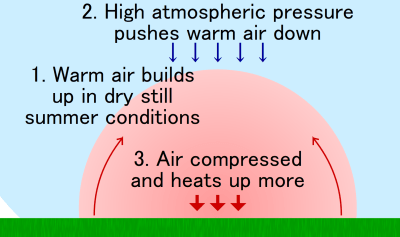
A heat dome requires two factors to form, the first being a period of calm, warm weather, the second being a large area of high pressure that remains in place for an extended period of time. As the hot air rises, the high pressure in the higher atmosphere layers pushes back on this air, compressing it and causing adiabatic heating.
This creates a cycle in which the increasingly warmer and drier soil is exposed to the relentless Sun in the cloudless sky, with even nights bringing barely any change. What keeps this stagnant air from dissipating an “atmospheric block”.
Weather Block
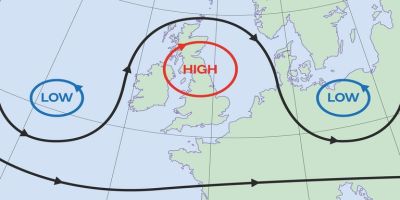
There are two types of blocks: omega and diffluent blocks. The omega block is commonly observed with heat domes, creating the Ω-shaped pattern from which it derives its name.
How long these blocks persist can differ wildly. The UK experienced a very hot Summer in 1976 when such a block persisted for months and thus drove up temperatures. Generally they last on the order of days to weeks.
Because of how heatwaves and heat domes overlap without a clear distinction, once you add a blocking system the UK’s Met Office prefers to call them ‘persistent summer blocking highs’, as this is their most defining feature. This can also be seen pretty well on maps of the 2021 Western North America heat wave.
Pacific Heat 2021
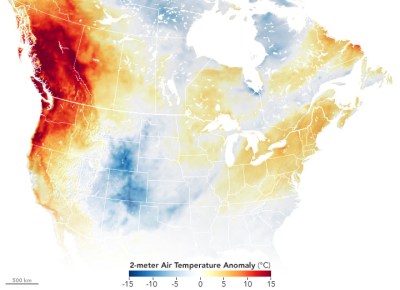
Affecting much of Western North America from late June through early July, this extreme heatwave broke many records, including the highest temperature ever measured in Canada, at 49.6 °C. Eventually classified as a heat dome, by the time it dissipated around 1,400 excess deaths among the human population were recorded, as well as countless more deaths among farm animals, in addition to the highly destructive Lytton wildfire and general damage to agriculture.
In this case a block ensured that this area of static hot air could not dissipate or otherwise experience some cooling air from the Pacific.
The formation of this block was predicted by meteorologists after they observed warm, moist air from torrential rains in China make its way across the Pacific with help from the jet stream. At this time the Southwestern US was already experiencing a drought, setting the stage for the heat wave by providing additional heat to the Pacific Northwest.
As can be seen in the below barometric chart of the time, this led to the air transported by the jet stream to become trapped in between low pressure areas, exerting downwards pressure on the area below that was already enjoying a warm summer.

A similar phenomenon occurred over Europe during the summer of 2026, with multiple heatwaves involving heat domes forming and persisting for weeks on end. Previous summers in Europe had already been significantly warmer and drier than previously, creating the conditions for a record-breaking summer.
With the blistering 2025 European summer already causing many wildfires and excess mortality cases, the summer of 2026 was by all metrics more severe. This raises the awkward question of we can expect things to only get worse from here, not just in Europe but worldwide.
Heat In The System
Ultimately the mechanisms that drive the formation of heatwaves and heat domes become more effective when there is more thermal energy in the system. This means more torrential rains, a higher surface temperature, more droughts and so on.
Of all of Earth’s continents, Europe is the one that is warming up the fastest, with already 2.3 °C above preindustrial levels in 2022. Although there are ways to adapt to a drier, hotter climate, including for our thermal power plants, ideally we would reduce the amount of energy in the Earth’s weather systems.
Doing this means effectively reverting as much as possible of anthropogenic climate change by not adding greenhouse gases to the atmosphere, including SF6 which is still very common in switching gear, including that installed in wind turbines. Even as we build out our grids with more clean power, it’s of course essential to also keep an eye on grid stability.
Ultimately this increase in heatwaves, and worse, is largely a human-made phenomenon which fortunately means that we also have the power to make the planet cool down again. As fascinating of a meteorological phenomenon a heat dome is, it’s definitely one of those things that’s best enjoyed once every generation or less.
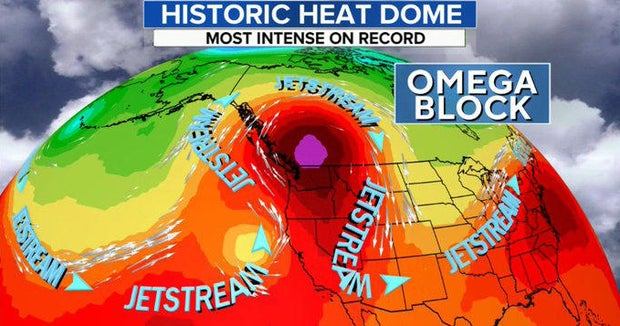
Overdone weather graphics from the 2021 Pacific Heat Dome from CBS News.











While most of Europe had a pretty hot and dry summer, Mid to Northern Norway/Sweden had a real wet and cold summer, which translates to poor crops as an already short summer is shortened even more, and farmers can’t get the machinery in the fields without it getting stuck in soft ground.
Climate change is not only heat.
Soft ground is a solved problem for many years. Lobby your local politics to allow tracked vehicles on the road. We have a 1969 DT-75 on our farm where fields are very difficult and it goes like boar through potatoes. In 2001 my father upgraded it with modern three point hitch to accept modern farming equipment. Even old machines can still be very useful if spare parts are still available. As they say you have it as you take care of it.
Might be a bit hard on paved roads. Just trailer them in.
I was in the middle of that magenta blotch in the cover image. It was weird. The creepiest things were the lack of bird song and the absolutely still air. We didn’t burn like Lytton did, but it was still intolerable.
It taught me why we grow a diversity of genetics: it’s not just for a romantic notion of “heritage tomatoes” like I previously thought, but because you just don’t know what the weather is gonna be like this year so you spread out your chances. Some cold-season tomatoes, some hothseadon ones. With climate change getting weirder, it’s important to apply the barbell strategy to plant and animal selection.
the cool thing about this ‘dome’ name is that it’s physically descriptive. the hot high pressure air really does mound up. there is literally more air over that place, and that air extends further above the land. and for new air to enter, it would generally have to flow up hill (or lift the whole dome from below, i guess).
an anecdote…in 2012 my part of the world had a huge heat dome for most of june-july, and incidentally i happened to buy a telescope right then. it was great! so many clear nights…good ‘seeing’ because the air wasn’t moving, and exceptional transparency. i played with the telescope for months before i even learned what haze and clouds look like through the eyepiece. really set me up for a big disappointment.
Hey, maybe if we can convince the orbiting datacenter folks to place their giant sun absorbing solar panels in a noon orbit, to shade the hottest part of the day, it might help cool off the place a bit.
They’re planning to pollute the heavily-populated-already dusk-dawn sun-synchronous orbit, where they, a) never see darkness, b) never shade the earth but, c) beam high power radio and light beams down, perversely heating the earth instead.
“the heavily-populated-already dusk-dawn sun-synchronous orbit” can you describe this?
dusk-dawn orbits are highly favored because the satellite remains sunlit (and therefor powered) at all times, no batteries to expend mass budget on or wear out — the satellite never enters earth’s shadow so doesn’t need them. Also useful for outside looking satellites that never want to look into the sun or toward earth, like the famous WISE/NEOWISE asteroid hunter.
It also (like all SSO orbits) sees the same sun angle on the earth below — useful for comparing observations day-to-day, though the specialized optical earth-observation satellites usually choose an orbit around mid-afternoon or mid-morning for better lighting.
If your question is “what’s a sun-synchronous orbit?”: it’s an orbit that uses Earth’s equatorial bulge to nudge (“precess”) its orbital plane by about a degree per day, so the orbital plane remains constant with respect to the sun, so the bird passes over the same spot on earth at the same local solar time each day.
“Pollute” is just such an absurd polemical word for what you’re describing. So is the idea that radio signals from space are a significant source of heating. You’re just looking for a way to shoehorn your unrelated obsession into a different subject.
Both ground-based (especially astronomers) and orbit users already call the Starlink constellation “pollution”, with “just” a few thousand of them.
Musk alone is proposing a hundred times more AI1 satellites, each ten times bigger, and all concentrated in the same orbital region — not spread all over the globe like Starlinks. That dusk-dawn SSO orbit already is heavily populated and requires careful traffic control to avoid collisions.
The proposed AI1 fleet will produce more electrical power than most entire countries, and about half that power will get radiated toward earth. And that’s just one of the proposed constellations.
Starlink doesn’t fly in that orbit, space is extremely large, and people only complain about Starlink because they hate Musk. If it were another company flying those satellites there’d be no complaints. If Musk simply didn’t buy and screw up their favorite online hangout space they wouldn’t care. Space is big. That’s basically its quintessential attribute. Ideas about crowding out an orbit/Kessler syndrome are science fiction. If you ask an honest astronomer they will freely admit this.
People moan and complain about the compute being hosted on the ground in their towns, in the wilderness, they complain about the energy and cooling, and if you put them in space where none of those are an issue then they still complain about polluting the enormity of a high 800-kilometer-altitude shell of space around the entire planet that will never ever ever be even 0.00001% filled. Starting to think it’s a psychological problem. Over and over again, it seems like people aren’t anti-pollution, they’re anti-energy itself, anti-progress, which is very strange and alarming.
If you went back in time and told 20-year-old me that in a few decades we’d have a fleet of orbital supercomputers that generate as much energy as a small country in space, I’d say “hell yeah man.”
Heat management and energy consumption in space are not an issue, because not having a very robust solution is a non-starter there.
If you have cubes with 50 cm edges on 800 km orbit which is filled 0,00001% the trajectories of the cubes are touching.
The hobby astronomers admitting to you just had something better to do than to argue and chose the easy way out.
No, I absolutely don’t care who does it, I don’t want the orbital billboards they’re trying to sell, I don’t want mirrors focusing sunlight from space onto people, and I don’t want someone filling everyone’s night sky with bright streaks just to make a profit.
What they are more likely to do, is to add giant mirrors on the orbit datacenters, that focus a beam on the planet, so that you have to pay a subscription so that they don’t char you to death.
Anthropogenic seems like a strange word choice.
I’m curious if we’ll see us active cooling to atmosphere at some point. I could see systems that use refrigeration loops to heat radiative panels with that tuned heat emission that allows it to escape the atmosphere.
Anthropogenic -> “human made”
Such cooling loops don’t work. On a small scale, they’re call air conditioners. On a planet scale, you’d literally never be able to build enough of them. And that radiation from “radiative panels” already can’t escape when it’s radiating from the surface of the earth, because the greenhouse effect reflecting radiation back down is what’s driving all this in the first place.
https://en.wikipedia.org/wiki/Atmospheric_window
I know what anthropogenic means. I’m saying it’s a word that is strange to use here, not that it’s one I don’t understand. Man-made or human-caused are more readily understood by many and likely more appropriate because of that.
Also about the reflection of radiation see the other person who points out something you probably were unaware of.
You can reverse entropy locally inside a system, but it requires energy and makes more heat elsewhere… It would be very difficult to do that with the entire Earth as the system, and only radiative heat as a heat sink (and that would have to be shadowed from the sun, so it would all have to hide in Earth’s shadow cone). On top of all that, keep the entire setup efficient enough that it doesn’t ruin its own gains with waste heat. Oh and it would be a ten thousand year project to construct it. Fun for a sci fi story, probably won’t happen in reality.
I think the radiative solution still would work in the sun/during the day but if not it could just run at night.
Your comment about radiative cooling makes me wonder how large of a tank/rocket we’d need to get a CoP over 1 by liquifying refrigerant on Mars or maybe the Moon and then sending it back here to evaporate.
Forgot to add that I think its a project that will eventually come by necessity if humanity lasts long enough and continues to grow energy-wise.
Global Warming (climate change) is currently caused by gasses holding in heat and preventing its escape to space. If we increase our energy use via solar, fusion/fission, etc. enough then eventually we’ll still heat the Earth.
“Heat domes” “polar vortexes”… just scarier ways to describe previously known phenomenon. I blame “El Nino”.
Half the terms used today in weather media I never heard when I was in meteorology school. I blame the Weather Channel.
I concur. I used to enjoy their content until they just started doing TV shows all the time and started naming thunderstorms.
And yet idiots still refuse to use their eyes and ears. Maybe we need to be even more explicit when describing natural disasters in progress.
An interesting read for many here:
https://710wor.iheart.com/featured/mark-simone/content/2019-10-08-the-list-of-120-years-of-climate-scares-by-scientists/
Can’t you climate change deniers just state flat out that you don’t believe in it instead of wasting our time with links to MAGA-friendly talking heads like Mark Simone? Plus the post is just plagiarizing content from another conservative attack blog called “American Thinker”.
Is the timeline inaccurate though? I fall into a category that makes absolutely nobody happy: I do believe in man-made climate effects, but I think the publicity around it is incredibly stupid and seems calibrated for maximum smugness instead of effectiveness. You have to carefully manage public trust in institutions, it’s very easy to destroy it… and believe it or not, generations of finger waggling and nagging doesn’t help you get it back. I thought some people would have learned that lesson six years ago.
Past generations were way better at this than we are today. Today’s PR people are both incompetent and incontinent… They have no discipline, they can’t resist any chance to get in a quippy smarmy insult towards those who they resent and despise (which, it turns out, is damn near everybody in the country).
Agreed. Right on the money.
Correction: I make one (1) guy happy
I think SF6 entombed in switchgear is a lot less of a concern than the constant intentional CO2 releases. And methane, which is routinely flared from “natural” gas infrastructure.
Typical Maya Posch strawman against renewable energies …
E.g. Germanies SF6 emission (losses during production, maintenance and decomission) went from 50 tons/a in 1998 to 10/a tons in 2023. Considering a GWP of 24.300 of SF6, this is equivalent to 243.000 tons of CO2. Compared to 580 million! tons/a of CO2 emissions in Germany in 2024 this is about 0.04%.
Notably, the SF6 emissions are also caused by switching equipment for coal power plants, gas power plants, etc., and the transmission networks. In 2019, about 1% of the SF6 used in Germany was by Wind Farms (Source: DeStaTis). Since 2026, SF6 has been banned for any systems <= 24kV, and for 2030 SF6 is banned completely.
According to NOAA, in 2024 about 66% of the global warming was caused by CO2, 16% by methane, 6% N2O, 8% CFCs, 2% HCFCs, and 2% HFCs. The influence of SF6 is lower than any of these.
Our home planet now has a fever. Think about when you have fever and how that makes you feel. On a planetary scale the aches and pains are not much more than annoying but once the fever becomes chronic then internal stress builds and stability begins to break down. We are there now! When systems start to fail like Atlantic Meridional Overturning Circulation then that collapse will trigger a major climate disruption to large populations. We are headed there now at high speed. No AI or smart boys can fix it before major damage is done. This is your future. Best of luck.
Ok, but what’s the solution? Otherwise pointless worry about it.
As I understand the various positions, the options are:
(1) pretend it’s not a thing, do nothing, be surprised when things go to hell,
(2) agree it’s a thing, decide it’s too hard to fix, be fatalistic about human nature when things go to hell,
(3) agree it’s a thing, leave it to beauracrats and “industry representatives” to bodge together meaningless and destined to fail solutions, blame others when things go to hell,
(4) propose a return to pre-industrial agrarianism that would relegate millions or
billions to poverty, be smug when things go to hell.
That’s all I got.
(5) Don’t be surprised when it doesn’t happen.
5) Pretend that nobody has actually proposed realistic solutions, refuse to take any action, be smug when things go to hell
That’s basically #2 – there are lots of realistic solutions … unless you ask bureaucrats, industry insiders and business leaders — then the answer is that there are no realistic solutions. Cue the hand wringing.