
 Although combining electronics and 3D-printed structures is fairly common, this usually entails some level of manual assembly. This contrasts strongly with the Print & Place approach demonstrated by [Oliver Child] et al. in their research article titled Print & Place: Using a 3D printer for Continuous Assembly of Electronic Devices.
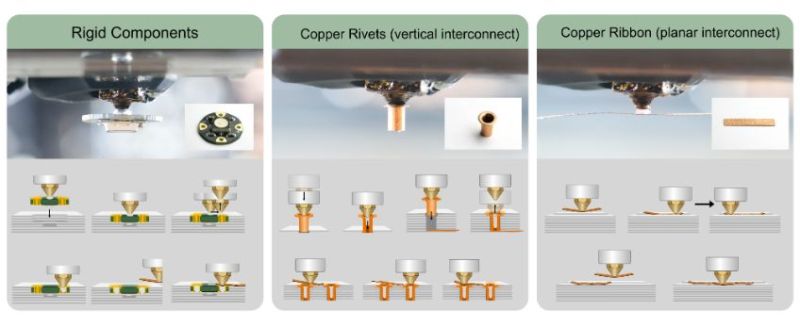
An accompanying video is also provided which covers all the basics and showing a few ways in which a regular FDM printer can be used without modifications to embed these components. Rather than requiring a custom tool head the thermoplastic is used as a temporary adhesive to pick up parts that are placed in a printed tray elsewhere on the build plate.
This parts tray is created parametrically before being printed. Following this an operator has to populate this tray with the requisite parts so that the print head can pick them up when they are needed. This is done during the printing of the actual parts, with regular G-code added to move the head over to the needed part before using a bit of extruded plastic to adhere to it and lift it to its new home.
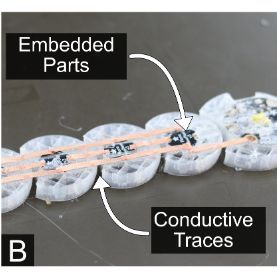
Subsequently these parts can be printed over to fully embed them, with this method supporting a range of parts. In the three demonstrations everything from small pre-populated PCBs to strips of conductive wire and braid were used together with rivets to provide paths between conductive traces.
Of course, with this being an open loop system you can expect many of the typical issues here, ranging from pick failures, placement misalignment and contact inconsistencies, as the authors encountered during their experiments. Here one could conceivably pitch adding a camera system as on typical pick & place machines to add a feedback loop that the firmware could then use for adjustments and to signal the human operator to assist.












Please be kind and respectful to help make the comments section excellent. (Comment Policy)