
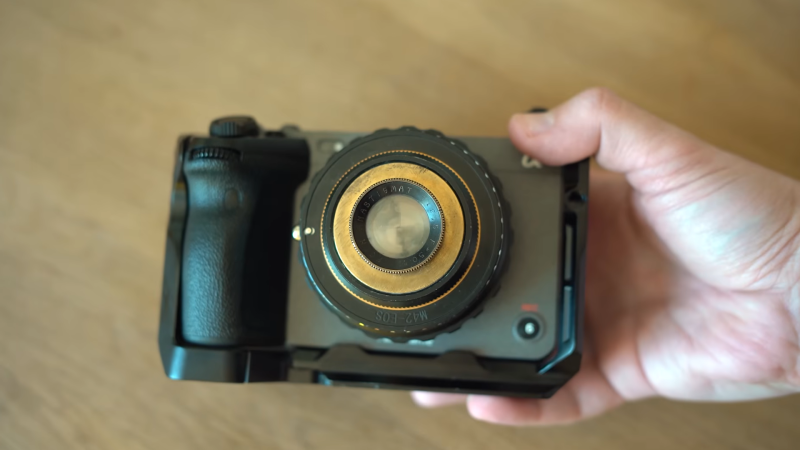
You can get all kinds of fancy lenses for modern cameras, with all sorts of mechanical and electronic wizardly to make them shoot better images. But what if you paired a vintage lens with a modern camera? It would take some work, as [Mathieu] found out, but you’d also get some interesting results.
The optic in question is a 100-year old lens—a Foth 50 mm f2.5 to be precise, originally used with a folding film camera. It was sourced from a market for just 3 euros. Notably, the lens was not designed for modern cameras, and so lacks an aperture and focusing mechanism. [Mathieu] thus had to fabricate something to fit the lens to a Sony FX3. A first attempt used an aperture adapter from Amazon and an elcoid adapter, but there were vignetting problems due to the lens placement in this case. Ultimately, [Mathieu] went with a special macro adapter that allowed him to control focus and tuck in an ND filter behind the lens, which made up for the lack of an aperture.
The vintage glass isn’t the sharpest lens out there, but that’s kind of what’s fantastic about it. The center of the frame is certainly focused, but it fades out softly towards the edges of the image, giving a cinematic, dreamlike effect. The bokeh in the background are particularly charming, too. As far as 3 euro lenses go, this one was a hit.
You can slap just about any lens on anything if you get creative with how you do it. Video after the break.
[Thanks to Stephen Walters for the tip!]











Pretty amazing that such an old lens automatically knows how to do colour!
I suppose i would have liked an objective comparison test by placing the camera on a tripod and pointing it perfectly perpendicular to a wall image of white squares and black lines grid, then swap to the Canon lens without disturbing the setup or lighting conditions and then compare the two for vignette and astigmatism effects.
These tests are boring. Todays lenses are all perfect, near 0 distortion and cromatic aberration, and the artistic meaning is void because all look the same. If you wanna make scientific images then you need the most perfect setup. Otherwise, for artistic images, the “feel” of the lens is all you need to know.
Eh the point is to use the Canon lens as the reference and overlay the image from the old lens over the top or flick between the two thus showing the distortion and lack of sharpness.
Wait, that’s the exact description of my Samsung S20’s camera. Which, about three times a day, I seriously consider placing on a solid surface and beating it with a large hammer until it is reduced back down to its constituent atoms.