

After the Foucault pendulum at the Houston Museum of Natural Science stopped working a while back after maintenance on the building, workers set out to determine what was wrong with the mechanism that normally keeps it in motion. Fortunately, it turned out that all they had to do was fiddle with some knobs to get everything dialed back in proper-like.
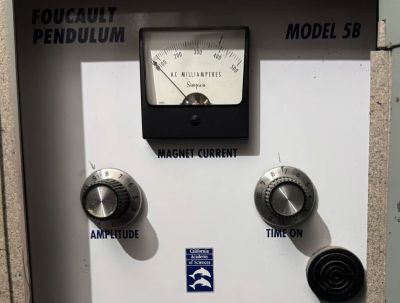
When we previously covered this dire event, it was claimed that this was a one-off system, hacked together by some random bloke. But as can be seen in the video and further detailed in the comments to the video the reality is far more interesting.
This particular Foucault pendulum is one of many that were created by the California Academy of Sciences, with hundreds of them installed throughout the US and possibly elsewhere. That said, since a pendulum of any description will never be a perpetual motion device, the electromagnet installed near the top of the installation has to carefully add some kinetic energy back that was lost due to friction as the pendulum moves around.
Sadly the video doesn’t go into much detail on what exactly was wrongly configured with this particular pendulum. Keeping a weight at the end of a long cable moving around at a set velocity is a tricky business, so it’s little wonder that getting some parameters wrong would engage and disengage the electromagnets at the wrong times and making the pendulum stop swinging.












Why would turning the power off and on again require recalibration? The control box looks pretty analog, wouldn’t it just start operating as it had before the power went off? There mustbe more to this story. Maybe they wanted to understand how to calibrate the drive system (because the original installers left no notes or things had drifted?)
Perhaps they didn’t initially figure out that the power was cut and fiddled with the knobs at first?
It might require some specific sequence of actions to restart it from a standstill (more than just giving the initial push). Maybe they just got it started by chance when readjusting.
[Much] more information here:
https://www.academypendulums.com/foucault-pendulum-manuals.html
The original maker was Cary Ponchione (from a Facebook post) at California Academy of Science.
The Boston Museum of Science has serial number three. Houston has serial number 62.
That’s a great resource, and to anyone looking, it has the schematic of the control system.
Umberto Eco to the rescue
Awesome resource, thank you :)
We have one of these (and it looks exactly the same) at the Boston Museum of Science. It’s at least 50 years old, because I remember seeing it as a teen.
Kansas State University used to have one in Durland Hall, the engineering building. Sadly, it was removed a number of years back. It was easily accessible and prone to abuse by students adding “excess” kinetic energy to the pendulum.
Couldn’t a feedback coil be fitted to enable automatic operation?
All kinds of things could be done these days. Who’s going to do it, and why?
That’s what surprised me as well – I mean even “back then” an analog feedback circuit should’ve been possible IMO.
-> I’m surprised any kind of fiddling (calibration?) was required.
It’s possible but the Museum is not a Disneyland with near infinite funds to hire special effects company to build their models and props. They have to do with what they do, otherwise it’s a no-show for everyone.
“They had to finely tune all of those dials…”
Uh, there are only two dials. Pedantically, I guess that was all of them, heheheh.
Don’t forget, A Stopped Foucault Pendulum is right twice a day.
Only at the poles :-)
They still make / sell them – https://www.academypendulums.com/. Manual / diagrams are available on their site.