
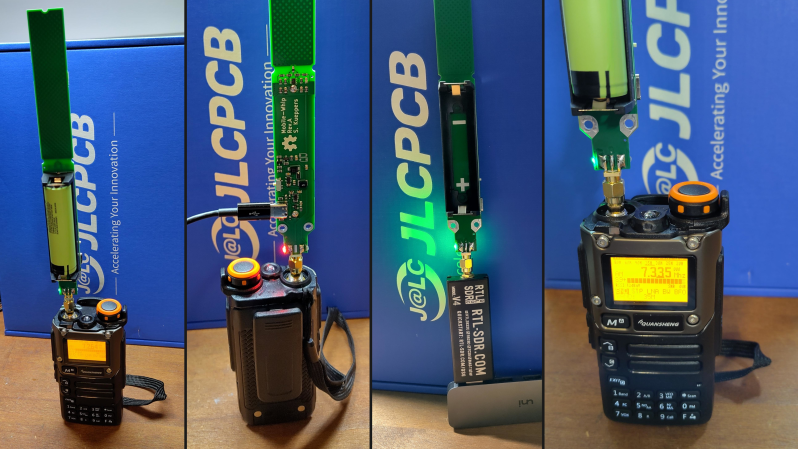
[skuep]’s Mobile-Whip is a compact, active receive-only antenna that is optimized for operation from a single lithium-ion battery or USB power. This makes it very handy for use on portable equipment, as shown in the images here.
What’s an active antenna do? Its main purpose is to provide useful reception with an antenna size much smaller than would normally be called for. It’s pretty handy to be able to have one that’s completely self-contained, and able to easily fit on a mobile radio or scanner.
The Mobile-Whip is based on the Mini-Whip active antenna by [PA0RDT], but with some important changes. One is that it has a narrower frequency range, but it’s also one piece, much smaller, can be powered by a single lithium-ion cell, and it integrates a charger.
It’s still in early development (and there’s no enclosure designed yet), but if you’d like to try it out for yourself the schematics and KiCad files are available. There are also instructions for ordering everything from a PCB manufacturer, which is about as easy as it gets.
[skuep] seems to have a knack for designing PCBs that attach directly to portable equipment, like the Ham Radio All-in-one cable (AIOC) which makes interfacing to a computer ridiculously easy.












I thought whip referred to the rubber-flexible nature of the antenna, and not a form factor. Also seems like it would make a radio very top-heavy and not very handy. Wouldn’t this have been better with a lead and a stand?
Not sure. Here’s basically the FAQ:
Active antennas also are particularly useful for a direct connection like this. The typical use is to overcome loss over long cable runs. Short runs like this can actually overdrive the radio amplifier. It’ll also introduce more noise so unless it’s a very low noise amp it’s probably doing more harm than good. Move to microwave and the mark changes but for HF and VHF it’s just not worth it.
+1
Also, Whip antennas are great on sea where there is no electrical noise.
On ships, to receive Navtex, Weather Fax and RTTY weather reports.
Here, they have an unrestricted view on the horizon.
In a city, a magnetic loop antenna might be a good alternative to some.
It can be tuned (pre-selector effect) and is deaf to electrical field component (man made noise) in the near.
Transmitting is more critical, because high voltages can develop.
Things like electronics or the eyes can heat up when being too close to a mag loop. Just saying..
Yeah and that UV-K5(8) Quansheng gets overdriven easily.
At least mine does, maybe it’s the IJV firmware I’m running though.
Yup. That’s where radios with thermionic valves were better.
A tube in the receiver stage goes softly into saturation rather than becoming deaf.
Better transistor radios had an acceptable large signal behavior, too.
I’m thinking of the Yaesu FT-101 (aka Sommerkamp FT-277), for example.
It handled strong signals rather well, despite its FET technology.
It even had a small lightbulb (!) in the receiver section, as a protection against lightning and overload.
In an ideal world, modern radio transceivers would still have a miniature valve or Nuvistor in the receiver stage.
So they would be better withstanding emps or large antenna voltages.
“Whip” covers pretty much all straight single element antennas. Old timey telescoping or single piece metal car radio antennas are also “whips”. Any more, it’s less about being able to whip someone with it, and more a differentiation from dipole, yagi, etc
Remember the days before everything on Hackaday was an advertisement for PCB production?
Waiting on RX/TX capability. Multiband porfavor.
Hm. Tricky. I’m mainly an SWL, but I think multiband antennas for transmit are poor, they’re always an unsatisfying compromise.
Only monoband antennas are the real deal, ask any real radio amateur with life experience.
Electrical solutions such as antenna tuners (matchboxes) merely make the transmitter happy,
they convert a lot of energy into heath.
Exceptions to this being antennas which use relays to physically enlarge the antenna.
Such as connecting/disconnecting parts of wire of a dipole.
Using traps is another possibility, but it has its disadvantages, too.
Large coils can help, too to match an antenna physically (the windings of a coil do enlarge it not only electrically).
Automatic antenna tuners, however, are the worst.
They do use small caps, inductors and relays to electrically match antennas to a given band.
They’re the most common, less efficient way of getting on the air.
Even a longwire antenna with a CB matchbox is more useful.
While it has a bad radiation pattern and is end fed, its physical lenght can make up for it (voltage, dimension).
Also, an antenna tuner has to be attached directly to the antenna fed point.
A lot of hams and CBers make the mistake of having the antenna tuner in the shack next to the transceiver, while the antenna itself is 20m apart.
In that situation, unless the coaxial cable has correct lambda in respect to the band/antenna, the coaxial cable will radiate and be part of the antenna.
That’s why built-in antenna tuners aren’t very wise.
Unless the transceiver is located in the open (on a field day), next to the antenna base.
Then it doesn’t matter if the cable radiates a lot.
(I’m mainly thinking about <30 MHz antennas used for shortwave here.)
Would this improve the performance of an rtlsdr?