
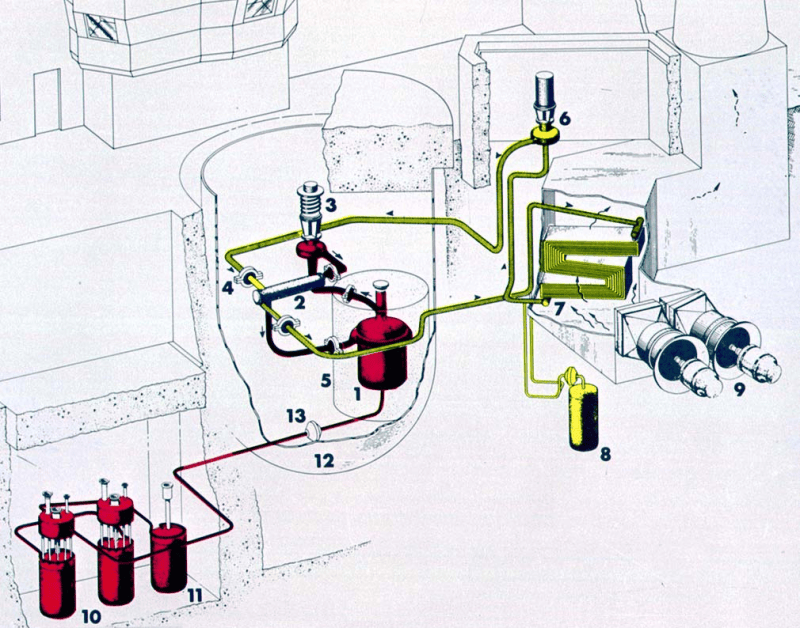
Recently [Huihua Yang] and fellow researchers at Argonne National Laboratory and Rensselaer Polytechnic Institute reported a way (paywalled, no preprint available) to keep the inside of molten salt reactors squeaky-clean from elemental metal contaminants that will otherwise build up.
There are a lot of advantages to a molten salt fission reactor (MSR) where the fuel is mixed in with the salt coolant, such as an inherently safe design, and very easy refueling by just dumping in more of the salt and fuel while scooping out any fission products that cannot be further fissioned. One issue is however the formation of noble metals like tellurium and palladium as well as semi-noble metals like silver that really prefer to stay in their metallic form, cluttering up the MSR’s internals.
Noble gases like xenon and krypton also naturally build up as fission products and are correspondingly removed from the loop, while helium can be added to encourage the metal particles to follow the same path even if they do not dissolve in the salt medium. The benefits of adding more helium was already observed with the US MSRE project half a century ago, as noted by [Frederix] in a 2022 paper on noble metal particle growth in MSRs.
The working principle appears to be that many small bubbles of a noble gas like helium prevents the metal from depositing on nearby surfaces, with this new study by [Yang] et al. thus providing more simulation-based evidence that with enough helium bubbles added, build-up of these noble metals can likely be largely avoided.
With MSRs such as China’s TMSR-LF1 being a popular design in upcoming nuclear-powered cargo ship designs due to their low maintenance characteristics, having such ways to reduce maintenance costs and downtime even more is always a good thing.












Please be kind and respectful to help make the comments section excellent. (Comment Policy)