
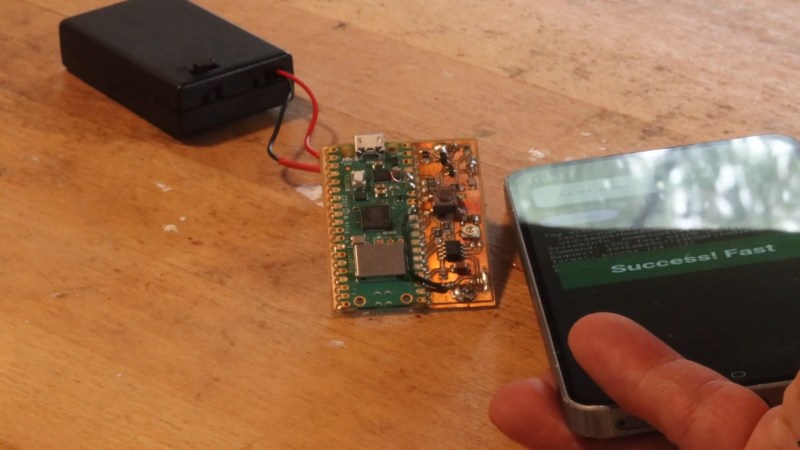
One of the more interesting categories of our ongoing Green Power Challenge is “anything but PV” — and since the radiated power of Near Field Communication is decidedly not photovoltaic, this hack by [caspar] to control a Pi Pico W from his phone using a tuned antenna absolutely counts.
Now, of course you’re not going to power the whole microcontroller that way, but [caspar] figures you don’t need to: the MCU is hooked to a battery, but through a transistor. That means it’s not asleep, but fully un-powered: only the leakage current of the transistor is draining that battery, so it can last a very long time. The waking is handled with a tuned NFC antenna hooked to a ST25DV04KC NFC chip. This chip is designed to be powered via NFC, and of course to accept commands. The ST25 then wakes the Pico — one GIPO on the MCU is used to latch that power transistor ON — and passes on the command via I2C.
Our favorite part might be the script he put on the Pico to live-tune the antenna coil, which you can see demoed in a video below, along with simplest possible demonstration of starting blinky on the Pico from the phone.
You aren’t limited to just a Pico and a blinky LED as in his proof-of-concept demo: [caspar] also uses the same technique with an e-ink display, which is pretty similar to the e-ink price tags you’ve likely seen at the grocery store, without the joy of reverse engineering.
Also without batteries, which is pretty neat, and arguably pretty green. If you’ve been hacking away at something that uses alternative energy, this challenge is still open — just get your project onto Hackaday.io and submitted by April 27.













Brainstorming use cases: Say you wanted to roll your own nfc “badge reader” to unlock your home doors. You place this device outside your house at waist-level so you can tap your tag (or phone) against it without taking it out of your pocket. It connects to wifi and lets Home Assistant know you’re home. With this circuit it will only be powered on a few seconds per day so a pair of lithium AA batteries could power it for a decade or more.
I was mostly, interested in how long it takes to wake/boot the pico. It has to start its own clock quite quickly so the NFC chip has to stay alive for a while. I assume the chip sends the SPI telegram onwards, a few times, interesting security application to try cracking it because the pico needs to record state to know it is being attacked. NFC powering is cool.
Nice idea! That should work, yes. I use the same concept to display data on an epaper, for home automation data or a room booking system here: https://hackaday.io/project/203726-inki-low-power-wireless-epaper-device.
Sequence: tap wakes circuit, connect via wifi, fetch data, display, power off. https://youtu.be/PFBjy5XDmfE?si=sgWR08XzmLGLAPaa
That is a good point. The command is written directly from the phone to the ST25 EEPROM on RF power — the ST25 is basically a dual-port mailbox. Next, the ST25 pulls the trigger on the transistor gate to start up the Pico, which has to power up and run the firmware. The gate net (R4=1M, C5=22n) gives roughly a ~22 ms window before it floats back up, and RF has to stay on through that window. Literally the first instruction in main() is to latch the transistor – now the circuit is powered independently of ST25 and the RF field. At this stage the Pico reads the payload over I²C and executes. Finally, after execution of whatever it is up to, it releases the latch and powers off. This also means the Pico only ever reads commands from EEPROM and evaluates for known and allowed ones accordingly.