
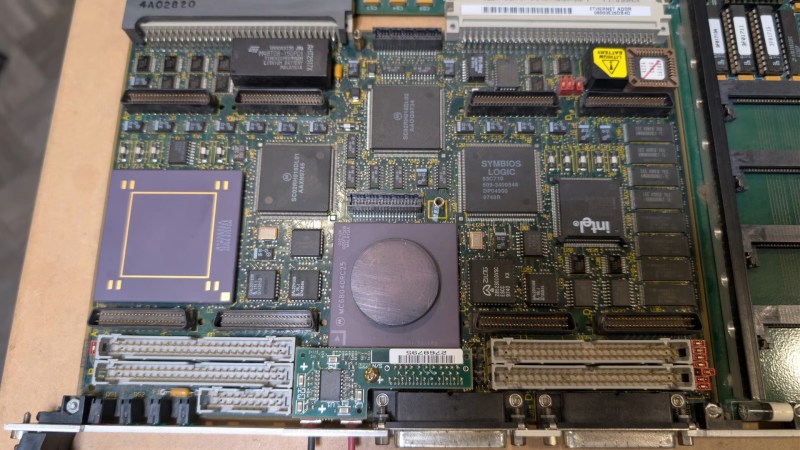
Perhaps at this point, getting NetBSD running on an obscure piece of hardware is a dog-bites-man story, and not worth reporting– their motto, after all, is “Of course it runs NetBSD”. So, the fact that [RetroComputingRanch] has got NetBSD running on a vintage Chyron Maxine broadcast computer is perhaps remarkable only for the fact that few people have even heard of Chyron before.
He’s already done a series of videos in which they explore this odd, old computer, which is powered by a Motorola 68040 on a VME bus and was once used to generate digital overlays– text and the like– on broadcast TV. NetBSD does have a port for the Motorolla VME SBCs, so he was able to vibe it onto the specific vme168 board that the Chyron is based on. It happens off screen, but apparently it was AI agent work that went into condensing the documentation for this machine as well as getting the NetBSD port set up. That’s a bit ironic, since NetBSD would never allow that in its commits.
Again, the Chyron Maxine was never intended to be a general-purpose-computer, and certainly never intended to run UNIX– it was meant to overlay text onto TV signals. With 4 MB of RAM, NetBSD leaves very little free once booted in single-user mode, but he realized that with a few extra chips the proprietary RAM board could become an 8 MB module. It seems like a pittance nowadays, but anyone who’s played with classic UNIX knows you can do a lot in 8 MB– even if only about 3MB is ‘free’ according to TOP.
There’s work still to be done– right now, it boots, but he wants to use NetBSD to really own this machine, so that’ll mean getting the vintage video hardware set up. Last time we saw a NetBSD user, they were doing game dev on a G4 Macbook, but nothing will ever match the legendary NetBSD toaster– not even toaster-shaped callbacks.












I remember when it cost at least a thousand an hour to rent studio time with one of those installed. I also remember when a Pixar was a piece of hardware about the size of a dishwasher.
Last time I had heard of CHYRON was the CHYRON/HEGO system used in CG for broadcast television. It interfaced with iNews through AVID and played out the audio on the Wheatstone Digital audio board for the WHOOSH noise along with the ROSS Video switcher to display it in its’ nice alignment inside the borders. That was 5 years ago since I’ve played with them. Interesting hardware / software they used. Those were the times.
A studio I was helping to update from analog to digital in the 90s had one in its old grass valley editing bay. I never messed with it and long forgotten it but it is pretty neat to see what is inside :)
Dude didn’t port anything.
They asked a char-bot to do it, then made some corrections.
Where is the attribution/credit being given to everyone who’s code was stolen to make the char-bot?
Even beyond that, if the whole story is “I asked claude to do it” why am I reading this article? I’m definitely not learning anything interesting about the porting process.
This article is wrong: It’s not uninteresting because NetBSD runs on lots of hardware like this already. It’s uninteresting because there’s nothing of substance to learn here.
Contrast with https://blog.netbsd.org/tnf/entry/porting_netbsd_to_hummingboard_pulse which while very brief is full of juicy details about the porting process and what was invovled.