
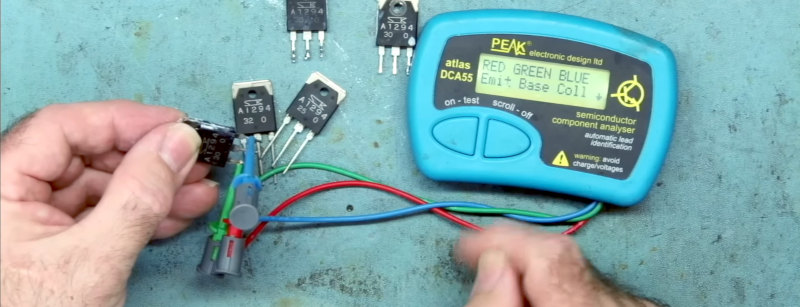
Transistors in some circuit configurations work together and, frequently, need to be matched. This is so common that you can sometimes find ICs that are just a pair of transistors made with the same piece of silicon, so they should be matched very closely by default. But with discrete transistors, two devices of the same type are not always identical. [Learn Electronics Repair] covers the topic and explains how to match devices in the video below.
Depending on the circuit, the matching parameters may be different, but generally, the idea is that you want similar gains or matching saturation characteristics. The reason is that when you have multiple transistors working together, you don’t want one to do more work than the other device. This is inefficient and could drive the “better” component to fail.
The same idea applies in bridge circuits, where you might match resistors or capacitors to make sure that, for example, two 10% resistors are very close to the same value. A 10K resistor could be between 9K and 11K, and you might not care as long as they are both, say, 9.2K or both 10.8K.
This is different, by the way, from impedance matching, where you achieve maximum power transfer by matching a source to a load.












[Learn Electronics Repair] has a very thick accent, Manx?(Isle of Man)? I recommend turning the subtitles on! (I do that with almost every video when I can, no matter how clear the English). Apparently he’s doing videos from his workshop in Spain, so that’s no clue as to where he’s originally from. It’s not a common accent for sure, although it’s not like he’s speaking in dialect. I imagine he could do so and I wouldn’t understand a word.
I already take pains to match components exactly -although it’s because I don’t really know what I’m doing and I have little idea of the consequences of what any changes might do. I have very little background in electronic theory, but I enjoy making little repairs to vintage stuff that can’t be replaced, and as a matter of principal, I back Right to Repair advocates when I can. So this was helpful.
He has a lisp which I imagine alters his accent. Especially if he’s had speech therapy to modify the way he speaks to reduce it.
I quite like his accent and don’t even think it’s that thick!
Yeah, though I’ve only listened to the first few minutes, I’ve had no problem understanding.
(Now, the farmer with the all the guns in Hot Fuzz, that I couldn’t understand at all, but I guess that was the point after all. )
Most helpful videos on YouTube in English are with the thick accent.
At least they are better than the anime-inspired vocaloids used in, like, Diodesgonewild videos. That, or those automatically generated audios without accent or intonation reduces the quality of the videos a lot.
A long time ago when I was making Audio Amps with symmetric circuits, simply blew up if I don’t use matching transistor.
I wonder if the factory did matched transistors’s hFe on the other channel too
There were manufactured matched transistor pairs for both BJTs and JFETs. The structures were matched by machine, and then bonded to the same baseplate and encapsulated together. This kept them at the same temperature during operation. The need for matched pairs decreased as manufacturers moved away from discrete components toward ICs. Rarely there is need for matched pair, and usually it’s for a very specialized circuitry…
For power transistors in audio amps matching is less important because design should use emitter resistors that will divide currents flowing between transistors equally…
The LM394 ultramatch pair is a single die. In my experience, the main uses are low offset amplifiers and precision analog multipliers. They behave very close to theory, which makes them useful in log and anti-log circuits.
if you have one of them nice digital power supplies with a usb port on the front, you can automate and generate a curve for each transistor with one click and without needing any other equipment :)
To anyone reading this, as a good rule of thumb, DO NOT handle transistors without properly grounding yourself with a regularly tested ESD strap, or at least regularly resting your hand on an ESD mat that is actually hooked up to ground. You’ll save yourself alot of trouble in debugging later- on a production floor for a big name wafer handling automation supplier, I saw 5 in a row fail after being installed by a non-grounded tech, it was thought to be a batch issue after 3, but the issue replicated across production lots- after being installed by a more cautious tech, the issue was resolved. Interestingly (frustratingly), the transistors that failed in circuit appeared good via basic bench testing(activating/discharging the gate and verifying threshold specs) w/ just an RMS multimeter and PSU, it was only after connecting a proper HP LCR and characterizing under load that the transistors were verified as failed(and new ones verified passed).
Mosfets are sensitive to ESD, static electrivity, as the gate is is insulated from drain source channel. This has been discovered the learning the hard way. Later when further formally educated i discoverd that total a failure of a device was good in that the failure was noticed. The worst failure mode was a partial failure, small defect that degraded the device, due to ESD that was not discovered in testing.
CMOS logic suffered from this in my experience, inputs should never be left open circuit, unconnected, as they float around due to high lmpedance of Gohms.
Matching is easier these days because you can buy matches transistors in package. While die to die variations in parameters is huge, on die variations are minimal and can even be tweaked as necessary. It’s simply too easy in a modern process to produce matched pairs on the same die.
As for handling. BJTs and JFETs are fine. It’s only MOSFETs with their delicate gate oxides that are easily destroyed by static.
With a product that needed matched bipolar transistors, we found that dual transistors in SMT were actually matched as the separate die are being picked off adjacent spots on the wafer and packaged, and also that adjacent single transistors in tape & reel were also matched for the same reason. (There was a temporary supply squeeze on the “proper” matched pairs, hence proving this, but then we never went back to the marginally more expensive matched pairs because cost)