24C3 Build Your Own UAV


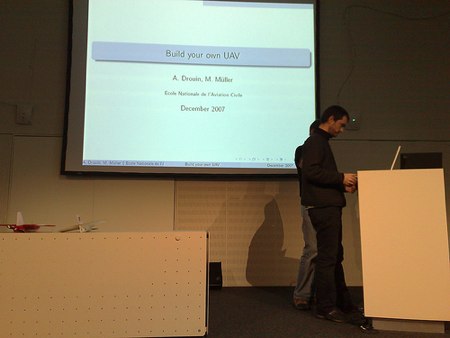
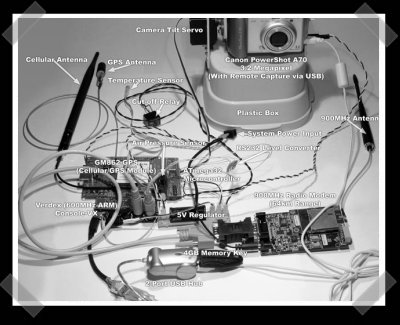
The 24th annual Chaos Communications Congress in Berlin is already off to a great start. The first talk we attended was [Antoine Drouin] and [Martin Müller] presenting Paparazzi – The Free Autopilot. Paparazzi is an open source hardware and software project for building autonomous unmanned aerial vehicles. The main hardware board has an ARM processor and GPS. It uses inertial and infrared sensors to determine orientation and altitude. The four infrared thermopiles measure the air temperature. The ground is warmer than the sky and if you compare the temperature in the direction of each wing tip your can tell what angle the airplane is at. It’s really that simple.

They did a pretty amazing live demo. Using the network connection they controlled a UAV flying in France and another in Germany. Both planes were streaming live video from belly mounted cameras. One relaying through a home DSL connection and the other through a UMTS cellphone. They were able to change way-points on the fly and issue flight pattern commands. There is a ground crew at each location with a security pilot that will switch the controls to manual if things get out of hand.

Talcum Powder Print Bot


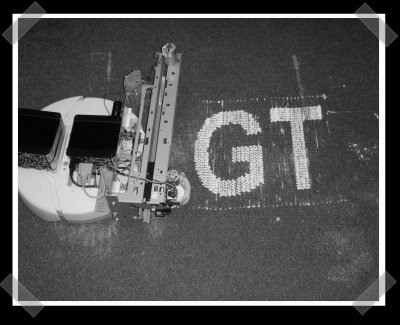
It’s been a while since we’ve seen a new print bot idea. [Kyle] sent in his groups final project at Georgia Tech. An ever so handy iRobot chassis, a dot matrix printer carriage and motorized drill bit in a funnel strategically dispenses talcum powder to print messages or images on the floor. Just think, one robot can write all over the floor and the other one can clean up afterward. How long until some sports geeks build a bigger one to deface a football before a big game?

Hackit: Cocktail Robotics


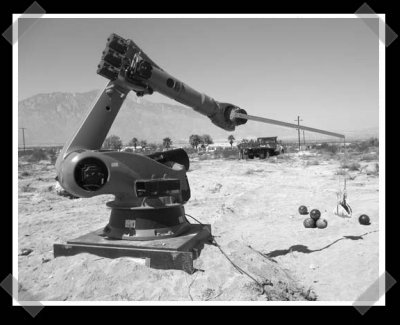
Here is a special edition Hackit in honor of Roboexotica. Ever since making the decision to attend Roboexotica we’ve been speculating on the type of machines we’d like to see at such an event. Here are a handful of ideas:

Iceware via rapid prototyping: As we type this post, [Bre] is in the background attempting to build a RepRap style rapid prototyping machine that will construct shot glasses on demand. We were thinking it would be neat to cut beverage glasses out of blocks of ice using a milling machine, but why stick with normal milling equipment? It’s ice right; you could be doing something stupid like using a butane torch for your working tool. We then began to wonder “Has anyone built an ice based rapid prototyping machine?” You could just deposit water on a frozen surface to create your glassware. A group at the University of Missouri has been investigating “rapid freeze prototyping“. Since they’re using water, they only have to create the frozen shell of the part and then fill in the empty cavity with water to create a solid.

Continue reading “Hackit: Cocktail Robotics”

Roboexotica 2007


Tonight marks the kickoff of Roboexotica in Vienna. It’s the world’s leading festival for cocktail robotics. The event aims to explore the role of cocktail robotics as an index for the increasing integration of technological innovations into human lives. It also explores the explosion of radical hedonism in man-machine interaction.

…or it’s just an excuse for a bunch of smart people to get together, build robots, and drink.

The word ‘robotics’ seems to always imply ‘efficiency’, but that’s definitely a no-no at Roboexotica. Fine tuned manufacturer grade cocktail production is not the goal; personality, charm, character, all of these qualities are important in machinery destined for Roboexotica. You can already see some photos from the event setup on Flickr and we’ll be bringing you more posts on the individual machines as we get more information/drinks.

Real Robots From Movie Designs


Thanks to Star Wars, Plenty of people have built their own R2 units. Pixar’s next movie has been running trailers for a while, and there’s already a group(free membership required) devoted to building real versions of the SGI robot star: WALL-E. I guess I’ll have to call it reverse-forward engineering. WALL-E has some interesting design ideas – it compacts trash into cubes, but it can also retract its treads into the same compacting area. (Pictured is a WALL-E style waste cube, by [Jawa Lunk]) Thanks to [Shannon] deserves the credit for turning me onto this one.