
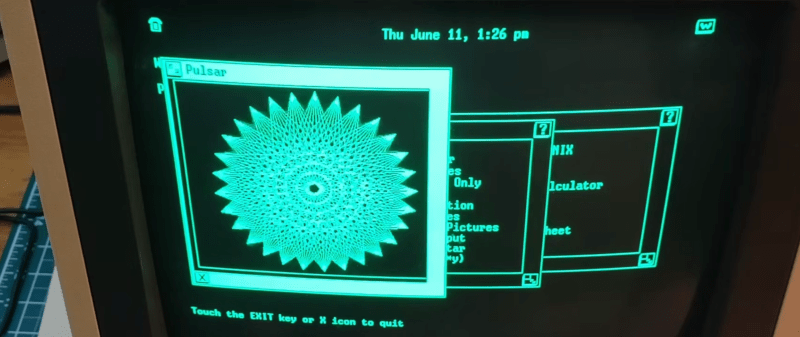
Before Linux, there was Unix. It was great, but it was and has been plagued by problems with licensing and proprietary competition. [Vintage Appartus] recalls, for example, the AT&T Unix PC from the 1980s. It was awesome, but you’ve probably never heard of it. For 1985, it was a nice setup. You got a 10 MHz Motorola 68010, 512K of RAM (but upgradable to 4M), a floppy, a modem, a 720×384 monochrome screen, and a 10 or 20 MB hard drive. You can check out the video explaining the machine and its problems below.
Physically, the computer looked like a high-end Apple ][ with a removable keyboard and a built-in monitor. Expansion was via three slots. Cold start took about three minutes, and then you have a fairly normal Unix setup for the period.
The sample machine uses a disk emulator, so the video shows the computer running much faster than it would with a real period hard drive. The card also has an 8086 expansion board that can boot MSDOS, an important feature in 1985.
We’d like to see inside the box. Why did it fail? The video says it was very slow and since Unix does more than DOS, it was perceived as very slow compared to an IBM PC. This was made worse by a very slow hard drive that was prone to failure. The price didn’t help. Apparently, the list price at introduction was $15,000. A comparable IBM AT was around half of that. To make the machine really usable, you’d have to throw even more money at it.
While 1985-era Unix isn’t as nice as what we have today, if you spent time on older versions, you’d appreciate what it does do. Unix workstations did have their day, and they were great. But your desktop will probably run circles around even the best of them today.












One of my early jobs just out of college was as part of the team porting and writing accounting software using a bunch of Olivetti M20s, an AT&T 3B2 & an AT&T 3B1 aka AT&T Unix PC
and yes half my day was spent leaning over the cubicle asking my team lead to please kill my session as i’d frozen my terminal AGAIN
It’s like that again. We’re running docker images on a cloud computing platform and half the day is spent waiting for someone to fix the server so it doesn’t bug out or drop the connection every five minutes.
Time is money, why not run them local?
With todays RAM prices?
Even while the original UNIX might be gone, it still continues to live forward in some shape/way in the form of Linux, *BSD, MacOS and other apple *os lines and other *nix forms.
I’m sure there’s still some Unix machines in college basements with 35+ year uptimes doing obscure tasks.
Actually they are very popular at the MARCH chapter in NJ at Infoage. One shows up from time-to-time as they shuffle their museum spaces. And one was out and basking in the attention with an exhibitor in the show last month. For the longest I worked over an AT&T PC 6300 and then the one with native 80286. But I’d longed for one of the UNIX PC fellows.
That was me at the show! This very machine in fact. People really loved it and had a great time playing around with the interface. So many folks had never seen one actively running, it was cool
if/when linux becomes more popular, all our desktops will become unix workstations by any functional measure. macOS computers are already there.
2027 will be the year of the Linux desktop!
and GNU/Turd is almost ready so by 2030 it should be able to fully replace Linux kernel.
And the German local governments will switch their employee workstations to a custom Linux distribution, and then back to Windows a couple years later.
“back to Windows a couple years later.”
If I had the cash to throw around like M$ does, I could have them
running 8086/87 puters again.
If they do go back, that will be why. And a few will be much richer in the end.
Ah, you mean like it happened with LiMux in Munich.. Yeah, that was sad to watch.
But now there’s also the state of Schleswig-Holstein that’s going Linux/Open Source.
https://www.theregister.com/2025/10/15/schleswig_holstein_open_source/
https://www.schleswig-holstein.de/DE/landesregierung/themen/digitalisierung/linux-plus1/Projekt
https://simple.wikipedia.org/wiki/Schleswig-Holstein
Last but not least, France goverment is using Linux, too.
Their police offices seem to use it for quite a while already.
In late 2013, Ballmer came to visit Munich’s then-mayor Christian Ude and was like “nice city you got there, it would certainly be a catastrophic if we situated our national offices, along with all the attendant jobs, elsewhere”
https://www.linux-magazin.de/ausgaben/2019/10/interview-2/
(You can’t make this stuff up.)
A new mayor took office in 2014, and declared that he was a “huge Microsoft fan”. A task force was establlished to switch back to MS products, and Munich got a prestige-architecture office complex and became German Microsoft HQ.
https://news.microsoft.com/europe/features/microsoft-in-munich/
In 2017, they switched away from Linux.
I’m certain that the city has profited from the new jobs and the tax revenue, and as long as Dieter Reiter didn’t personally take any money, I don’t think that it’s technically bribery.
I do not think this is ethical behavior on the part of Microsoft. But they could not afford the high-profile black eye either, I guess.
I hope Paris gets a sweet Microsoft campus out of the deal. :) We’ll see how many of them MS can afford to build.
The whole point of commercial software development is that the users are not experts in software development and generally do not want to be. It takes a greater effort and greater cost from the user – here the government is the user – to maintain the software system, because they’re simply not very good at it^. What that means, it’s a better use of their time and money to simply pay outside experts to do it.
It doesn’t take much from Microsoft to improve the product just enough that governments and institutions would no longer see the benefit of supporting their own operating systems. It’s just political posturing. Ten years from now, unless we’re completely fallen out with the US, they’ll be back to Windows.
What’s really needed is a true European competitor to Microsoft: some commercial entity that isn’t tied to a particular government, that takes responsibility of the product and ensures uniformity and compatibility across the market. Linux as an open source project doesn’t do that.
^(Which is ironic considering the government’s job description is “system maintenance”.)
The TRS-80 Model 16, which could run the XENIX variant of UNIX, didn’t sell well either.
Professor had one with a Winchester drive singing away.
And yet, for the time, it was a fantastic machine. I set up and administered one of these systems for a medical office.
I think we had 3… maybe four users running Xenix applications on Tandy’s V100-equivalent terminals.
I remember the software being surprisingly responsive.
I built a time-clock switch that, after 6 pm, transferred one of the comm ports to a 1200 baud modem on an unused phone line. That allowed me to access the system after hours for work or maintenance.
It remains one of my favorite computers.
It’s always astonishing to look back at the price of computers in the 1980s. When i was a teenager around 1994ish i got a free hand-me-down IBM PC XT that i used as a dumb terminal and it just blows my mind that it was $5000 new only a decade earlier. By the time i got ahold of it, it was the very picture of e-waste. Even i didn’t find much to do with it.
And now people are again paying top dollar for these old machines to relive their glory days, use in minimalist setups, or refresh their aging equipment.
A Raspi running an emulator does more for less money and pain.
I recall a 386 Tandy DOS PC at radioshack in the early 90’s, $2,700. And I believe this model could not run Win 3.11
Interesting, might been a hardware incompatibility.
Some (if not most) Tandy 1000 descendents were XT or PCjr-derived, after all.
They had 8-Bit i/o and 1 MB RAM limit despite of their 80286 or 80386/386SX CPUs.
Thus, without Extended Memory, himem.sys couldn’t load and the RAM was barely enough for Standard Mode.
Just checked, the Tandy 4000 of 1988/89 was about 2600 USD.
It seemed to have been Xenix and Windows/386 ready, though.
https://www.aei.org/carpe-diem/the-web-is-now-25-years-old-and-the-computer-equipment-we-use-today-is-exponentially-cheaper-and-faster-than-in-1989/
https://colorcomputerarchive.com/repo/Documents/Catalogs/Radio%20Shack/Tandy%20Computer%20Catalog%20and%20Software%20Reference%20Guide%20(1988)(Tandy).pdf
Another 80386 PC, the Tandy 2500RSX, could run Windows for Workgroups 3.11, apparently.
https://www.toughdev.com/content/2024/04/tandy-2500rsx-a-powerful-386-system-by-tandy-corporation/
That being said, Windows 3.11 and Windows for Workgroups 3.11 are two separate things, of course.
The latter uses VFAT and relies more on VXDs (.386) drivers than plain Windows 3.1x or Workgroups 3.10.
So there might be issues with older hardware, maybe.
Normal Windows 3.1x and original WfW could still run on 80286 PCs and in Standard Mode.
It’s all relative and money is fleeting, let’s don’t be obsessed by the latter too much.
I mean, those PCs were never meant to be in hands of teenagers as their toys but meant to be tools to professionals that fulfilled their task.
And here, in context, these office PCs weren’t necessarily expensive.
They probably saved a lot of money compared to their alternatives (minis, workstations etc) or made life easier.
In construction and design, for example, CAD/CAM software running on low-end PCs allowed editing, re-using and sharing files.
For example, it was such a relief to architects who previously had to carry big plans and use pens on a drawing board.
To them, a DOS PC with Hercules graphics, a copy of AutoCAD+extensions and a large plotter did cost almost nothing in comparison to how much it improved their work life.
Same goes for DTP, desktop publishing. It used to be a big deal in industry.
It wasn’t just about productivity, but also about lower stress levels and about enjoying work.
To them, a computer was the equivalent to writers getting a typewriter first time.
Of course, envyness makes us end-users blind to that.
We’re bitter because we couldn’t afford something back then or had to pay a “big price”.
That’s human. We feel betrayed, maybe, when the price had dropped soon after we bought something.
Maybe we should see in differently, be proud that we simply were able to afford something or that we just were around when things were new?
Or let me put it this way, in the hands of a professional a PC isn’t just an expensive item that eats up money,
but a valuable tool that helps earning money.
Like a high quality drill machine or a robust tractor.
It’s an investment that pays off, in short. Over time, it will pay its own bill manyfold.
Also, work equipment can be deducted from taxes, too.
So the high price tag suddenly nolonger is that high in practice.
That’s why spending a reasonable amount of money on upgrades or extras isn’t necessarily a waste of money, either. No luxury, in short.
Because it can extend usability and life time of the tool,
giving an initial advantage over competitors and also because pays time for preparing for the next major upgrade (new PC generation).
Which in turns allows for a smoother transition without panic.
Buying a faster PC in the early days, such as choosing an AT over an XT or buying an CPU accelerator for an existing 4,77 XT made sense (Orchid Tiny Turbo 286, MS MACH 20).
Simply because that allowed for a good, smooth workflow with less headache.
That’s why fixed-disks (HDDs) were such a big deal back then.
It wasn’t just about storage capacity and speed, but because users could work without playing disk jockey all time.
The world of the consumer/end-user/teen was different, of course.
Here the computer was in the role an entertainment equipment, like a hi-fi stereo or a CD player.
That’s why home computers were such a big hit in good, old (poor) Europe.
This type of computer was meant for home use, for family.
It was more limited often but also meant to be always financially affordable.
Mean time, in the US, the Tandy 1000 was a popular family PC running DOS.
That’s why PC games were a much bigger thing over there.
The US citizens liked the idea of having something at home that they were familiar with from their workplace.
Here in Europe, by late 80s, the Amstrad PC-1512/PC-1640 or the Olivetti Prodest PC-1 had a similar role (albeit to a lesser extent).
By that time, 8-Bit integrated circuits reached a high integration level.
So XT class systems on 8088 to 80186 basis could be built using only a few parts.
RAM was probably the most expensive part, still.
And with the MS-DOS of its time being limited to 1MB, still, the default RAM expansion in x86 PCs remainded low.
Merely 386 PCs and Windows/386, Xenix 386 or OS/2 had real use for it.
DOS applications merely used extra memory as RAM Drive, a printer spooler etc.
EMS aware DOS applications being the exception (EMS used bank-switching).
Such as DESQView or Lotus 1-2-3 or Ventura Publisher.
Or Windows 2.x and some of its commercial applications that ate megabytes for breakfast (PageMaker, WinWord, Excel).
They needed an EMS memory board or a 386 with LIMulator, though. Such as Compaq CEMM or Windows/386.
Which ruled out most XTs and 286 ATs without any integrated EMS hardware.
They had little use for a big memory expansion, because due to lack of ordinary DOS software being able to use.
By the 90s, XMS and HMA and UMB memory was being utilized in the DOS world more often, so expandung XTs and 286 ATs made sense.
At the time, Windows 3.x was a popular example for a software using then-new XMS that also worked on a 286 PC.
In Real-Mode, it could use EMS with a Large Page Frame (256KB).
So XTs with a physical LIM 4 board could run larger Windows applications, too.
(Though Windows 2.x was better for normal EMS cards with normal 64 KB page frame. Windows 3.0 had little support for that).
Anyway, this is just meant as a little overview.
With the right investments, those (formerly) expensive PCs could be really useful years after, still.
Even the older ones. The Minuet “web browser” of 1994 could run on a 4,77 PC, according to Wikipedia.
So it was possible to go online with a dinosaur even in schools and universities that had old equipment, still.
A dial-up modem or a network card with a sinple DOS packet driver was all it needed.
https://en.wikipedia.org/wiki/Minnesota_Internet_Users_Essential_Tool#Background
The US Coast Guard ran specialized Unix set ups for their COMDAC (Command, Display and Control) navigation and ARPA (radar) computers up until about 2015-ish. Yes, we had dedicated a Unix “navigation computer”, with a loud mechanical keyboard and track balls the size of a grapefruit.
The graphics were 16-bit color over a black background like the top down and side scrolling PC games from the early 90s. The COMDAC side was for navigation and tactical maneuvering and it shared data with the ARPA side. The whole thing was part of the C4ISR suite.
It really did look like a military movie from the late 80s. As much as I complained about it not being “high tech”, it worked. Every time, without fail. Once I learned the system I actually got pretty fast at hooking targets and laying down track lines for navigation. The best part of the Unix system was stability and boot time. It did what all good tools do, two, maybe three jobs really well, and that’s it.
The windows based replacement we got was… a dumpster fire that slowly progressed into a burning landfill.
That is cool. Trackballs the size of grapefruits had me rolling. My brother had a similar if not same setup when he was active. He also lamented it never went down long enough to enjoy his hobbies lol. He said it always reminded him of the table arcade pac man at pizza hut back in the day lol. Just stares back at you from the dark and phosphor void I think he said lol.
Duckpin bowling balls? NASA used them as giant track balls to position dish antennas.
I found one of these, complete and in great shape, sitting on the curb in Madison WI around August 1994-5. It only booted up once, and I couldn’t get logged in. I was basically homeless (working as a temp and subletting a room) so when I had to move on, I had to toss it. It weighed as much as a moped and blew out enough hot air to dry your hair. I still have the CPU somewhere though.
Managed a whole lab full of these in a university setting, including a 1Mbit StarLan network to connect them and a 3B2 server. All had 2M RAM, unfortunately the gcc binary was 2.5M, about 5 minutes to compile helloworld.c … but still was the best student lab on campus until we upgraded to 386-based ATT boxes, then later to NeXT workstations…
“But your desktop will probably run circles around even the best of them today.”
Are you kidding? Your smartwatch will run circles around the best of them today. Dual core, 1.5GHz, 2GB RAM, 32 or 64GB storage. Could probably run an entire Apollo mission from your wrist.
Or a fleet of them.
Hi there! A C64 would be better suited, maybe. ;)
Computing power and response time are separate.
A modern hardware can be insanely fast at processing information,
but the immense complexity of hardware and software might burn all the improvements away.
Just think of Windows 11 PC vs an Atari ST with 8 MHz CPU.
Windows 11 needs lots of time to boot, while an Atari ST is near instantly at the desktop after power on (assuming TOS 1.x without the diagnostic screen).
Key presses on a C64 or Atari ST are registered insanely fast, too,
while Office software on Windows has a delay.
That’s because there are so many layers of abstraction involved, from key press to the rendered character to screen.
It’s like an engine of a race car that runs wild but has no proper transmission.
Mean time, a single horse will outpower it in terms of strenght.
Same ways, the Apollo AGC was very efficient and “hard-wired” to its tasks.
It also had a priority scheme, so lesser relevant tasks couldn’t stop critical tasks.
There was this scenario, I think, when radar data flooded the AGC and it still didn’t crash due to overload.
Modern technology must be painstakenly modified to act similar reliable under such circumstances.
A bog standard Android/iOS device is not like that.
Your dumb ruler calculator can run circles around the Apollo computer.
One of my mom’s friends bought one these at a garage sale for $10 in the 90s, and then asked me for help using it. They thought they were getting a cheap computer, instead of a paperweight.
I had the KIX Shell from Kyan Software on the Apple IIe in 1986 IIRC. It went to the floppy for every command. It had Kyan Pascal, a text editor, and an assembler. From there on you were on your own.
As a founder of the AT&T PC 6300 shrine, I weep with envy, after most of my collection was lost to fire, but it brings my joy that some of these machines are still kicking around and well appreciated.