The modern office environment has shifted in recent years. Employees are routinely asked to collaborate with co-workers half way around the globe and be camera ready, or whatever passes for webcam ready, in order to telecommute when they are out of office. Every office laptop, tablet, or cell phone these days comes equipped with some sort of camera sensor capable of recording at HD resolution. Twenty years ago, that was not the case. Though tech conglomerates like HP had a different idea of teleconferencing to sell back in 2005 dubbed the Halo Collaboration Studio.
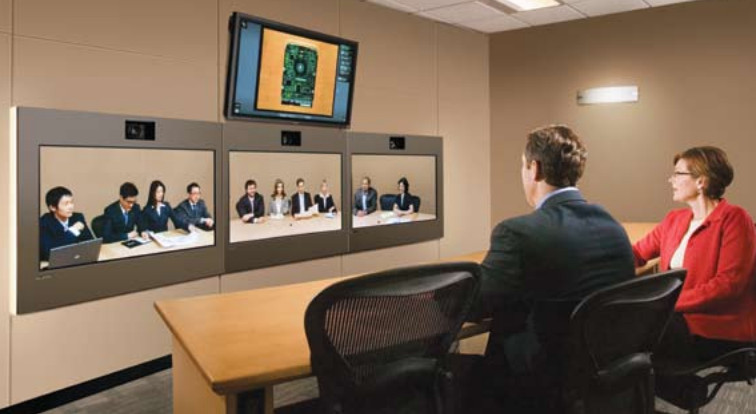 The Halo Studio was a collaboration between HP and Dreamworks that was used during the production of Bee Movie. Studio heads at Dreamworks thought it necessary to install the HP teleconferencing solution inside the New York office of Jerry Seinfeld, the writer of the film, as to allow him to avoid long trips to Dreamworks production offices in Los Angeles. According to the HP Halo Collaboration Studio brochure, “Halo actually pays for itself, not only by reducing travel costs, but also by encouraging higher productivity and stronger employee loyalty.” Certainly Dreamworks believed in that sales pitch for Bee Movie, because the upfront asking price left a bit of a sting.
Less of a singular machine, more of an entire dedicated room, the Halo Studio had a $550,000 asking price. It utilized three 1280×960 resolution plasma screens each fitted with a 720p broadcast camera and even included an “executive” table for six. The room lighting solution was also part of the package as the intent was to have all participants appear true to life size on the monitors. The system ran on a dedicated T3 fiber optic connection rated at 45 Mbps that connected to the proprietary Halo Video Exchange Network that gave customers access to 24×7 tech support for the small sum of $30,000 a month.
For more Retrotechtacular stories, check out Dan’s post on the Surveyor 1 documentary. It’s out of this world.
Continue reading “Retrotechtacular: The $550K Video Conferencing System Used To Make Bee Movie“