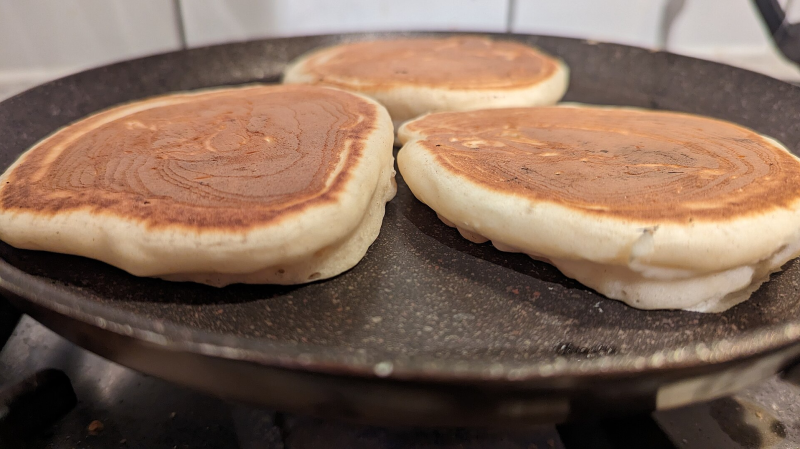
Although parents and teachers like to point out the deep link between cooking and chemistry, most people don’t deliberately apply any chemical principles beyond acid/base reactions to their recipes. Not so [Ben Kazez]: he’s written a thorough exploration of the chemical journey to the perfect pancake, and made a calculator for others to use with their own ingredients.
The goal is to optimize the pancakes along four dimensions: interior texture (light and smooth), a tangy flavour, rise, and a crisp, brown exterior layer. The tang comes from residual acids, and since lactic acid produces the best taste, dairy-based acid sources (such as Greek yoghurt or buttermilk) are preferable. Acids also react with baking soda to release carbon dioxide, making them a part of one of the four rising agents. The other three are carbon dioxide released when double-acting baking powder is heated, steam released from the batter, and air bubbles stabilized by egg white foam.
Dairy products, besides contributing acid, also provide a protein structure to keep the interior smooth. In a normal wheat-heavy pancake, two proteins (glutenin and gliadin) interact to form tough strands of gluten. Fats bind to hydrophobic amino acids in these proteins and shorten the gluten chains, hence the name shortening. Adding ricotta cheese also replaces some of this gluten network with a smoother structure of previously-denatured dairy proteins. Dairy products also contribute to the Maillard reaction between reducing sugars (such as lactose, glucose, and fructose) and amino acids, which causes the browning of the pancake’s surface. Besides being brown, the surface should be crisp; since amylose, found in corn starch, forms a brittle, glassy, crackly network when dehydrated, corn starch was added.
The result is a set of chemical equations which can be tuned to create perfect pancakes, combined in the calculator. This summary doesn’t do justice to the depth of the research here; [Ben] also investigated optimal batter resting times, fermentation, cooking fats, cooking surfaces, and spatula properties. If all this has you interested in more about dairy proteins, check out our article on cheesemaking.
Featured image: “Buttermilk pancakes from a recipe by Darina Allen” by [Didym].