Some municipalities implement bike counters on cycling routes in order to monitor traffic. [nullpxl] recently investigated how these counters work, and explored methods that can be used to trick the counter into thinking a bike passed over it.
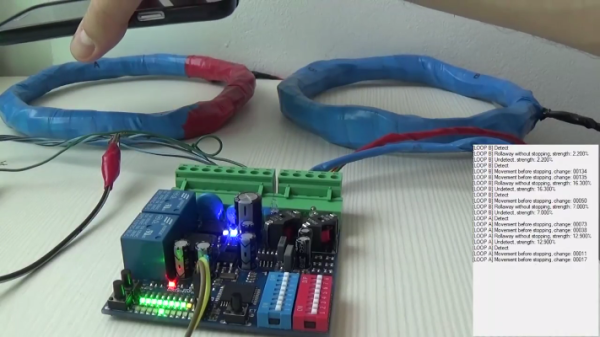
A great many of these devices are built using inductive loop sensors. This involves passing a current through a loop of wire embedded in the ground. When a conductive item such as the metal wheel of a bike passes through the electric field, eddy currents are generated in the item, creating their own magnetic field which reacts with the loop’s field itself. This creates a change in inductance which can be measured, and thus used to log the number of times a conductive item has passed over the sensor. By looking at the signature of the inductance change, a system can be tuned to detect specific objects—for example, two bicycle wheels passing over a sensor will create a signal that varies over time in a characteristic way.
[nullpxl] first tried to recreate a “bike” signal for the inductive loop by running over the area holding two metal pans. This wasn’t close enough, so a new idea was needed. Experiments with a scrap bike then indicated that there was a speed gate involved, and that wheeling one wheel over the sensor and back again could trick the sensor into thinking a bike had passed by. Eventually, [nullpxl] distilled all this learning down to create “the BIKE BASKET.” It’s simply a bag with a bike wheel in it, and swinging it over the sensor twice makes the counter tick up.
Is there any money in tricking the average municipal bike counter in your local city? We doubt it, unless Big Bike is getting increasingly filthy in its lobbying efforts. In any case, we love to see weird sensor hacks around these parts. Continue reading “Tricking A Bike Counter”