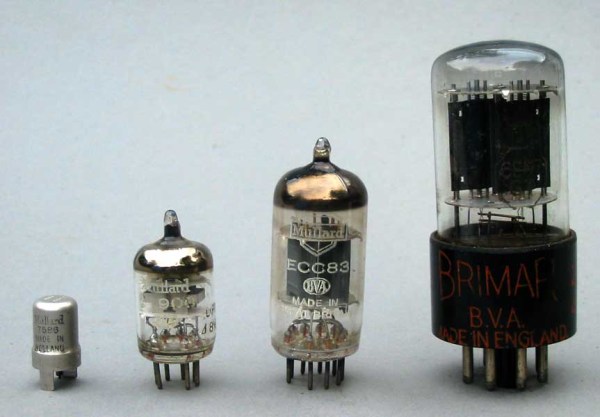
For a little while vacuum tubes and semiconductors were fighting a heated battle for dominance, with bipolar junction transistors and 1959’s RCA Nuvistor both allowing you to build a compact circuit with relatively low power usage and no high voltages. Although we now know that semiconductor technology won out overwhelmingly, that doesn’t mean that you cannot build a brand new Nuvistor board in 2026, as [Eric Schlaepfer] AKA [TubeTimeUS] recently did.
Nuvistors saw their most use in small-signal radio frequency applications, like VHF and UHF, with excellent low-noise characteristics that saw them used until the early 1970s in television sets, radios and oscilloscopes, as well as in space probes like the 1960s US Ranger Moon missions, so by that metric they had a good run.
Nothing so exciting is built in this video, sadly, but alongside a breakdown on how nuvistors work, we do see a discrete 555-style timer built using a gaggle of tetrode nuvistors, giving a pretty good idea of what using them in a project is like. Being a vacuum tube at its core, nuvistors still have the heater element, which is what gives vacuum tubes their reputation for being slow to start working and large current draw.
Despite their drawbacks, nuvistors still have a range of benefits compared to modern-day transistors, including being practically immune to electrostatic discharge (ESD) and electromagnetic interference (EMI) all the way up an EMP that will destroy most semiconductor electronics.
That said, the somewhat limited 8-nuvistor implementation of the 555 had to get a few extra pins for the heater supply, which burns up about 7.5 Watt just to allow the circuit to function. Terming it the ‘hollow-state 555 timer’, it works effectively just like any semiconductor 555, just with that extra power cost and of course no significant prospect of making it smaller, barring a semiconductor evolution as with the pixels-sized CRTs in the SED and FED type displays.
We covered the nuvistor before, including a great reference on this device, and its history that was much longer than people often assume today, as well as the vacuum tubes we use every day in for example our microwaves.