
Reflective pool of the Court of the Myrtles, looking north towards the Comares Tower. (Credit: Tuxyso, Wikimedia)

Medieval Alhambra’s Pulser Pump And Other Aquatic Marvels

Recently the Practical Engineering YouTube channel featured a functional recreation of a pump design that is presumed by some to have been used to pump water up to the medieval Alhambra palace and its fortress, located in what is today Spain. This so-called pulser pump design is notable for not featuring any moving parts, but the water pump was just one of many fascinating engineering achievements that made the Alhambra a truly unique place before the ravages of time had their way with it.

Although the engineering works were said to still have been functional in the 18th century, this pumping system and many other elements that existed at the peak of its existence had already vanished by the 19th century for a number of reasons. During this century a Spanish engineering professor, Cáceres, tried to reconstruct the mechanism as best as he could based on the left-over descriptions, but sadly we’ll likely never know for certain that it is what existed there.

Similarly, the speculated time-based fountain in the Court of the Lions and other elements are now forever lost to time, but we have plenty of theories on how all of this worked in a pre-industrial era.

Continue reading “Medieval Alhambra’s Pulser Pump And Other Aquatic Marvels”
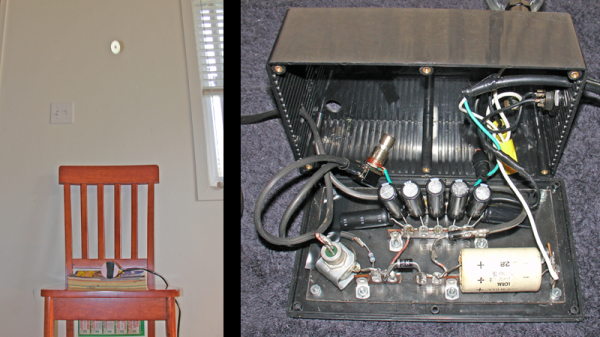
DIY Electro Magnetic Pulser

EM Pulser Flings Washers, Side Effects May Include Curing Cancer Or Death

Some folks believe that exposure to electromagnetic pulses helps the human body heal itself (one portion of the [Bob Beck] protocol). [Steffan] is one of those folks and was interested in EMP generation but wasn’t crazy about the several-hundred dollar price tag for professional units. As any determined DIYer would do, he set off to make his own.

This whole thing works by straight-out-of-the-wall 110v AC running through a couple 60 watt light bulbs before moving through a rudimentary rectifier circuit. The DC output from the rectifier charges five 130uF camera flash capacitors. An inductor coil is responsible for generating the EMP and is only separated from the capacitors by a single normally-open momentary switch. Although it is possible to wrap your own coil, [Steffan] decided to use an off the shelf 2.5mH unit normally used for speaker system crossovers. Once the momentary switch is pressed, the energy in the capacitors is discharged through the inductor coil and the EMP is created. To demonstrate that the pulser does indeed work, a metal washer was placed on the inductor coil and the unit fired resulting in the washer being thrown into the air.

[Stephan] did deviate from the some of the online designs he had researched, using 7 capacitors instead of the recommended 5. The result was a firecracker-like discharge sound and melting of the 14 gauge wire. Well, back to 5 caps.









