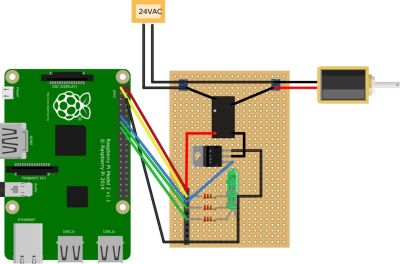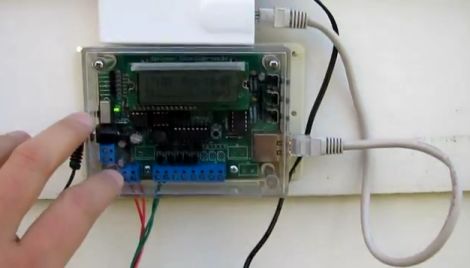
RS-485 Sprinkler system

RS-485 Sprinkler Control: Scaling Irrigation Across The Farm

Building your own sprinkler system controller isn’t that difficult on the face of it, but what happens when your system starts to grow, adding more distant areas? To tackle this, [Vinnie] leveraged the tried-and-true RS-485 differential pairs to communicate reliably with ever-more-spread-out valves on his farm’s irrigation system.

The system uses a Raspberry Pi to control when each valve turns on and for how long. It does this via a custom RS-485 valve master board, whose code and design files are on GitHub. The master board communicates with the Pi over I2C and issues RS-485 commands while controlling the 12V line to the valves. Toggling the 12V supply is a smart move it lets [Vinnie] save power by not keeping the valves energized when idle.

At the valves themselves lives a valve node board (also on the GitHub repo). Each node has a unique address so it knows when its name is called to open or close a valve. The valves are latching solenoids, ideal because they don’t require constant current during the watering cycle. The Valve Nodes also support their own protocol to report state, firmware version, and allow in-situ configuration.

Be sure to head over to [Vinnie]’s project page and check out all the work that went into this great DIY irrigation control system, along with the thoughtful boards and tools he made to help others set it up. This is a welcome addition to the sprinkler-related projects we’ve seen.
K.I.S.S. Pi Sprinkler – Just Keep The Plants Alive

A good first step in a project is knowing what you want to do. [Ben Fino] made it clear that his Raspberry Pi Sprinkler control system for his wife’s garden had one goal: keep the plants alive. The resulting project is doing just that and no more.

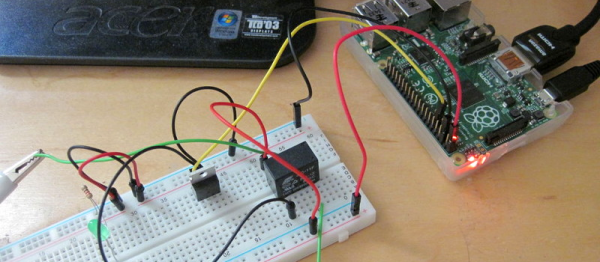
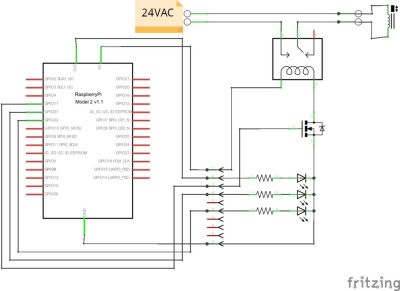
The circuitry, and plumbing, is straightforward and explained well in the Instructable. All the electronics consists of is the Pi and a MOSFET to take the 3.3v GPIO to 5v to control a relay. The valve controlling the water requires 28v AC which necessitated the relay to control it. There are also three LEDs: one is for power, one to indicate when the valve is opened, and one is an extra for some future purpose.

The intriguing part is the use of weather data from the web to determine if it’s rained recently. Python scripts provided by [Ben’s] friend [Mark Veillette] use a weather site API to get the rainfall data. The main script is set to run once every 24 hours. [Ben] set his system to water unless the previous day had sufficient rain. How much rain and the number of look-back days is programmable.

What a great application of the KISS principle: keep it simple, stupid – except for that third LED without a purpose.

Open-source Sprinkler Controller Keeps Your Lawn Looking Great

open_source_sprinkler_controller

[Ray] wrote in to share a great project he just recently wrapped up, an open-source sprinkler valve controller. Built in collaboration with Wired Magazine’s editor-in-chief [Chris Anderson], the sprinkler controller is designed to replace the limited commercial sprinkler timers that typically come with a new home sprinkler setup.

Their system greatly expands on the idea of a standard sprinkler timer, adding Ethernet connectivity, web-based scheduling, and 8 separate controllable zones. At the heart of the controller is an ATmega328 running the Arduino bootloader, which means that the system is easily tweakable to fit your specific needs. The controller works off a standard 24V AC sprinkler transformer, which means that the controller can easily act as a drop-in replacement for your existing system.

The pair sells kits through the web site, but you can always simply download the schematics, PCB layout files, and BoM to build one yourself. Whichever path you choose, be sure to swing by [Ray’s] site and take a good look around – there is an incredibly detailed assembly and programming guide there that will be a great resource as you go along.

Continue reading to see a video of the sprinkler controller in action.

Continue reading “Open-source Sprinkler Controller Keeps Your Lawn Looking Great”