
2026 Frikkin Lasers Contest: Steampunk, 360 O-Scope Does It With Tubes

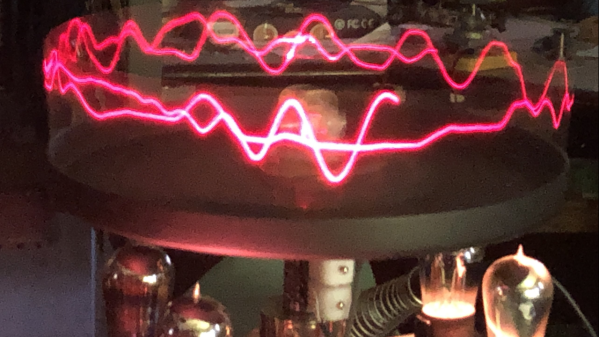
Audiophiles all know everything sounds better fed through vacuum tubes, but did you know visualizers look better with them, too? That’s what we’re forced to conclude looking at the Tachyscope Laser, a 360-degree oscilloscope display that is [Daniel Ross]’s entry into the ongoing Frikkin Lasers contest.
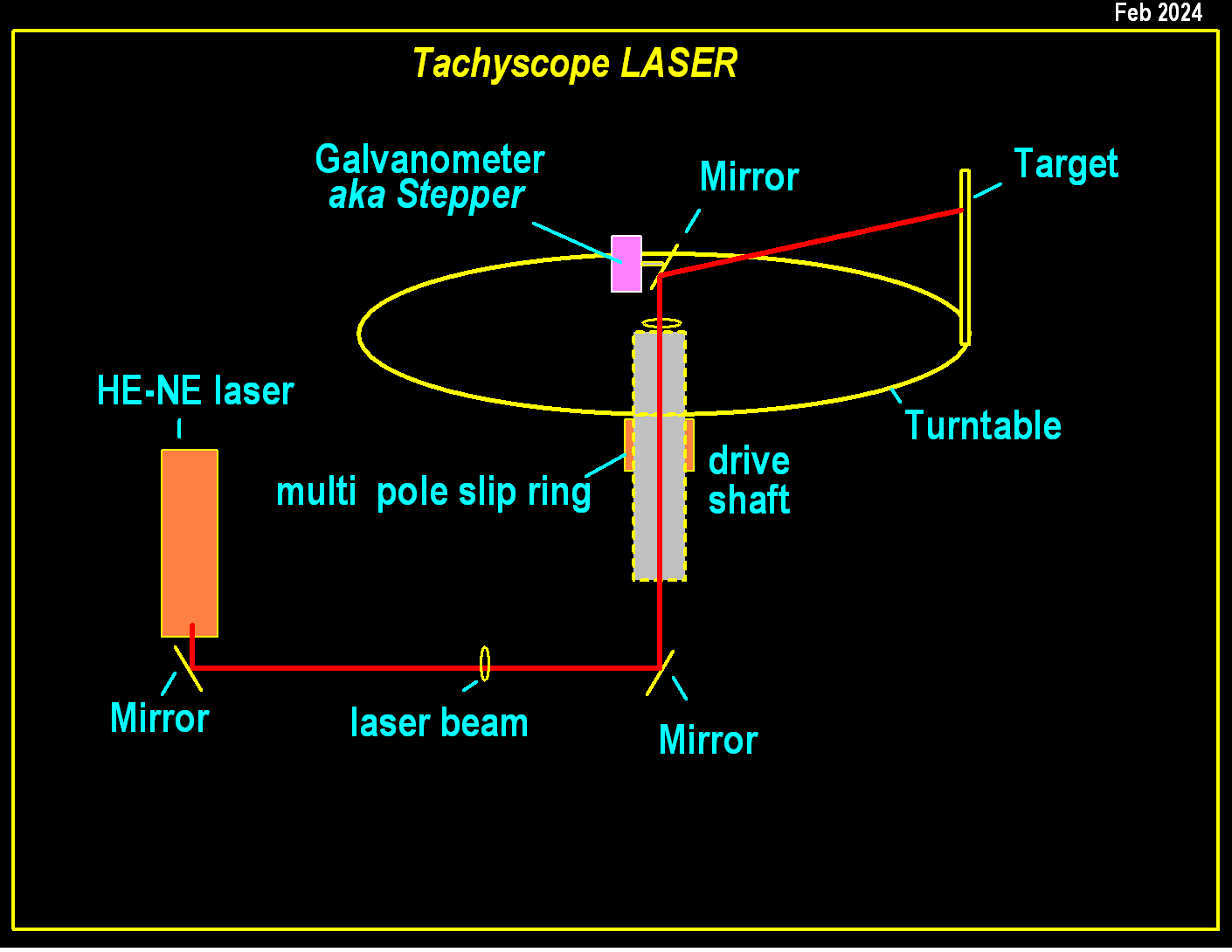
The diagram makes it look easier than building it probably was.

The laser is a good old-fashioned helium–neon tube — something we see less and less of in this era of solid state lasers — and the wavelength gives the waveform display a retro charm. The actual display is unique in our experience, with the beam shining up through a hollow shaft to bounce off a galvanometer mirror on a spinning platform. Galvo sweeps the laser across a translucent target, which creates the waveform by persistence of vision as it spins at 100 RPM or so.

Does the fact that the audio signal feeds through a tube amp to drive the single galvanometer actually improve the visuals? Only in the sense that those tubes make the steampunk-style enclosure look really, really cool, as does the exposed laser tube. That all of the steampunk elements obviously have a point to them rather than just being a another “glue some gears on it” project is icing on the laser-flavored cake.

The contest runs until July 23rd, so there’s lots of time to get laserin’ — and remember that there are categories for DIY lasers and anything that isn’t a display, just in case you think this project puts the bar too high for a light show. We’ve actually featured one of [Daniel]’s tachyscope waveform visualizers before, but that one, madly enough, spun an actual CRT.

Continue reading “2026 Frikkin Lasers Contest: Steampunk, 360 O-Scope Does It With Tubes”

Spinning CRT Makes A 360 Degree Audio Oscilloscope

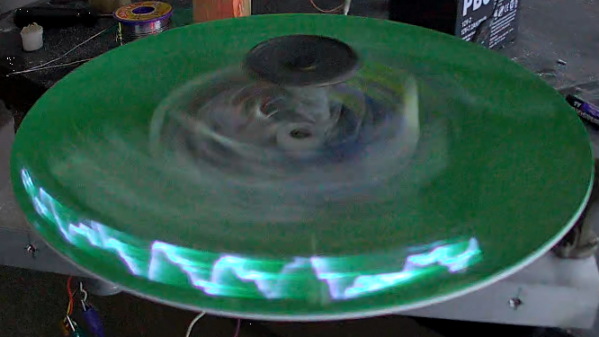
A question for you: if the cathode ray tube had never been invented, what would an oscilloscope look like? We’re not sure ourselves, but it seems like something similar to this mechanical tachyscope display might worked, at least up to a point.

What’s ironic about this scenario is that the tachyscope [Daniel Ross] built actually uses a CRT from a defunct camcorder viewfinder as the light-up bit of what amounts to a large POV display. The CRT’s horizontal coil is disconnected while the vertical coil is attached to the output of a TEA205B audio amplifier. The CRT, its drive electronics, and the amp are mounted to a motorized plastic platter along with a wireless baby monitor, to send audio to the CRT without the need for slip rings — although a Bluetooth module appears to be used for that job in the video below.

Speaking of slip rings, you’d expect one to make an appearance here to transfer power to the platter. [Daniel] used a slip ring for his previous steampunk tachyscope, but this time out he chose a hand-wound air core transformer, with a stationary primary coil and secondary coil mounted on the platter. With a MOSFET exciter on the primary and a bridge rectifier on the secondary, he’s able to get the 12 volts needed to power everything on the platform.

Like most POV displays, this one probably looks better in person than it does in video. But it’s still pretty cool, with the audio waveforms sort of floating in midair as the CRT whizzes around. [Daniel] obviously put a lot of work into this, not least with the balancing necessary to get this running smoothly, so hats off for the effort.

Continue reading “Spinning CRT Makes A 360 Degree Audio Oscilloscope”






