In structures like photovoltaic cells there is only a limited spectrum of wavelengths that can perform useful work, with the remaining wavelengths of electromagnetic radiation effectively wasted. If the energy of such wavelengths could be coaxed into this useful spectrum, this could then correspondingly boost the performance of the devices, but doing so is not straightforward. Going from lower-energy photons to higher-energy photons is very inefficient, with a recent study by [Thilini Ishwara] et al. demonstrating a liquid triplet medium that has a conversion efficiency of about 8.2%.
Generally the absorption and emission of electromagnetic radiation involves a shift to a lower energy state, the Stokes shift, but the inverse anti-Stokes shift – the goal of photon upconversion – is decidedly less common, even if it finds uses today in for example industrial pigments that can absorb in the near-infrared and re-emit in the visible spectrum. This is practical in luminescent displays and anti-counterfeiting measures, where details like conversion efficiency aren’t paramount.
Unlike the Stokes shift, the mechanisms that underlie the anti-Stokes shift either require cooperation from the material’s lattice, or – in the case of organic molecules – what is termed triplet-triplet annihilation (TTA), also known as photochemical upconversion (PUC). This involves an absorbing species, a sensitizer and an emitting species, allowing for the summing of multiple lower-energy photons into a higher-energy photon, with this 2023 review article by [Jiale Feng] et al. providing a good primer.
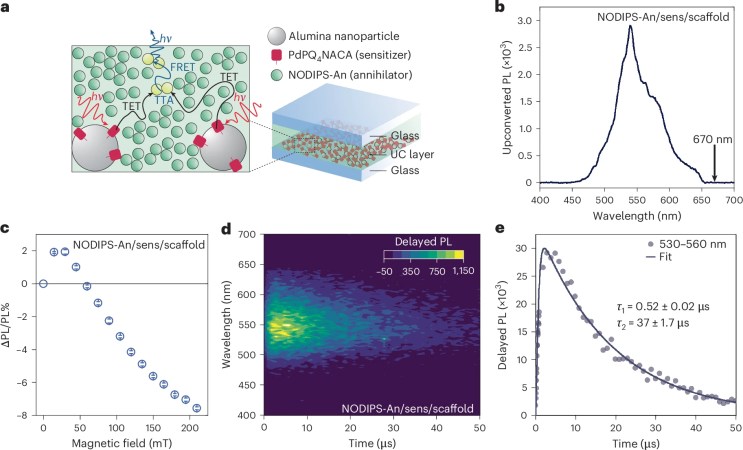
In the study by [Ishwara] et al. this triplet medium is 9,10-bis(n-octyl-diisopropylsilylethynyl)anthracene (NODIPS-An), affixed to a nanostructured alumina scaffold (see top image). After characterizing the assembled device and taking internal losses due to e.g. reabsorption into account, the final conversion efficiency of 8.2% was established.
Of course, TTA isn’t the only way to do PUC, with SOMET (singlet oxygen mediated energy transfer) being an alternative approach, with [Roslyn Forecast] et al. comparing the two in a 2023 article. As noted in its conclusion SOMET is currently most suited to PUC to the red and infrared regions of the spectrum. For now research continues with no clear path to commercialization visible yet.