
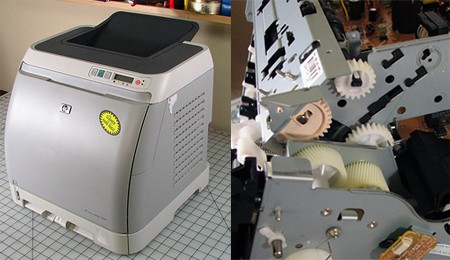
In the ongoing quest to find parts for new projects by scavenging old devices, the curiously sane and benevolent team at Evil Mad Scientist Laboratories took apart an HP Color LaserJet 2600n. They wanted to see what makes it tick and what parts can be culled from it for later use.
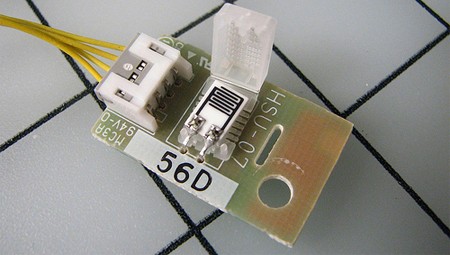
Using nothing more than a phillips head screwdriver and a small lever to push tricky plastic tabs, the team removed every single component from the printer until nothing was left. After removing the rear panel and a pair of medium circuit boards that control most of the printer’s functions, they found this unique item: a humidity sensor.
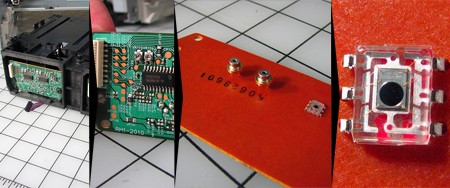
They removed several more parts, including the small PCB with transparent circuits that holds the LCD, the power board, the entire belt assembly, and several gears and motors. This brought them to the optics box containing two boards like the one above. The rear sides of the boards each have two laser diodes and one photodiode that is likely used in synchronizing data with the position of the page being printed. The optics box also yielded mirrors that reflect the laser, the motors that turn the mirrors, and several lenses, including a plastic molded lens assembly with three different lenses built into it.
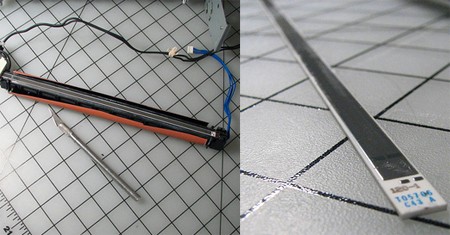
When they were through with the optics package, the team moved on to the fuser assembly. Instead of using a quartz lamp to melt the toner like many other printers, this one contains a film resistive ceramic heater inside one of the rollers. After disassembling the fuser assembly, there was only one board left inside the remaining steel shell.
Evil Mad Scientist Labs posted more than 200 pictures in a Flickr photoset (all photos by [Windell H. Oskay]) showing every step of the process, and at the end of their article they list all the usable parts they got from the teardown. Taking apart the printer is only half the fun, though; we’re looking forward to what they build next.











I would be particularly interested in the accuracy and precision of the humidity sensor. I had no idea one was in there, and I can think of several uses for one. It would be interesting to collect data on inside and outside temperature, and how much energy an airconditioner used, and attempt to see how much of your AC bill was spent condensing water as compaired to cooling.
no comments yet? this is the kind of artical hackaday has been seriously lacking lately. sure I have a drawer full of parts salvaged from flatbed scanners and such, but someone, uh, ‘more learned’ than myself may just point out the one or two items i didn’t id, and now regret deepsixing. Hackaday needs less products, more projects, and more how-tos.
actually this is an article that’s relevant to my interests as my work has a tonne of these printers
yay, my printer! (or very similar) I have the 2605dn, and its been working great.
i have to work with one of these printers and i wish i could ripit appart because it is USELESS!
Great HAD article
A note to Rob Ristroph. Rob- The water “condensed” by your AC is a direct result of the cooling of the air. All your energy goes to cooling the air. You are now free to spend more time on other hacking projects. :)
IMO I think entrys as this are more suited to hackaday wikis that are still “coming soon” rather than the main blog/page. Then again that comment would be best suited for a forum in the forums that are still “coming soon” as well. :(
I will end with a note to hardware hacking noobs with question and the elmers willing to help them. Adougp created http://tech.groups.yahoo.com/group/hackaday/ for that very purpose.
I have the 2605dn… and its great!
I have this printer at my work. Guess where it sits, out in the warehouse next to our old files.
iv just done similar to my printer, am trying to get the laser to do something