
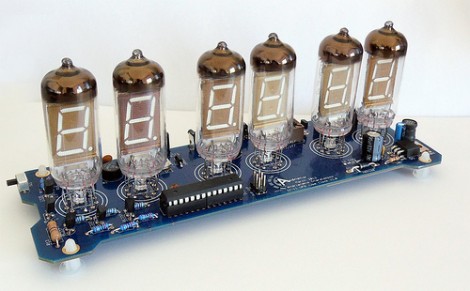
[Haris Andrianakis] just finished building this very clean-looking vacuum fluorescent display clock. It shows six digits using IV-11 tubes, and also has a half-dozen RGB LEDs to spice things up (check out the video after the break for an example). An ATmega168 drives the device, controlling the display and serving as a battery-backed real-time clock.
As with any tube-based clock there’s a fair amount of work that goes into driving the display. Each tube has a filament which requires 1.2V, and the segments themselves need 60 volts to light up. The microcontroller is not hard to protect; this is done with a series of transistor-based circuits used for switching. But the need for three voltages (to power microcontroller, filament, and segments) means a more complex PSU design. [Haris] chose to use a MAX6921 to simplify the process.
If you’re considering building something like this, we’d recommend looking for some 12-segment tubes. As we’ve seen before, they can display letters as well as numbers in case you wish to repurpose the device in the future.












every time a nixie or vfd clock lights up a led, god kills a kitten.
Delicious kittens.
They’re best with sweet n’ sour sauce.
Hey is this site about hacking or eatin’ pussy(cats)? Cool hack though.
very clean design, i like :)
The text suggests that MAX6921 is used for PSU – that’s not quite true, MAX6921 is the VFD driver. 60V is generated by a simple boost converter.